Taxi operations are challenging, especially during peak hours. Missed bookings, idle drivers and dispatch chaos can quickly eat into revenue and harm customer satisfaction.
Operators face a key decision: continue with manual dispatch, relying on staff to assign rides, or switch to automated dispatch using modern taxi dispatch software.
The question is simple yet crucial: “Is automation worth the cost?”
In this article, we break down the real ROI of auto dispatch versus manual dispatch. You’ll see cost and revenue impacts, understand operational bottlenecks, and learn exactly when it’s time to make the switch.
What is Manual Dispatch in Taxi Operations?
How Manual Dispatch Works
Manual dispatch is the traditional method where human dispatchers assign rides using phone calls, WhatsApp messages, or other communication channels.
Key points:
-
Bookings are received via calls or messaging apps.
-
Dispatchers manually assign drivers based on availability and location.
-
There is no algorithm or automation to optimize assignments.
Where It Still Works
Despite its limitations, manual dispatch can be effective for:
-
Small fleets of 5 to 10 vehicles.
-
Low ride volume markets with minimal peak congestion.
Hidden Operational Costs of Manual Dispatch
Manual dispatch carries hidden costs that often go unnoticed:
-
Human errors: Misassigned rides or missed bookings.
-
Slow response time: Customers may cancel or book with competitors.
-
Driver idle time: Unoptimized allocations reduce efficiency.
-
Missed peak demand: Dispatchers struggle to manage multiple requests simultaneously.
According to industry data, manual dispatch can reduce daily ride completion by up to 30% compared to automated systems.
What is Auto Dispatch? And How It Works
Definition of Auto Dispatch in Taxi Software
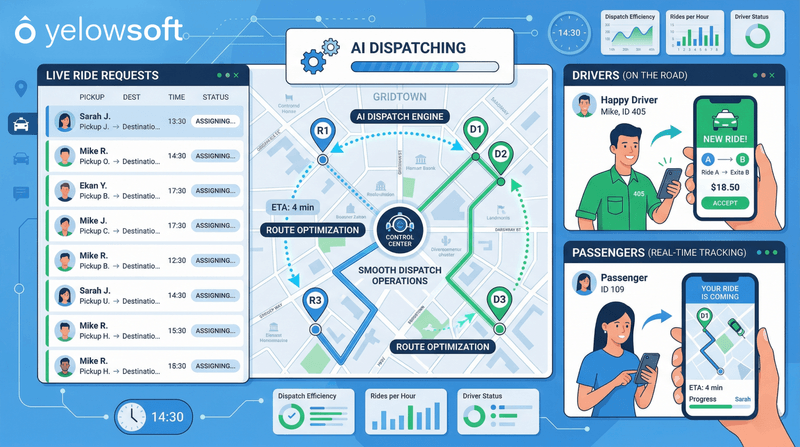
Auto dispatch is an algorithm-driven system within taxi dispatch software that automatically matches bookings with the most suitable drivers in real time.
Key features include:
-
Algorithm-based ride assignment
-
Real-time driver matching
-
Data-driven decision-making to optimize operations
How Auto Dispatch Works Step-by-Step
-
Booking Received: Customer request enters the system through app, web, or WhatsApp.
-
Driver Identification: System locates the nearest available driver.
-
Rule Application: Factors like availability, driver rating, and zone are applied.
-
Instant Assignment: Ride is assigned automatically, often in seconds.
Key Features That Enable Auto Dispatch
-
GPS Tracking: Monitors driver locations in real time.
-
Smart Routing: Optimizes routes to reduce wait and travel time.
-
Demand Heatmaps: Predicts high-demand areas for better allocation.
-
Rule-Based Allocation: Custom rules for priority customers, peak hours, or vehicle types.
Auto Dispatch vs Manual Dispatch – Core Differences
| Factor | Manual Dispatch | Auto Dispatch |
|---|---|---|
| Revenue Impact | Decreases | Increases |
| Speed | Slow (minutes) | Instant (seconds) |
| Accuracy | Human-dependent | Algorithm-driven |
| Scalability | Limited | High |
| Driver Utilization | Low | Optimized |
| Error Rate | High | Minimal |
| Peak-Hour Handling | Poor | Efficient |
Insight: Dispatch is no longer an operational task, it is a revenue lever.
| Cost Area | Manual Dispatch | Auto Dispatch |
|---|---|---|
| Staffing Cost | High | Reduced |
| Training | Continuous | Minimal |
| Errors & Refunds | Frequent | Rare |
| Infrastructure | Low | Moderate |
Real ROI Breakdown: Auto Dispatch vs Manual Dispatch
Cost Components Comparison
Automation significantly reduces overhead and staff dependency while maintaining operational efficiency.
Revenue Impact Comparison:
| Metric | Manual Dispatch | Auto Dispatch |
|---|---|---|
| Rides Completed/Day | Lower | Higher |
| Missed Bookings | High | Low |
| Driver Idle Time | High | Low |
| Customer Retention | Low | High |
Auto dispatch drives both operational efficiency and revenue growth by improving ride completion and reducing customer churn.
ROI Summary
Auto dispatch doesn’t just reduce cost. It multiplies revenue, improves customer satisfaction, and scales effortlessly.
Operational Bottlenecks Solved by Auto Dispatch
- Missed Bookings During Peak Hours
Automated systems ensure no booking is missed, even during high-demand periods.
- Driver Allocation Inefficiencies
AI algorithms optimize assignments, minimizing idle time and maximizing fleet utilization.
- Delayed Customer Response Time
Instant assignment and communication through app or WhatsApp improve response times dramatically.
- Dispatcher Dependency and Human Errors
Manual errors and reliance on dispatchers create growth ceilings. Automation removes these bottlenecks.
Expert Tip:
Use predictive routing and zone-based allocation to reduce average pickup time and improve on-time performance across the fleet.
When Should You Switch to Auto Dispatch?
Clear Signs You’ve Outgrown Manual Dispatch
-
Fleet size of 20+ vehicles
-
Frequent missed rides
-
Dispatcher overload
-
Plans for expansion
When Manual Dispatch Still Makes Sense
-
Very small fleets (under 10 cars)
-
Low ride frequency markets
Common Myths About Auto Dispatch (Debunked)
-
“Automation Removes Control” Reality: Custom rules in automated dispatch give you more control over driver assignments, fare settings, and surge management.
-
“It’s Too Expensive” Reality: Reduced missed bookings, optimized driver utilization, and faster rides generate ROI that outweighs setup costs quickly.
-
“Drivers Won’t Adapt” Reality: Drivers enjoy consistent ride flow, predictable schedules, and smarter routing that reduces idle time.
-
“I Can Do Better Manually” Reality: Manual dispatch is prone to errors, delays, and missed peak-hour rides, limiting fleet efficiency.
-
“It’s Only for Big Fleets” Reality: Even small to medium taxi or limo operators benefit from automated dispatch, improving response time and customer satisfaction.
-
“Automation Reduces Customer Interaction” Reality: Customers receive faster confirmations, transparent fare info, and timely pickups, improving their overall experience.
-
“Switching Is Complicated” Reality: Modern taxi automation software like Yelowsoft provides easy integration and step-by-step onboarding.
How to Maximize ROI from Auto Dispatch
-
Set Smart Dispatch Rules: Prioritize peak hours, VIP clients, and specific vehicle types.
-
Use Demand Heatmaps: Predict high-demand areas for proactive driver allocation.
-
Optimize Driver Availability: Balance schedules and reduce downtime.
-
Integrate Multi-Channel Booking: Combine app, web, and WhatsApp bookings for seamless operations.
Smart usage of AI-powered taxi dispatch software ensures the highest efficiency and maximum revenue growth.
Expert Tip:
Align driver schedules with peak demand and VIP bookings to boost ride completion and revenue.
Which One Wins?
-
Manual Dispatch: Short-term control, long-term limitation.
-
Auto Dispatch: Scalability, efficiency, profitability.
Takeaway: If you want to grow, automation is no longer optional. Modern taxi dispatch software transforms operations into a revenue-generating engine.
FAQs
Yes, particularly if growth is planned or expansion is on the horizon.
Typically 20–50%, depending on fleet size, peak demand, and ride volume.
No, it enhances their efficiency and reduces repetitive tasks.
Usually a few weeks with SaaS taxi dispatch software platforms.
Yes, AI-driven algorithms assign rides instantly, even during busiest hours.
Absolutely, drivers are matched to rides optimally, reducing idle time.
Yes, rules can be tailored for service type, zones, surge, and more.
Yes, modern platforms support calls, apps, websites, and third-party portals.
Yes, leading platforms use encryption and role-based access controls.
Yes, real-time dashboards track ride volume, revenue, driver performance, and efficiency.
Stop losing rides and revenue. Switch to smarter dispatch and scale your taxi business faster.


