Most taxi businesses already receive booking requests on WhatsApp. Customers use it for local rides, chauffeur services, hotel transportation, on-demand trips, and scheduled bookings because it feels quicker and easier than calling a dispatcher or filling out a website form.
But for many operators, WhatsApp still works like a manual inbox instead of a real booking system.
A dispatcher reads every message, asks for pickup details, checks availability, confirms pricing, and manually enters the ride into dispatch software. As booking volume increases, this process becomes slow, repetitive, and difficult to manage consistently.
That is where WhatsApp taxi booking software changes daily operations.
Instead of handling every enquiry manually, businesses can automate conversations, create bookings instantly, assign drivers faster, and deliver a smoother customer experience from the first message itself.
In this guide, you will understand how WhatsApp taxi booking software works, why taxi operators are adopting it rapidly, and which features actually matter before choosing a platform.
What Is WhatsApp Taxi Booking Software?
WhatsApp taxi booking software helps taxi companies convert customer conversations into confirmed ride bookings automatically.
Instead of depending on dispatchers for every step, the software uses automation and AI to manage the booking journey inside WhatsApp itself.
The system can collect pickup and drop details, answer customer questions, share estimated fares, create bookings instantly, assign drivers automatically, send trip confirmation and tracking links
For customers, the experience feels simple and familiar. They just send a WhatsApp message and complete the booking within minutes.
For operators, it reduces operational pressure while improving booking speed and accuracy.
More importantly, the business stays available 24/7, even when the dispatch team is offline.
Why Manual WhatsApp Booking Creates Operational Problems
At the beginning, manual WhatsApp handling may seem manageable. A few messages per day are easy to track.
But once bookings increase, the cracks start appearing.
Slow Response Times Affect Conversion
Customers expect quick replies, especially for urgent transportation requests.
If a customer sends an urgent ride request and receives a response after 15 or 20 minutes, there is a high chance they have already booked with another provider.
Fast response time directly impacts conversion rates in service businesses. The longer the delay, the higher the probability of losing the booking.
Dispatchers Repeat the Same Conversations
Most customer chats follow the same pattern.
Where is your pickup? What is the drop location? What time do you need the ride? How many passengers are travelling?
These repetitive conversations consume valuable dispatcher time throughout the day.
Instead of focusing on operations and driver coordination, teams spend hours typing the same responses repeatedly.
Human Errors Increase With Volume
Manual booking processes naturally create mistakes.
Pickup timings may be entered incorrectly. Ride requests may be overlooked. Duplicate bookings can happen during busy hours. Sometimes incorrect fare information gets shared with customers.
Even a single operational error can damage customer trust and affect repeat business.
No Booking Availability After Working Hours
Many taxi businesses still rely entirely on dispatch teams to respond manually.
When the office closes at night, enquiries remain unanswered until morning. That means potential bookings are lost while competitors continue accepting rides.
With customer expectations shifting toward instant service, delayed responses are becoming increasingly expensive.
How WhatsApp Taxi Booking Software Works
The booking process is designed to feel simple for customers while reducing manual work for operators.
Customer Starts the Conversation
The process begins when a customer sends a WhatsApp message such as:
“I need a taxi tomorrow morning at 8:00.”
There is no app download or complicated booking form involved.
AI Collects Booking Information
The system replies instantly and guides the customer step-by-step.
It asks for pickup location, destination, date and time, passenger count, preferred vehicle type. The conversation feels natural instead of robotic.
Frequently Asked Questions Are Handled Automatically
Customers often ask similar questions before confirming a booking.
For example:
Can I book a ride in advance? What payment methods do you accept? Which vehicle types are available? How much will the ride cost?
The software answers these automatically without requiring dispatcher involvement.
Booking Enters the Dispatch System
Once the customer confirms the trip, the booking is pushed directly into the dispatch dashboard.
There is no need for copy-paste workflows or manual data entry. Dispatchers immediately see the ride request and can assign drivers faster.
Driver Details Are Shared Automatically
After driver allocation, the customer receives trip details instantly.
This usually includes driver name, vehicle information, estimated arrival time, live tracking link
The overall experience feels faster, more professional, and better organised.
Expert Tip:
Always use the official WhatsApp Business API instead of a personal WhatsApp account for operations.
The API supports automation, improves message delivery reliability, allows multiple team members to manage conversations, and reduces the risk of account restrictions. For growing taxi businesses, this becomes essential very quickly.
Key Features to Look For in WhatsApp Taxi Booking Software
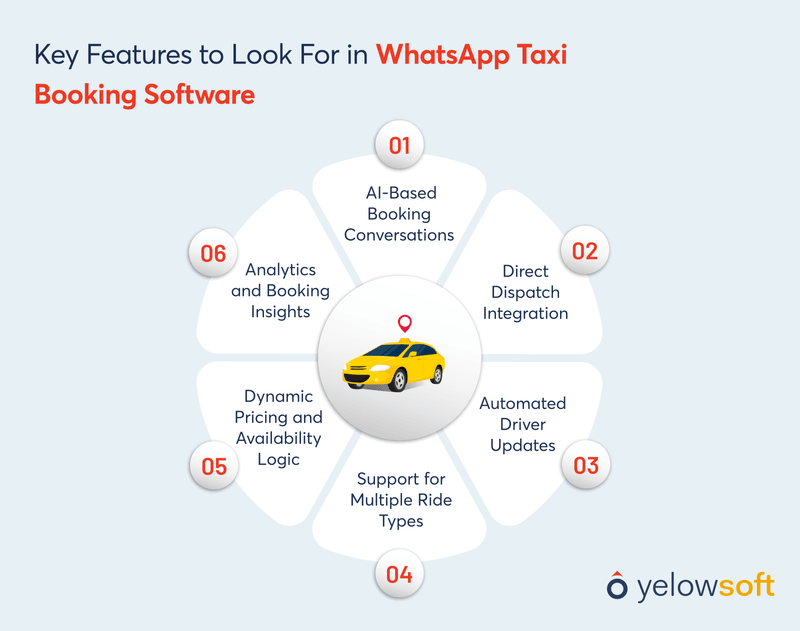
Not every platform offering WhatsApp integration provides real booking automation.
Some systems only connect chats without streamlining operations. The right software should support the entire booking workflow from conversation to dispatch.
AI-Based Booking Conversations
The software should understand customer intent naturally.
Customers should feel like they are having a guided conversation instead of interacting with a rigid chatbot that only follows fixed commands.
Natural conversation flow improves booking completion rates significantly.
Direct Dispatch Integration
This feature is critical.
Bookings created on WhatsApp must automatically appear inside the dispatch panel. Without dispatch integration, teams still depend on manual work, which defeats the purpose of automation.
Automated Driver Updates
Customers expect transparency after booking confirmation.
The system should automatically share driver details, vehicle information, ETA updates, and tracking links without dispatcher involvement.
Support for Multiple Ride Types
Strong WhatsApp taxi booking software should support different booking categories, including local city rides, on-demand bookings, chauffeur services, scheduled trips, return journeys, and hotel concierge transportation.
This flexibility allows businesses to manage multiple customer segments through a single workflow.
Dynamic Pricing and Availability Logic
Pricing accuracy matters.
The software should connect with fare rules, service zones, vehicle categories, distance-based pricing, hourly pricing models, and booking-time conditions to provide accurate estimates automatically.
Incorrect fare quotations often create customer disputes later.
Analytics and Booking Insights
Good systems provide visibility into operational performance.
Operators should be able to track whatsapp booking volume, response time, missed enquiries, booking conversion rates, peak booking hours
These insights help businesses improve customer handling and operational efficiency over time.
See How WhatsApp Booking Connects With Dispatch
Explore how customer messages are converted into structured bookings, added to the dispatch system, and followed by automated driver and trip updates.
Explore the WhatsApp Booking Workflow
Manual Booking vs Automated Booking
The difference is operational, not just technical.
| Manual WhatsApp Booking | Automated WhatsApp Booking |
|---|---|
| Slow response time | Instant replies |
| Staff dependent | 24/7 availability |
| Repetitive manual chats | AI handles conversations |
| Manual dispatch entry | Direct system integration |
| Higher error rate | Better booking accuracy |
| Missed night bookings | Continuous lead capture |
That is why many growing operators eventually move toward automated WhatsApp booking systems once their daily enquiry volume increases.
Want to understand what happens after a customer confirms the ride? See how WhatsApp booking connects directly with dispatch, driver assignment, and passenger updates.
Best Use Cases for Taxi Businesses
Different types of transportation businesses can benefit from whatsapp automation in different ways.
Airport Transfer Operators
Airport bookings usually require quick confirmation and scheduled coordination.
WhatsApp automation helps operators reduce missed pickups, manage pre-bookings more efficiently, and provide better communication for travellers.
Corporate Transportation Providers
Employee transport and recurring business rides involve structured booking workflows.
Automation simplifies account-based bookings and reduces dispatcher dependency for recurring transportation requests.
Chauffeur and Limo Services
Premium customers expect professional communication and quick confirmations.
Automated WhatsApp workflows improve customer experience while maintaining a polished booking process.
Ride-Hailing Startups
For startups, hiring large dispatch teams early can become expensive.
WhatsApp taxi booking software allows operators to manage higher booking volumes without scaling operational costs immediately.
Hotel and Concierge Transportation
Hotels frequently arrange rides for guests throughout the day.
Automated booking workflows reduce repetitive phone coordination and help hotel teams manage transportation requests more efficiently.
Local Taxi and Private Hire Operators
Local operators often receive urgent and scheduled ride requests throughout the day.
WhatsApp automation collects complete booking information, responds instantly, and sends confirmed requests into dispatch without requiring staff to re-enter customer details.
After-Hours and Night Booking Operations
Ride requests do not stop when the dispatch office closes.
An automated WhatsApp booking workflow allows customers to request and confirm rides after working hours while the system applies availability, fare, and dispatch rules consistently.
How to Choose the Right Software
Before selecting a provider, taxi businesses should evaluate whether the platform supports real operational automation or simply acts as a messaging tool.
Ask these questions before making a decision:
Can the system work with your existing WhatsApp Business number? Does it integrate directly with dispatch software? Can it support on-demand and scheduled bookings? Does it handle fare and availability rules correctly? Can it automatically send driver details and trip updates? Does it provide reporting and booking analytics?
If the platform cannot support these workflows, it is not complete WhatsApp taxi booking software.
It is simply another inbox your team still has to manage manually.
Conclusion
WhatsApp is already where your customers are communicating every day.
The real challenge is deciding whether your business will continue managing bookings manually or transform WhatsApp into a fully automated booking channel.
As taxi operations grow, manual handling becomes slower, more expensive, and increasingly difficult to scale. Dispatch teams become overloaded, response delays increase, and customer experience starts suffering.
A reliable WhatsApp taxi booking software solution helps businesses automate conversations, improve booking accuracy, reduce dispatcher workload, and provide faster customer service without operational chaos.
It turns simple customer messages into confirmed rides automatically.
The taxi businesses growing fastest today are not necessarily the ones answering more enquiries manually.
They are the ones building smarter booking workflows through automation.
Explore a More Connected WhatsApp Booking Workflow
See how Yelowsoft connects WhatsApp conversations with booking creation, dispatch, driver assignment, and passenger updates.
Explore WhatsApp Booking
FAQs
WhatsApp taxi booking software collects ride details through WhatsApp, creates structured bookings, connects them with dispatch, and sends confirmations and trip updates automatically.
It reduces dispatcher workload, speeds up booking responses, improves booking accuracy, and allows taxi businesses to accept ride requests 24/7.
Yes. A connected system sends confirmed WhatsApp bookings directly into the dispatch dashboard, where drivers can be assigned manually or automatically based on operational rules.
Generally, yes. The WhatsApp Business API supports automated conversations, approved message templates, multiple agents, system integrations, and more reliable communication at scale.
WhatsApp Business API supports automation, multi-agent access, reliable messaging delivery, and scalable communication for growing taxi operations.
Manual booking requires staff to read messages and enter every trip. Automated booking collects details, validates the request, creates the ride, and sends it to dispatch without repeated manual work.
Yes. Once a booking enters the dispatch system, driver assignment can follow rules such as distance, availability, vehicle type, zone, acceptance status, or scheduled pickup time.
Yes. Automated WhatsApp booking can collect and process ride requests 24/7. Availability, pricing, booking cut-off times, and dispatch rules determine whether the trip is confirmed.
WhatsApp can reduce phone-booking dependency, but it should usually complement phone, web, app, and Voice AI channels rather than replace every booking option.
No. Customers use the WhatsApp application they already have. The booking workflow collects their trip information and connects it with the operator’s booking and dispatch system.
The booking is created in the dispatch system, a driver is assigned, and the customer can receive confirmation, driver details, vehicle information, ETA, and a live tracking link.


