Poor invoicing is one of the biggest hidden profit leaks in the limousine industry.
Many operators focus on getting more bookings, hiring chauffeurs, expanding fleets, and improving customer experience. But revenue is not protected when billing workflows stay manual, delayed, or disconnected from operations.
A completed trip only becomes real revenue when the invoice is accurate, approved, delivered on time, and paid without disputes.
And when billing depends on spreadsheets, manual updates, delayed follow ups, or disconnected finance systems, revenue slowly starts slipping away.
-
Corporate clients question charges.
-
Airport transfer invoices get delayed.
-
Affiliate rides go untracked.
-
Chauffeur payouts become difficult to reconcile.
-
Finance teams spend hours correcting avoidable mistakes.
The problem is rarely the number of bookings your limo business handles. The real problem is the lack of a structured invoicing process connected with dispatch and operations.
In this blog, you will learn where limousine businesses lose money because of poor invoicing, why manual billing becomes risky as operations grow, and how modern limo dispatch software helps you regain financial control before revenue disappears quietly.
Let’s get straight into it!
Why Invoicing Is More Important Than Most Limo Companies Realize
Many operators treat invoicing as a back office responsibility, but invoicing directly impacts profitability, cash flow, and long term client retention.
Here’s why:
A Ride Is Not Revenue Until Payment Is Collected
Many limo operators assume the job is complete once the passenger reaches the destination. In reality, the financial process only finishes when payment is successfully collected.
This is where many businesses struggle.
Trips are completed daily, but invoices are:
-
Delayed
-
Forgotten
-
Disputed
-
Manually adjusted, and
-
Sent incorrectly
A delayed invoice creates delayed cash flow. Even profitable businesses face financial pressure when payments arrive late.
Manual invoicing also creates invisible revenue leakage:
-
Airport waiting charges never billed
-
Extra stops forgotten
-
Hourly ride adjustments missed
-
Chauffeur overtime ignored
-
Affiliate bookings excluded from invoices
Over time, these small gaps become major financial losses.
More importantly, repeated invoice disputes damage operational trust with corporate clients.
And businesses that rely heavily on executive travel or airport transfers cannot afford billing inconsistency.
Expert Tip:
If your finance team spends more time correcting invoices than reviewing profitability, your invoicing workflow is already slowing business growth.
Corporate and Airport Clients Expect Structured Billing
Corporate and airport transportation clients expect professional invoicing systems.
They need:
-
Monthly statements
-
Employee-wise trip history
-
Department-based billing
-
Clear tax records
-
Booking validation
-
Transparent fare breakdowns
When invoices arrive late or contain unclear charges, approval cycles slow down immediately.
For example:
-
Finance departments delay payments
-
Procurement teams request clarifications
-
Accounts teams reject incomplete invoices
-
Repeated corrections increase administrative workload
This becomes even more difficult when your business manages:
-
Executive travel
-
Recurring bookings
-
Airport transfers
-
Partner rides
-
Affiliate networks
In short: Professional invoicing is no longer optional for premium limo services. It directly affects client confidence and repeat business opportunities.
Where Limo Companies Commonly Lose Money in Manual Invoicing
Most revenue leakage does not happen because of major operational failures. It happens through daily billing habits that slowly create financial inefficiencies.
Missed Trips That Never Get Billed
One of the most common problems in manual billing systems is incomplete ride reporting.
This usually happens when:
-
Dispatchers manually update spreadsheets
-
Affiliate rides are recorded separately
-
Chauffeurs communicate changes through calls or messages
-
Airport wait times are not logged properly
-
Additional stops are forgotten
As booking volume increases, tracking every billing adjustment manually becomes almost impossible.
For many limo operators, the problem is not missing bookings. The problem is missing billable events connected to those bookings.
Commonly missed charges include:
| Missed Revenue Area | Operational Impact |
|---|---|
| Airport waiting time | Reduced trip profitability |
| Extra passenger stops | Revenue leakage |
| Affiliate rides | Untracked billing |
| Parking and tolls | Out-of-pocket expenses |
| Hourly extensions | Lost premium charges |
Delayed Invoices That Slow Payments
Manual invoicing often creates end of month billing pressure.
Finance teams wait for dispatch data. Dispatch teams wait for chauffeur confirmations. Managers manually review ride adjustments. Invoices are prepared late, sometimes days or weeks after trip completion.
This creates slower payment cycles, longer accounts receivable periods, unnecessary cash flow pressure, and delayed revenue realization
Corporate clients also process invoices based on internal accounting cycles. And a delayed invoice may miss the client’s payment cycle completely, thereby pushing payments into the next month.
That delay affects:
-
Operational liquidity
-
Chauffeur payouts
-
Marketing budgets
-
Fleet expansion planning
Incorrect Billing That Creates Client Disputes
Incorrect invoices damage both revenue and brand trust.
Common issues include:
-
Duplicate billing
-
Incorrect fare entries
-
Missing surcharge explanations
-
Wrong account mapping
-
Inconsistent pricing
When clients repeatedly question invoices, your team spends more time defending charges than improving operations.
For premium chauffeur businesses, this weakens the professional image clients expect.
Chauffeur Payment Confusion and Revenue Mismatch
Manual invoicing also creates payout confusion internally.
Without centralized systems:
-
Driver commissions become inconsistent
-
Completed rides do not match payouts
-
Cash trips remain unclear
-
Partner revenue splits become difficult to reconcile
This creates operational tension between:
-
Dispatch teams
-
Finance teams
-
Chauffeurs
-
Management
Expert Tip:
If you cannot instantly verify whether every completed ride has been billed correctly, your invoicing system is creating operational risk.
Why Spreadsheet Based Billing Stops Working at Scale
What works for a small limo fleet quickly becomes unstable when operations grow.
Spreadsheets Create Dependency on Specific People
Many limo businesses rely on one dispatcher or finance executive who “understands the system.”
This creates dangerous operational dependency.
When billing logic exists inside spreadsheets instead of structured systems:
-
Knowledge stays with individuals
-
Onboarding becomes difficult
-
Reporting becomes inconsistent
-
Operational continuity weakens
As your fleet grows, manual spreadsheet coordination becomes harder across:
-
Airport rides
-
Recurring bookings
-
Corporate accounts
-
Affiliate partners
-
Chauffeur schedules
Scaling operations without centralized invoicing eventually creates financial confusion.
No Real Time Visibility Means No Financial Control
Without connected invoicing systems, management loses visibility into:
-
Pending invoices
-
Overdue accounts
-
Unpaid corporate bookings
-
Chauffeur payout status
-
Daily revenue trends
This weakens decision making.
Instead of proactively managing cash flow, businesses become reactive to payment problems after they happen.
Revenue forecasting also becomes unreliable because invoice status remains disconnected from actual ride operations.
How Modern Limo Dispatch Software Fixes Invoicing Problems
The goal is not simply faster invoice generation. The real goal is complete revenue visibility and operational control.
Here’s how modern limo dispatch software fixes invoicing problems:
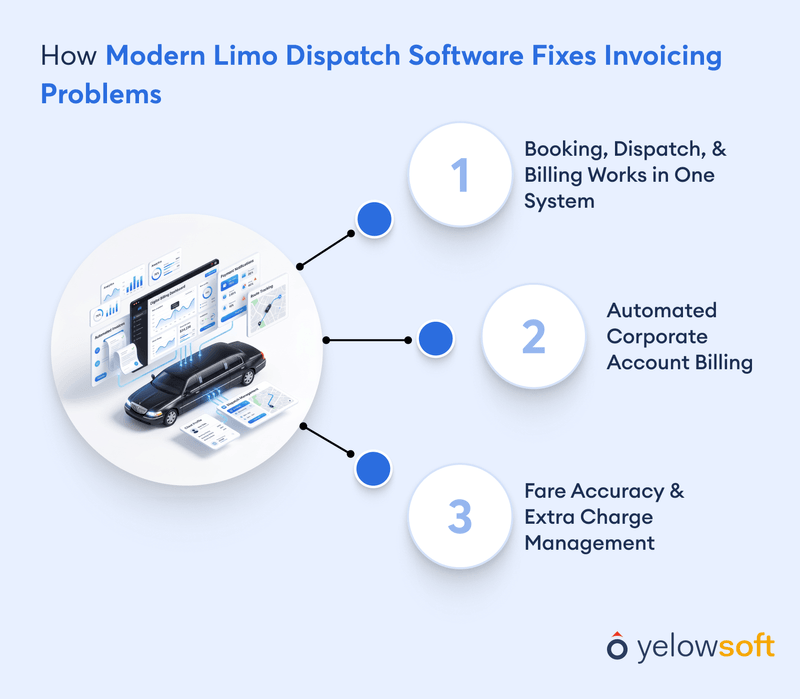
Booking, Dispatch, and Billing Should Work in One System
Modern limo dispatch software connects bookings, dispatch, trip completion,, invoicing, chauffeur payouts, and payment tracking
When a trip is completed:
-
The fare updates automatically
-
Surcharges are added
-
Payment status changes instantly
-
Invoices generate immediately
This eliminates manual re entry and reduces human error.
A centralized system also creates:
-
Clear booking history
-
Accurate fare records
-
Easier auditing
-
Faster dispute resolution
Automated Corporate Account Billing
Corporate clients require structured invoicing workflows.
Modern systems support:
-
Monthly statements
-
Department-wise billing
-
Employee trip reports
-
Recurring invoice automation
-
Approval workflows
This improves both operational efficiency and client experience.
Corporate clients prefer vendors who make accounting easy.
When invoices are timely, transparent, accurate, and easy to validate payments move faster.
Fare Accuracy and Extra Charge Management
Premium limousine operations involve multiple fare variables:
-
Waiting time
-
Parking fees
-
Airport surcharges
-
Tolls
-
Return trip calculations
-
Hourly adjustments
Manual tracking creates inconsistencies.
In contrast, modern systems automatically calculate these adjustments using predefined rules, reducing revenue leakage, client disputes, and dispatcher workload
Before vs After: What Better Billing Looks Like
The clearest buying decisions happen when operators compare old workflows with modern operational systems.
Before: Manual Billing Workflow
In traditional workflows:
-
Ride completes
-
Dispatcher updates spreadsheet
-
Finance team checks details manually
-
Invoice is prepared later
-
Payment follow up starts days later
This creates delays, inconsistencies, and missing data.
After: Automated Billing Workflow
With modern limo invoicing workflows:
-
Ride completes
-
System updates fare automatically
-
Invoice generates instantly
-
Corporate statement updates automatically
-
Payment tracking stays visible in real time
This creates:
-
Faster collections
-
Better accuracy
-
Cleaner reporting
-
Improved client trust
Here’s a quick overview of old billing process vs modern billing process
| Old Workflow | Modern Workflow |
|---|---|
| Manual fare entry | System generated fare |
| Spreadsheet invoice prep | Instant invoice creation |
| Delayed monthly statements | Scheduled billing automation |
| Manual payment tracking | Real time payment visibility |
| Frequent disputes | Clear invoice transparency |
What to Look for Before Choosing Limo Invoicing Software
Not every dispatch platform solves invoicing properly. Choosing the right system matters.
Must Have Features for Limo Billing Control
Your invoicing system should support:
-
Automated invoice generation
-
Recurring billing
-
Chauffeur reconciliation
-
Client-specific pricing
-
Surcharge flexibility
It should also connect directly with dispatch workflows.
Disconnected accounting tools create unnecessary duplication.
Questions Buyers Should Ask Before Choosing a Vendor
Before selecting any limo invoicing software, ask:
-
Can invoices generate automatically after ride completion?
-
Can corporate clients receive monthly statements?
-
Can affiliate and partner rides be tracked properly?
-
Can chauffeur payouts match completed billing accurately?
-
Can finance and dispatch teams work from one dashboard?
-
Can airport surcharges and waiting charges be automated?
The answers to these questions determine whether the system supports operational growth or creates more manual work.
Conclusion
The biggest financial losses in your limo business often do not come from missed bookings. They come from delayed invoices, forgotten charges, payment disputes, and manual reconciliation that quietly reduce profit every month.
When invoicing depends on spreadsheets and disconnected workflows, revenue gets lost between dispatch, finance, chauffeurs, and corporate accounts.
A completed ride should move smoothly from booking to billing without manual intervention. That is how you protect cash flow, improve client trust, and maintain operational control as your business grows.
This is where Yelowsoft’s limo dispatch software creates real value. It connects bookings, trip completion, invoicing, chauffeur payouts, and corporate account management in one system. You get faster payments, fewer billing disputes, and better financial visibility.
If your invoicing still feels manual, it may be time to see how Yelowsoft can simplify it.
Take control of every invoice, eliminate revenue leaks, and scale your limo operations with confidence.
FAQs
Limo companies lose money when trips are billed late, extra charges are missed, invoices contain errors, or payment tracking stays manual. These issues create delayed payments, disputes, and revenue leakage.
The best approach is using limo dispatch software that connects bookings, dispatch, trip completion, billing, chauffeur payouts, and payment tracking inside one centralized system.
Yes. Modern limo dispatch systems support monthly statements, department-wise billing, employee trip reports, recurring invoices, and corporate account management workflows.
Automated invoicing improves fare accuracy, records extra charges properly, creates transparent billing history, and reduces manual errors that commonly trigger disputes.
Look for automated invoices, corporate billing support, chauffeur reconciliation, payment integrations, real time reporting, surcharge flexibility, recurring billing, and centralized dispatch-to-payment workflows.


