Luxury transportation in 2027 is no longer defined only by the vehicle you put on the road. For limo and chauffeur operators, the bigger change is happening behind the service. Customers expect faster bookings, reliable trip updates, professional chauffeurs, flexible vehicle options, and smoother corporate and airport travel.
Technology is reshaping how operators meet these expectations. From AI-powered booking automation to limo dispatch software, businesses are adopting smarter tools to manage reservations, coordinate chauffeurs, track trips, and improve operational efficiency.
At the 2026 CD/NLA Show, the National Limousine Association highlighted practical AI applications, vehicle technology, autonomous mobility, and strategies for running safer and more efficient chauffeured transportation businesses. Meanwhile, electric vehicles accounted for one in four new cars sold globally in 2025, according to the International Energy Agency.
These shifts make limo industry trends more than predictions about new vehicles. They influence fleet planning, dispatch operations, chauffeur management, customer experience, and profitability.
Here are the limo trends 2027 that luxury transportation operators should understand and what each could mean for their business.
What Are the Biggest Limo Industry Trends in 2027?
The biggest limo industry trends in 2027 include electric and hybrid fleet adoption, a changing mix of luxury vehicles, AI-assisted booking and dispatch, connected fleet operations, higher corporate and airport service expectations, stronger safety and data protection practices, and continued development of autonomous vehicle technology.
| Trend | What It Means for Limo Operators |
|---|---|
| EV and hybrid fleets | More fleet-planning decisions around charging, range and operating cost |
| Changing vehicle mix | Greater demand for executive sedans, SUVs and premium vans |
| AI and automation | Less manual work across booking, dispatch and customer communication |
| Connected operations | Real-time visibility across bookings, chauffeurs and trips |
| Corporate and airport expectations | Higher standards for reliability, communication and schedule management |
| Safety and data protection | More focus on chauffeur safety, risk management and customer data |
| Autonomous technology | Important to monitor, but not yet a mainstream operating model |
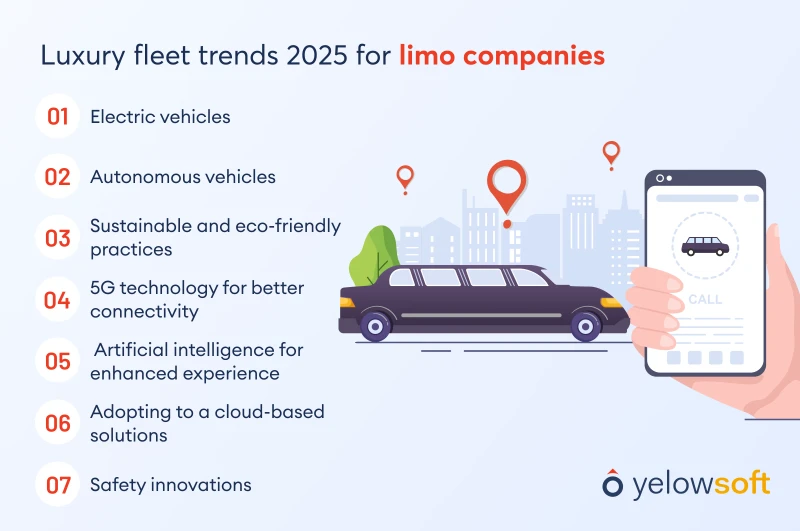
Luxury fleet trends 2027 for limo companies to look out for
To stay ahead of the competition, limo businesses need to make sure they are following the current trends and are aware of the future of luxury transportation trends as well, to adopt them quickly. So, here are a few trends to keep an eye on in 2027.
Electric and Hybrid Vehicles Are Becoming a Fleet Strategy
Electrification is becoming one of the most important luxury fleet trends for limousine and chauffeur operators. But adopting electric vehicles is not simply about replacing every petrol or diesel vehicle with an EV.
Operators need to determine where electric and hybrid vehicles actually fit their service model.
City transfers, executive travel and predictable airport routes can be strong candidates because trip distances and charging windows are easier to plan. Longer journeys and unpredictable schedules may require a different vehicle strategy depending on charging availability and range.
The International Energy Agency reported that electric cars accounted for one in four new cars sold globally in 2025, showing how quickly vehicle availability and adoption are changing.
For limo businesses, the practical question is therefore not whether EVs will influence the future of luxury transportation, but where electrification improves operating economics without compromising vehicle availability, service reliability or passenger experience.
Sustainability is also becoming more operational than promotional. For luxury fleet operators, it involves choosing the right vehicle for each trip, reducing unnecessary mileage, improving vehicle utilization and planning charging intelligently rather than simply adding an EV badge to the fleet. This makes sustainability increasingly connected to fleet efficiency as well as brand positioning.
Autonomous Vehicles Are a Trend to Monitor, Not an Immediate Operating Model
Autonomous driving remains part of the future of the limousine industry, but limo operators should treat it as a developing technology rather than an immediate replacement for professional chauffeurs.
The US National Highway Traffic Safety Administration notes that Level 4 and Level 5 automated driving systems are not currently available for consumers to purchase. That distinction matters because many discussions around autonomous transport move much faster than commercial deployment.
For limo companies in 2027, the more relevant developments are advanced driver-assistance systems, vehicle safety technology, autonomous pilot programs and the regulations that will eventually determine where highly automated vehicles can operate.
Luxury transportation also depends heavily on hospitality, discretion, luggage assistance, airport coordination and executive service. So autonomous technology may change parts of chauffeured transportation over time, but operators should avoid building their near-term fleet strategy around a fully driverless future.
Real-Time Connected Operations Are Becoming the Standard
One of the more important limo technology trends is the shift from disconnected booking, dispatch and driver communication toward real-time connected operations.
Clients increasingly expect immediate booking confirmations, accurate pickup information and clear trip updates. Dispatch teams, meanwhile, need visibility into chauffeur availability, scheduled rides, vehicle status and live trip progress without switching between multiple systems.
This is where modern limo dispatch software becomes more relevant than the network technology underneath it. When bookings, trip information, driver availability and customer communication operate within the same workflow, dispatchers can respond faster to schedule changes and reduce repetitive coordination.
Features such as automated dispatching can further reduce the amount of manual work required to match available chauffeurs and vehicles with suitable trips while allowing dispatchers to manage exceptions when human intervention is required.
AI Is Moving From Experimentation Into Daily Limo Operations
AI in the limousine industry is becoming more practical. The biggest opportunity is not simply recommending a passenger's preferred vehicle. It is reducing repetitive operational work while giving dispatch teams faster access to the information they need.
AI can support booking intake, identify missing trip information, assist with chauffeur or vehicle assignment, automate routine customer communication and analyze operational patterns. For larger fleets, it can also support demand planning by identifying periods, locations or service types where more capacity may be required.
The important distinction is that AI should strengthen the operating workflow rather than remove human oversight.
Luxury transportation frequently involves VIP requests, airport delays, corporate policies, hourly bookings and last-minute itinerary changes. These situations still require operational judgment.
That means the strongest limo technology trends are moving toward AI-assisted operations where automation manages repetitive decisions and experienced dispatchers focus on exceptions, service quality and high-value customer requirements.
Cloud-Based Operations Are Connecting the Entire Service Workflow
A modern limousine industry trend is the movement toward connected platforms where reservations, dispatch, chauffeur operations, pricing, customer information and reporting can be managed from the same environment.
For multi-location or growing limo companies, this matters because operational data should not remain trapped inside individual computers, spreadsheets or separate tools.
Cloud-based operations allow authorized teams to access current booking and fleet information across locations while integrations connect other parts of the business, such as payments, maps, customer communication and external booking sources.
The business advantage is not simply remote data storage. It is coordination.
When each department works from the same trip information, operators can reduce duplicate data entry, improve visibility and scale booking volume without increasing administrative work at the same rate.
Luxury Fleets Are Becoming More Diverse
The modern limousine fleet is no longer defined by the stretch limousine alone. Executive sedans, premium SUVs, luxury vans and Sprinter-style vehicles are becoming increasingly important because operators now serve very different trip requirements.
A corporate executive traveling alone may prioritize a discreet premium sedan. Airport clients with luggage may need an SUV. Corporate groups, wedding parties and event transfers may require an executive van.
This change has an important operational consequence.
Instead of simply expanding fleet size, operators need to understand which vehicle classes generate demand across airport transfers, hourly bookings, corporate travel, special events and group transportation.
That makes vehicle utilization one of the most important limo fleet management trends to watch. A more diverse fleet can create new revenue opportunities, but only when operators can match the right vehicle capacity and service level with actual booking demand.
Reliability Is Becoming Part of the Luxury Experience
The latest luxury ground transportation trends show that premium service increasingly depends on what happens before and around the ride, not just inside the vehicle.
Corporate travelers may expect straightforward account booking and consistent billing. Airport passengers expect operators to respond when flight timings change. VIP customers expect discretion, accurate chauffeur coordination and clear communication without repeatedly contacting the dispatch office.
For limo companies, this raises the operational standard.
A premium vehicle cannot compensate for a missed airport pickup, incorrect chauffeur assignment, delayed confirmation or poorly handled itinerary change.
This is why reservation management, trip visibility, chauffeur coordination and customer communication are becoming central to luxury service delivery.
The companies that adapt successfully will increasingly treat technology as infrastructure behind hospitality rather than as a replacement for it. The client should experience a smooth service; the complexity should remain behind the scenes.
Safety, Risk Management and Data Protection Are Getting More Attention
Safety remains fundamental to chauffeured transportation, but the conversation is becoming broader than vehicle safety alone.
Operators increasingly need structured processes around chauffeur verification, driver behavior, vehicle condition, incident management and emergency response. As more reservations, payments and customer records move through digital systems, protecting client information also becomes part of operational risk management.
That is particularly important in luxury and executive transportation, where customer records may contain travel schedules, pickup addresses, contact information and corporate booking data.
Industry pressure is increasing as well. The National Limousine Association has highlighted rising insurance costs, competition and emerging technology as major issues facing luxury transportation operators in 2026.
For operators, the direction is clear: future safety strategies need to protect the chauffeur, passenger, vehicle and digital booking environment together rather than treating each as a separate concern.
How Should Limo Operators Respond to These Trends?
Not every trend requires an immediate investment. Before changing your fleet or technology stack, evaluate each trend against four business questions:
- Does it improve service reliability?: A trend matters more if it reduces missed bookings, delays, assignment problems or customer uncertainty.
- Does it improve fleet economics?: Consider vehicle utilization, operating cost, charging requirements, driver time and trip profitability.
- Does it reduce operational complexity?: Technology should remove repetitive work rather than add another disconnected system.
- Does the customer actually value it?: Prioritize changes that improve punctuality, convenience, communication, comfort or service consistency.
Conclusion
The most important limo industry trends in 2026 are not simply about adding more technology or buying newer vehicles. They point toward a broader change in how luxury transportation businesses operate.
Electric and hybrid vehicles are changing fleet planning. AI and connected systems are reducing manual coordination. Corporate and airport customers are raising expectations around reliability, while safety, privacy and operational visibility are becoming increasingly important.
Autonomous transportation deserves attention, but it remains a longer-term development rather than an immediate operating model for most chauffeur businesses.
The operators positioned to benefit from these luxury transportation trends will be those that adopt technology selectively: when it improves fleet utilization, service consistency, customer experience or operational control.
If booking and dispatch complexity is already limiting your operation, exploring modern limo dispatch software is a practical place to begin.
Frequently Asked Questions
The biggest trends include electric and hybrid fleet adoption, diversified luxury vehicle classes, AI-assisted booking and dispatch, connected fleet operations, stronger corporate and airport service workflows, and increased focus on safety and data protection.
AI is increasingly being used to reduce repetitive work in booking, dispatch, customer communication and operational analysis. The strongest applications support human dispatchers rather than attempting to replace operational judgment completely.
They can be practical for predictable city, corporate and airport routes, but suitability depends on trip distance, charging availability, utilization and vehicle requirements. Operators should evaluate EVs according to their actual service model rather than adopting them across the entire fleet automatically.
Not in the immediate future. Level 4 and Level 5 automated driving systems are not currently available for ordinary consumer purchase, and luxury transportation continues to depend heavily on hospitality, discretion and trip coordination.
Priority should go to technology that improves booking, dispatch, chauffeur coordination, real-time trip visibility, customer communication and operational reporting rather than adopting technology purely because it is new.