Most taxi businesses do not struggle with demand. They struggle with converting that demand into confirmed rides.
In many cases, 20 to 40 percent of booking attempts drop off before completion, which directly impacts daily revenue and fleet efficiency.
This usually happens due to slow response time, manual dispatch delays, unclear pricing, or a complicated booking process.
If your system cannot confirm rides quickly and clearly, customers do not wait. They move to the next available option.
This is why improving your taxi booking conversion rate matters more than increasing traffic.
It helps you generate more bookings from the same demand, reduce wasted leads, and improve driver utilization.
In this guide, you will learn seven practical ways to improve your taxi booking conversion rate and how taxi booking software can remove friction across the booking journey.
Let’s explore!
What Is Taxi Booking Conversion Rate And Why It Matters
Taxi booking conversion rate is the percentage of users who complete a booking after starting one.
The formula is:
Completed bookings ÷ Total booking attempts × 100
For example, if 100 people attempt to book a ride and 65 complete the booking, your conversion rate is 65 percent.
This is a clean and useful metric because it tells you how well your system turns interest into actual trips.
Why Conversion Rate Is a Growth Multiplier
A stronger conversion rate improves business performance without forcing you to spend more on lead generation.
Plus, a higher conversion rate helps you:
-
Get more revenue from the same demand
-
Reduce wasted marketing spend
-
Improve driver utilization
-
Lower customer acquisition cost
-
Create a more dependable booking pipeline
This matters because many taxi businesses focus too much on getting more traffic and too little on converting existing demand.
Here is the industry benchmark breakdown:
| Metric | Low Performing | Average | High Performing |
|---|---|---|---|
| Booking Conversion Rate | 40 to 50% | 60 to 70% | 75 to 90% |
| Missed Booking Rate | 25%+ | 10 to 20% | Under 10% |
If your numbers are closer to the low-performing range, the issue is not small. It is likely affecting daily revenue, customer trust, and long-term growth.
7 Key Reasons Taxi Businesses Lose Bookings Before Conversion
Before you improve conversion, you need to know what causes bookings to fail in the first place.
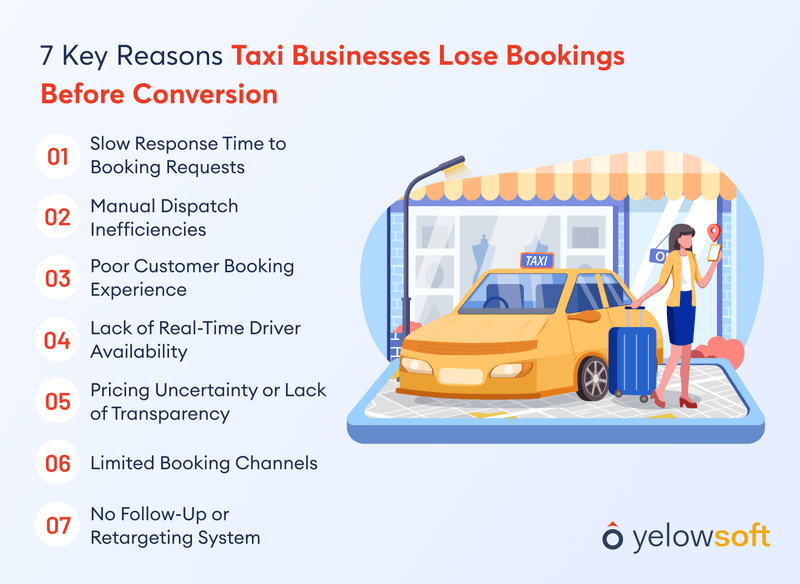
1. Slow Response Time to Booking Requests
Your customers expect speed in reponse.
If they request a booking and do not receive a quick response, their confidence drops immediately.
-
In app and web flows, even a short delay can push them away.
-
In call-based systems, unanswered calls or delayed callbacks create the same result.
2. Manual Dispatch Inefficiencies
Manual dispatch creates friction between booking and confirmation. And a dispatcher may need to call drivers, check availability, confirm location, and then return to the customer.
That process feels slow in real time, especially when the customer expects an instant answer.
3. Poor Customer Booking Experience
-
A complicated booking process reduces completion rates.
-
Long forms, unclear labels, too many screens, and weak mobile usability all create drop-off points.
If a customer has to work too hard to book, they are less likely to finish.
4. Lack of Real-Time Driver Availability
Customers want to know that a ride is actually available. If your system cannot show clear availability or ETA, uncertainty takes over.
People hesitate when they do not know whether a driver can be assigned quickly.
5. Pricing Uncertainty or Lack of Transparency
Unclear pricing is one of the fastest ways to lose trust. If the fare estimate appears too late, or if extra charges seem hidden, customers often abandon the booking rather than take the risk.
6. Limited Booking Channels
Some taxi businesses depend too heavily on one booking source. That might be calls only, app only, or website only.
But customer behavior is not limited to one channel. If your booking system does not support different preferences, you lose potential conversions.
7. No Follow-Up or Retargeting System
A large number of users leave before completion and never return. Without reminders, follow-up messages, or abandoned booking recovery, that lost demand stays lost.
Fixing these gaps gives you the clearest opportunity to convert more booking attempts into confirmed rides.
7 Practical Ways to Increase Taxi Booking Conversion Rate
Now let’s move from diagnosis to action and look at the strategies that improve conversion in real taxi operations.
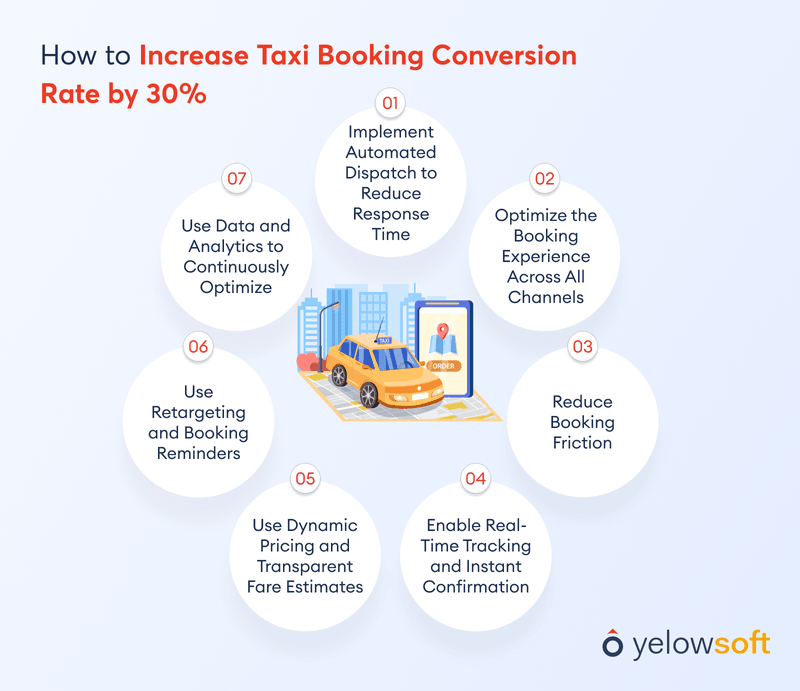
1. Implement Automated Dispatch to Reduce Response Time
With automated dispatch, the system can assign the most suitable driver based on location, availability, and booking conditions. That removes the delays caused by manual coordination.
The impact is direct:
-
Faster booking confirmation
-
Lower customer wait time
-
Fewer abandoned requests
-
Better dispatcher productivity
In many cases, improving dispatch speed alone can move conversion by 10 to 15 percent because customers get certainty sooner.
Expert Tip:
Track the time between booking attempt and driver assignment. If that gap is too long, your conversion rate is already under pressure.
2. Optimize the Booking Experience Across All Channels
Your customers do not all behave the same way.
-
Some prefer the mobile app.
-
Some visit your website.
-
Some still call.
A high-performing online taxi booking system works well across each important channel.
With such multichannel booking options, the goal is not to force customers into one path. The goal is to remove friction wherever they choose to book.
3. Reduce Booking Friction
Every extra step in booking lowers conversion. That is true in almost every online transaction, and taxi booking is no different.
A strong taxi booking platform should make booking feel quick and obvious.
You can reduce friction by:
-
Cutting unnecessary form fields
-
Using saved pickup and drop locations
-
Enabling repeat bookings
-
Adding autofill and location suggestions
-
Keeping the mobile flow short
4. Enable Real-Time Tracking and Instant Confirmation
If your booking process provides instant confirmation and clear ETA visibility, confidence rises. And if it feels vague, hesitation rises.
Real-time tracking helps because it shows that your operation is active and responsive. Plus, instant confirmation helps because it closes the gap between action and reassurance.
This improves:
-
Trust
-
Booking completion
-
Customer satisfaction
-
Cancellation control
5. Use Dynamic Pricing and Transparent Fare Estimates
Pricing affects conversion more than many operators admit. Customers do not always reject high fares. They often reject unclear fares.
So you should aim for visible and understandable pricing at the right moment.
| Pricing Strategy | Conversion Impact |
|---|---|
| Transparent fare estimate | High |
| Hidden or delayed pricing | Low |
| Dynamic pricing with explanation | High |
| Unclear surcharge logic | Low |
If you use dynamic pricing, explain it clearly. Customers are more accepting when the fare feels understandable rather than random.
6. Use Retargeting and Booking Reminders
Not every failed booking is permanently lost. Some customers leave because they get distracted, compare options, or delay the decision.
You can recover part of that lost demand with reminders and retargeting.
Useful methods include:
-
Push notifications
-
SMS reminders
-
Follow-up emails
-
WhatsApp prompts
-
Abandoned booking recovery messages
A simple reminder like “Your ride is still available” can bring back a customer who was close to confirming.
7. Use Data and Analytics to Continuously Optimize
Conversion improvement is not a one-time fix. It is an ongoing process. Hence, you need data to understand where people drop off and why.
Track the basics:
-
Number of booking attempts
-
Completion rate by channel
-
Drop-off point in the journey
-
Response time
-
Failed payment attempts
-
Peak hour performance
This is where reporting and analytics become valuable. Without data, you are guessing and with data, you can improve specific weak points.
Expert Tip:
Review booking drop-off patterns weekly. Small improvements made consistently usually outperform one-time redesigns.
Before vs After: Impact of Optimization on Conversion Rate
The optimization of conversation rates can have a greater impact on your booking outcomes. Here’s the breakdown how:
| Metric | Before Optimization | After Optimization |
|---|---|---|
| Booking Conversion Rate | 55% | 75%+ |
| Response Time | 3 to 5 min | Under 30 sec |
| Missed Bookings | High | Minimal |
| Customer Satisfaction | Average | High |
Conversion growth is not abstract. It changes ride volume, revenue consistency, and customer trust in ways you can measure.
How Taxi Booking Software Directly Impacts Conversion Rates
A good taxi booking software does more than accept ride requests. It improves the conditions that influence conversion from the first click to final confirmation.
The most useful capabilities that drive conversion include:
-
Instant booking confirmation
-
Smart driver allocation
-
Clean customer booking flow
-
Integrated payments
-
Availability visibility
-
Ride status updates
-
Repeat booking support
This is why conversion should not be viewed as a marketing issue alone.
In taxi operations, conversion is strongly tied to process quality, dispatch speed, pricing clarity, and system responsiveness.
Put simply, conversion is not just marketing. It is an operation.
Conclusion
By now, it is clear that improving your taxi booking conversion rate is not about getting more traffic. It is about fixing the gaps in your booking process where customers drop off.
When your response is instant, your pricing is clear, and your booking flow is simple, more users complete their rides without hesitation.
The difference between a 55% and a 75% conversion rate is not small. It directly impacts your daily revenue, driver utilization, and customer retention.
And small operational improvements such as faster dispatch, real-time confirmation, and multi-channel booking can unlock consistent growth without increasing marketing spend.
If you want to implement this at scale, you need more than isolated fixes. You need a system built for it.
Yelowsoft’s taxi booking software is designed to eliminate booking friction, automate dispatch, and deliver instant confirmations across channels.
If you are serious about increasing conversions, it is worth exploring how Yelowsoft can help you turn more booking attempts into completed rides.
Start converting more bookings today with Yelowsoft and scale your taxi business faster
FAQs
A good taxi booking conversion rate is usually around 60 to 75 percent. High-performing operators may achieve 75 percent or more, depending on booking channel, market conditions, and system efficiency.
The fastest improvements usually come from automated dispatch, simpler booking flows, clearer pricing, and real-time confirmation. These changes reduce hesitation and shorten the path to booking completion.
Bookings usually fail because of slow response time, manual dispatch delays, poor mobile experience, unclear pricing, limited booking channels, or lack of visible availability.
Yes. Automated dispatch improves conversion by reducing the time between booking request and driver assignment, which increases confidence and reduces customer drop-off.
Divide the number of completed bookings by the total number of booking attempts, then multiply the result by 100. For example, if customers make 200 booking attempts and complete 140 bookings, the taxi booking conversion rate is 70 percent.
Customers commonly abandon bookings because of long forms, slow confirmations, unclear fares, unavailable vehicles, failed payments, poor mobile usability, or delays in assigning a driver. Tracking where users leave the booking journey helps operators identify the exact source of the problem.
Faster dispatch gives customers immediate confidence that their ride can be fulfilled. When driver assignment takes too long, customers may assume no vehicle is available and book with another provider. Automated dispatch can reduce this delay by matching suitable drivers using availability, location, and predefined rules.
Taxi operators can improve website booking conversion by shortening the booking form, showing fare estimates early, optimizing the experience for mobile users, offering location suggestions, reducing unnecessary steps, supporting secure payments, and providing instant booking confirmation.
Reduce abandoned bookings by simplifying the booking flow, displaying clear prices, confirming availability quickly, preventing payment errors, and using automated reminders through SMS, email, push notifications, or WhatsApp. Operators should also review drop-off data regularly to identify recurring friction points.
Record booking attempts and completed bookings separately for the passenger app, website, phone, WhatsApp, email, corporate portal, and other booking channels. Comparing conversion rates by channel helps operators identify which sources perform well and which require better workflows, response times, or user experiences.


