Every taxi trip starts with one thing. Information.
If that information is incomplete or wrong, everything that follows begins to break. Drivers reach the wrong location. Dispatchers step in to fix issues. Customers lose patience. What looks like a small mistake at the booking stage quickly turns into lost time and lost revenue.
Many taxi businesses still depend on traditional systems like an IVR taxi booking system to manage calls. Others are moving toward more advanced approaches like voice AI taxi booking to handle conversations and capture data more accurately.
But the real question is not about automation alone. It is about accuracy.
In this guide, you will understand IVR vs voice AI for taxi booking, and more importantly, which system actually improves booking accuracy in real operations, not just in theory.
Booking Accuracy Is the Real Bottleneck in Taxi Operations
Before comparing technologies, it helps to look at the root problem.
Most booking issues do not come from large system failures. They begin with small gaps in information:
-
Incorrect pickup location
-
Missing landmark details
-
Misheard destination
-
Incomplete customer input
Each of these may seem minor. But once entered into the system, they move directly into dispatch.
A driver reaches the wrong location. A customer calls again to explain. Dispatchers intervene. The trip gets delayed or cancelled.
Over time, these small issues stack up. Fuel costs increase. Driver productivity drops. Customer trust weakens.
Booking accuracy is not just a technical detail. It directly impacts revenue, operational efficiency, and brand reputation.
How IVR Systems Handle Taxi Bookings Today
Let’s start with how traditional systems operate.
An IVR taxi booking system follows a fixed path. Customers interact through keypad inputs or basic voice prompts. The system collects information step by step and creates a booking.
It is structured, predictable, and easy to deploy. But it comes with clear limitations.
Where IVR Still Works
IVR performs well in controlled scenarios where variability is low.
-
Repeat bookings with saved locations
-
Low call volume environments
-
Simple and predictable routes
In these cases, the system can capture input quickly without much complexity.
Where IVR Breaks Down
Real-world taxi operations are rarely predictable.
Customers do not always follow structured inputs. They speak freely, add context, or change details mid-call.
-
It cannot process complex spoken instructions
-
There is no built-in confirmation before booking
-
Rigid menu flows often lead to wrong selections
The system captures what is selected, not what is actually meant.
Once the booking is created, any error becomes an operational issue.
How Voice AI Changes the Booking Process
Now compare this with a system designed around conversation.
A voice AI taxi booking system listens to the customer, understands intent, and responds naturally. Instead of forcing the caller into a menu, it adapts to how people speak.
What Makes Voice AI Structurally Different
-
It understands natural speech patterns
-
It captures context, not just keywords
-
It confirms details before creating a booking
This shift is important.
The system does not simply record input. It interprets, validates, and confirms it.
That means the booking process becomes structured without feeling rigid. The customer speaks normally, while the system ensures accuracy in the background.
IVR vs Voice AI for Taxi Booking: Accuracy Comparison
When you compare IVR vs voice AI for taxi booking, the difference becomes clear when you look at how each system handles errors.
| Factor | IVR Taxi Booking System | AI Voice Booking System |
|---|---|---|
| Interaction | Menu-based | Conversational |
| Flexibility | Low | High |
| Confirmation | Missing | Built-in |
| Error handling | Reactive | Preventive |
| Scalability | Limited | Strong |
IVR focuses on collecting input quickly.
Voice AI focuses on understanding and confirming that input before it becomes a booking.
That difference directly affects accuracy.
Why IVR Fails to Maintain Accuracy at Scale
As operations grow, the weaknesses of IVR become more visible.
During peak hours, call volumes increase. Customers rush through menu options. There is little time to confirm details.
-
Call volume increases pressure
-
Customers rush through inputs
-
No validation layer exists
-
Errors move directly into dispatch
The system does not adapt to pressure. It simply processes more input at the same level of accuracy, or lack of it.
This creates a scaling problem. More bookings do not mean better performance. They often mean more errors.
Expert Tip 1:
Track repeat driver callbacks for location confirmation and map them against booking sources. This reveals whether your intake system is causing hidden inefficiencies.
How Voice AI Improves Booking Accuracy in Real Conditions
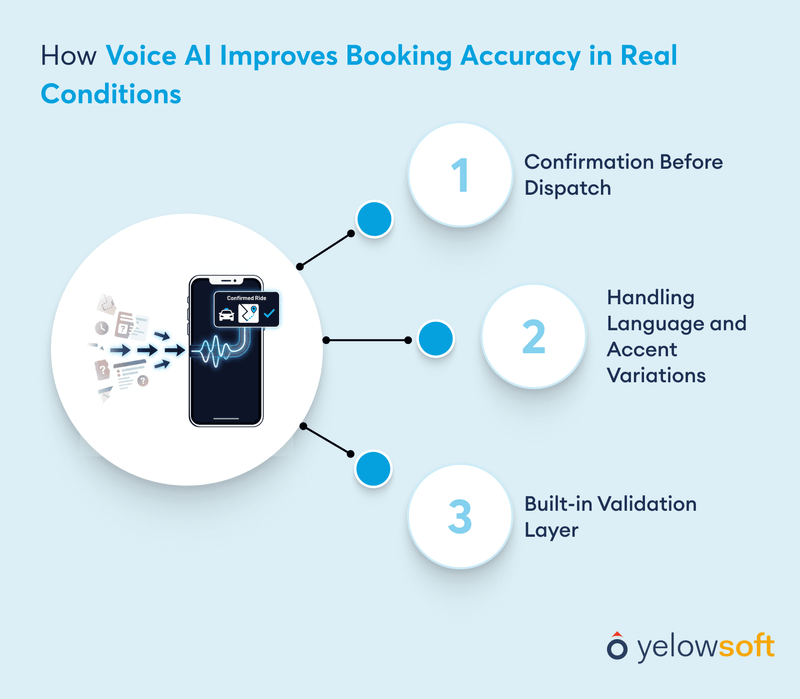
Voice AI addresses the problem at its source. It does not wait for errors to appear. It prevents them before the booking is created.
Confirmation Before Dispatch
The system repeats key details such as pickup and drop locations. The customer confirms before the booking is finalized.
This simple step eliminates a large percentage of errors early in the process.
Handling Language and Accent Variations
In real operations, customers speak in different accents, speeds, and languages.
Voice AI processes these variations using advanced speech recognition. It can detect unclear input and ask for clarification.
This reduces mistakes caused by pronunciation or background noise.
Built-in Validation Layer
The system checks whether the captured information is complete and consistent.
If something is missing or unclear, it prompts the user again.
Only validated data moves forward into dispatch.
Expert Tip 2
Use structured logs from your AI voice booking system to track correction patterns. This helps identify recurring gaps in customer input and improves long-term accuracy.
Impact on Customer Experience and Operations
Accuracy is not just an internal metric. It shapes how customers experience your service.
When bookings are accurate from the start:
-
Delays and cancellations reduce
-
Dispatchers spend less time correcting errors
-
Customers trust the service more
-
Drivers complete more trips efficiently
The difference is visible in day-to-day operations.
Instead of reacting to problems, your system prevents them.
When Should You Move from IVR to Voice AI
Not every business needs to switch immediately. But there are clear signals that your current system is limiting you.
-
Frequent booking errors
-
High dispatcher workload
-
Growing call volume
-
Customer complaints about pickup issues
If these issues are present, the problem is not your team. It is the system handling the bookings.
Expert Tip 3
Measure booking-to-dispatch correction time. If significant effort happens after booking creation, your system lacks pre-dispatch validation.
Validation Defines Accuracy
Automation alone does not solve booking errors.
IVR systems helped reduce manual effort, but they were designed to collect input, not validate it.
Voice AI introduces a structured approach where information is confirmed and checked before it enters your operations.
That difference matters.
Accurate bookings lead to smoother dispatch, better driver utilization, and stronger customer trust. Errors decrease not because people work harder, but because the system works smarter.
If your goal is to improve booking accuracy as your business grows, the shift from IVR to an AI voice booking system becomes less of an upgrade and more of a requirement.
See how structured voice booking improves accuracy and reduces booking errors in real operations
FAQs
IVR follows fixed menu inputs, while voice AI understands natural speech, confirms details, and validates booking data before dispatch, improving overall accuracy.
Yes. Voice AI reduces errors by confirming pickup and drop details, handling unclear input, and validating information before creating the booking.
IVR works for simple and repeat bookings, but it struggles with complex inputs, real conversations, and high call volumes where accuracy matters most.
Voice AI uses advanced speech recognition to understand accents, detect unclear input, and ask for clarification, reducing errors caused by miscommunication.
When booking errors increase, dispatch workload grows, or customer complaints rise, it indicates the need for a system with better validation like voice AI.


