Customer acquisition often dominates conversations in the transportation industry. Operators invest heavily in marketing campaigns, referral programs, and promotions to attract new riders. Yet sustainable growth rarely comes from acquisition alone.
The real opportunity lies in retention.
Research shows that acquiring a new passenger can cost up to five times more than retaining an existing one. At the same time, transportation businesses with strong retention strategies consistently outperform competitors in profitability, operational efficiency, and customer lifetime value.
The challenge is that customer expectations have evolved. Passengers expect instant confirmations, real time updates, accurate arrival times, frictionless payments, and personalised experiences. Businesses still relying on manual booking methods often struggle to deliver that level of service consistently.
This is where an automated taxi booking system creates a significant advantage.
Instead of relying on a single booking method, operators can accept ride requests through a passenger app, website, WhatsApp booking, Voice AI, email, and other digital channels while managing every request through one connected workflow.
By connecting these booking channels with taxi dispatch software, operators can automate confirmations, driver assignment, ride updates, tracking, and payments, creating a smoother experience that encourages passengers to return.
Why Customer Retention Has Become a Growth Priority for Transportation Businesses
Before looking at technology, it is important to understand why retention has become one of the most important growth metrics for modern transportation operators.
The Economics of Retention vs Customer Acquisition
Retaining customers is often far more profitable than constantly replacing them.
According to industry research, transportation businesses maintain an average customer retention rate of 79%, while the broader automotive and transportation sector averages 83%. These numbers highlight a simple reality: successful operators focus on keeping customers, not just acquiring them.
| Metric | Statistic |
|---|---|
| Cost of Acquiring New Passenger vs Existing Customer | 5x Higher Acquisition Cost |
| Industry Average Retention Rate | 83% |
| Transportation Industry Retention Rate | 79% |
Existing passengers typically book more frequently, require less marketing investment, trust your service more, refer new customers through word of mouth.
The result is higher profitability without proportional increases in customer acquisition costs.
How Customer Expectations Have Changed
Today's passengers live in an on demand world.
They order food from mobile apps, track deliveries in real time, and expect instant digital interactions across every service they use. Transportation services are no exception.
Customers now expect mobile first booking experiences, instant confirmations, real time vehicle tracking, digital payment options, personalized offers and recommendations.
When those expectations are not met, switching to a competitor requires very little effort.
Why Manual Booking Processes Create Retention Challenges
Many transportation businesses still rely heavily on phone calls and manual coordination.
While this approach may work at a smaller scale, it often creates issues that directly impact customer loyalty:
-
Missed booking requests
-
Delayed confirmations
-
Inconsistent communication
-
Human errors during booking
-
Limited visibility into ride status
Over time, these friction points reduce trust and increase customer churn.
What Is an Automated Taxi Booking System?
To understand its impact on retention, it helps to understand what a modern booking platform actually does.
An automated taxi booking system connects passengers, drivers, dispatchers, and administrators within one ecosystem. It receives bookings from apps, websites, WhatsApp, Voice AI, email, phone, and partner channels before moving confirmed rides into dispatch.
Core components typically include:
- Passenger mobile application
- Web, WhatsApp and Voice AI booking channels
- Driver mobile application
- Dispatcher dashboard
- Automated dispatching
- Real-time tracking and navigation
- Automated passenger notifications
- Payment integrations
- Reporting and analytics tools
The customer journey becomes streamlined:
Multichannel Booking Request → Automatic Confirmation → Automated Driver Assignment → Live Tracking and Notifications → Payment → Feedback and Rewards
Unlike traditional methods, a modern online taxi booking system allows operators to automate routine interactions while maintaining a consistent customer experience.
| Traditional Booking | Automated Taxi Booking System |
|---|---|
| Phone-only booking | App, web, WhatsApp and Voice AI bookings |
| Manual ride entry | Structured booking capture |
| Manual dispatch | Automated driver assignment |
| Limited visibility | Real-time ride tracking |
| Cash-dependent payments | Integrated digital payments |
| Reactive communication | Automated passenger notifications |
A modern web based taxi booking system eliminates many of the delays and inconsistencies that cause customer frustration.
Expert Tip:
Track booking abandonment rates inside your passenger app. Many operators monitor completed rides but ignore abandoned bookings. Understanding where users drop off can reveal hidden retention issues long before churn becomes visible.
The Direct Connection Between Booking Experience and Customer Retention
Passenger loyalty is often shaped by small interactions throughout the booking journey.
Convenience Creates Habit
When customers can book quickly, save favorite locations, and complete transactions in seconds, the service becomes part of their routine.
The easier the experience becomes, the less likely customers are to explore alternatives.
Reliability Builds Trust
Trust is built through consistency.
Passengers want confidence that every booking will receive the same level of service. Accurate ETAs, dependable driver allocation, and clear communication all contribute to a predictable experience.
Over time, predictability becomes loyalty.
Friction Leads to Churn
Many customers leave because of avoidable frustrations booking delays, lack of ride updates, payment difficulties, poor communication.
Passengers rarely tolerate repeated inconvenience when alternatives are only a few taps away.
7 Ways Automated Booking Systems Improve Customer Retention
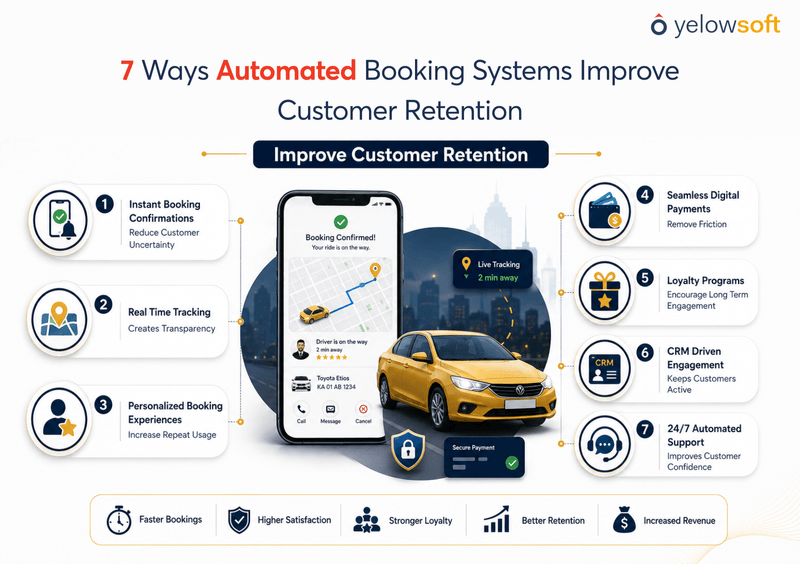
The strongest retention gains come from combining convenience, communication, and personalization.
Instant Booking Confirmations Reduce Customer Uncertainty
Waiting for confirmation creates anxiety.
Automated systems instantly acknowledge requests, provide booking details, and reassure passengers that their ride is secured.
This reduces uncertainty and improves confidence from the first interaction.
Real Time Tracking Creates Transparency
One of the biggest causes of customer frustration is uncertainty around arrival times.
A connected real-time tracking and navigation system gives passengers greater visibility throughout the ride by providing:
-
Live driver tracking
-
Accurate ETAs
-
Route visibility
-
Automatic status updates
Transparency builds trust, and trust drives repeat bookings.
Personalized Booking Experiences Increase Repeat Usage
Personalization transforms convenience into loyalty.
Modern systems can recognize:
-
Frequent destinations
-
Preferred drivers
-
Booking history
-
Travel patterns
A European mobility case study found average monthly bookings increased from four rides to seven rides after introducing personalized offers and recommendations.
Seamless Digital Payments Remove Friction
Payment is often the final step in the customer journey.
Secure payment integrations supporting saved cards, digital wallets, and cashless transactions remove unnecessary checkout friction and create a smoother booking experience.
The fewer barriers customers encounter, the more likely they are to return.
Loyalty Programs Encourage Long Term Engagement
Well-structured loyalty programs and referral rewards give passengers a clear reason to continue booking with the same taxi brand.
Research shows:
-
81% of consumers continue using businesses that offer rewards
-
Loyalty initiatives can increase customer lifetime value by up to 30%
Ride rewards, referral bonuses, cashback offers, and milestone incentives all encourage repeat usage.
CRM Driven Engagement Keeps Customers Active
Retention does not end when a ride is completed.
Integrated CRM capabilities allow operators to deliver:
-
Personalized promotions
-
Re engagement campaigns
-
Location specific offers
-
Customer segmentation based messaging
Relevant communication helps keep your brand top of mind.
24/7 Automated Support Improves Customer Confidence
Customers value responsiveness.
WhatsApp automation, Voice AI, and chatbots can respond to booking requests, collect ride details, answer common questions, and provide updates even when your dispatch team is unavailable.
Fast responses reduce frustration and improve overall satisfaction.
Expert Tip:
Create customer segments based on ride frequency instead of total spend. High frequency riders often deliver more long term value than occasional high spend passengers because their lifetime retention potential is significantly higher.
Real Customer Retention Results Achieved Through Digital Booking Technology
Beyond theory, real world results demonstrate the measurable impact of digital booking systems.
Passenger App Adoption and Retention Growth
Operators adopting modern booking technology have reported impressive improvements:
| Outcome | Result |
|---|---|
| Customer Retention | 4.2x Higher |
| Repeat Riders | 40% Increase |
| Billing Errors | 90% Reduction |
These improvements stem from better experiences, faster service, and reduced operational friction.
Loyalty Programs and Churn Reduction
A European transportation startup reported a 35% reduction in customer churn after implementing loyalty and gamification features.
The same initiative increased booking frequency while strengthening customer engagement across the platform.
Why These Results Are Consistently Reproducible
These outcomes are not isolated.
They consistently appear because successful platforms improve the same retention drivers:
-
User experience
-
Trust
-
Communication
-
Personalization
-
Convenience
When those factors improve together, retention naturally follows.
Features That Have the Greatest Impact on Customer Retention
Not every feature contributes equally to customer loyalty.
Passenger Mobile Applications
A branded passenger app gives customers one direct channel to book, track, pay, access trip history, receive offers, and quickly rebook future rides.
Automated Notifications and Ride Updates
Automated booking confirmations, driver-assigned alerts, arrival updates, and trip notifications reduce uncertainty throughout the passenger journey.
Digital Wallets and Payment Flexibility
Modern payment options simplify transactions and reduce booking abandonment.
Loyalty and Rewards Engine
Integrated loyalty points, referral rewards, cashback offers, and promotional incentives give passengers a measurable reason to book again.
Integrated Customer Communication Tools
Modern taxi reservation software and taxi booking management system platforms combine messaging, notifications, promotions, and support within a single customer experience.
Expert Tip:
Measure retention across 30 day, 90 day, and 180 day windows. Many operators only track monthly retention, which often hides long term customer behavior patterns that directly affect growth.
How to Evaluate a Booking Platform for Retention Capabilities
When evaluating a platform, ask:
-
Does it support passenger apps?
-
Are loyalty programs available?
-
Does it provide real time tracking?
-
Can it automate customer communication?
-
Does it include CRM functionality?
-
Does it support digital payments?
| Feature | Retention Impact |
|---|---|
| Passenger App | High |
| Loyalty Program | High |
| Live Tracking | High |
| CRM | Medium to High |
| Automated Notifications | High |
| Digital Wallet | High |
Future Trends Shaping Customer Retention in Transportation
AI Powered Personalization
AI will enable increasingly personalized recommendations, promotions, and customer experiences.
Predictive Customer Engagement
Operators will proactively identify customers at risk of churn and engage them before they leave.
Omnichannel Booking Experiences
Passengers will increasingly expect to move between passenger apps, websites, WhatsApp, Voice AI, email, and phone booking without restarting the booking process or repeating ride details.
Smarter Loyalty Programs
Future loyalty programs will become more dynamic, rewarding customer behavior in real time based on usage patterns and preferences.
Conclusion
Customer retention is no longer a secondary business metric. It is one of the strongest indicators of long term growth and profitability in the transportation industry.
Passengers stay loyal when booking is simple, communication is clear, payments are effortless, and service remains consistent. Digital experiences now play a direct role in shaping customer expectations and booking behavior.
The data supports this shift. Businesses adopting automated booking technologies have reported higher retention rates, more repeat riders, lower churn, and stronger customer lifetime value. Those outcomes are not driven by a single feature but by a connected experience that removes friction throughout the customer journey.
If your goal is to increase repeat bookings and build stronger passenger relationships, investing in an automated taxi booking system is no longer just about operational efficiency. It is about creating the type of customer experience that keeps passengers returning. Platforms like Yelowsoft help transportation businesses deliver those experiences through automation, real time visibility, personalized engagement, and customer focused booking journeys.
Turn One Time Riders Into Loyal Customers With Smarter Booking Experiences
FAQs
An automated taxi booking system is a digital platform that allows passengers to book rides through a mobile app, website, or other digital channels while automatically handling confirmations, driver assignment, notifications, payments, and ride tracking. It reduces manual intervention and creates a faster, more reliable booking experience.
An automated booking system improves customer retention by reducing booking friction, providing instant confirmations, offering real time ride tracking, enabling seamless payments, and delivering personalized experiences. These features increase customer satisfaction and encourage passengers to book repeatedly.
Customer retention is important because retaining existing passengers costs significantly less than acquiring new ones. Repeat customers tend to book more frequently, generate higher lifetime value, and are more likely to recommend your service to others, helping drive sustainable business growth.
Yes. Passenger mobile apps make booking faster and more convenient by storing ride history, favorite locations, payment methods, and preferences. Studies have shown that operators using passenger apps can achieve significantly higher retention rates compared to businesses relying on manual booking methods.
Real time tracking improves transparency by allowing passengers to see driver locations, estimated arrival times, and trip progress. This reduces uncertainty, builds trust, lowers support inquiries, and increases the likelihood of customers booking again.
Yes. Loyalty programs encourage repeat bookings by rewarding customers with points, cashback, ride discounts, referral bonuses, or special offers. Research shows that customers are more likely to continue using services that provide meaningful rewards and incentives.


