Running a limousine business today involves much more than managing vehicles and drivers. As booking volumes increase, operators must also manage a growing number of invoices, payment records, corporate accounts, airport transfers, affiliate bookings, and financial reports.
The transportation industry continues to expand rapidly. The global Taxi and Limousine Services market is projected to reach USD 182.78 billion by 2030, while the global limousine services market is expected to grow to USD 4.59 billion by 2033. As more transportation businesses digitize their operations, efficient billing processes have become a critical requirement rather than a luxury.
The challenge is that billing becomes increasingly complicated as operations grow. A single corporate account may generate hundreds of trips every month. Each ride may involve different rates, waiting charges, tolls, gratuities, airport fees, and payment terms. Managing these invoices manually often leads to errors, delayed payments, and unnecessary administrative work.
This is why modern limo booking software increasingly relies on automated invoice generation. By converting completed trip data directly into professional invoices, operators can improve billing accuracy, reduce manual effort, and accelerate revenue collection.
In this guide, you will learn how automated invoice generation works, the systems involved behind the scenes, and the benefits it delivers for limousine operators.
Why Manual Invoicing Becomes a Growth Bottleneck
Before understanding automation, it is important to understand why traditional billing processes struggle as limousine operations expand.
The Complexity of Modern Limo Billing
Limousine businesses often manage multiple service types simultaneously.
A corporate executive transfer may use negotiated contract rates. Airport transfers may include waiting charges, parking fees, and meet and greet services. Hourly chauffeur bookings require time-based billing. Affiliate rides often involve commission calculations and partner settlements.
Each service type creates different billing requirements. As trip volume increases, manually tracking these variables becomes increasingly difficult.
Common Problems Caused by Manual Invoicing
Manual invoicing introduces several operational risks.
Missed invoices are among the most common issues. During busy periods, completed trips may never be billed.
Fare calculation errors can occur when waiting time, tolls, or additional services are not included correctly. Incorrect tax calculations can create compliance challenges. Delayed invoice creation often extends payment cycles and slows cash flow.
Research suggests that correcting a single billing error can cost businesses approximately $53 per mistake. When these errors occur repeatedly, the financial impact becomes substantial.
The Financial Impact on Limousine Operators
Manual billing does not only affect accounting teams.
It impacts revenue collection, customer satisfaction, operational efficiency, and long term growth.
| Billing Area | Manual Process Risk |
|---|---|
| Fare Calculation | High |
| Tax Handling | Moderate to High |
| Invoice Delivery | Moderate |
| Payment Tracking | High |
| Corporate Billing | High |
Even small billing inefficiencies can create significant operational challenges as the business scales.
Expert Tip:
Monitor the average time between trip completion and invoice delivery. Faster invoice generation often leads directly to faster payments and healthier cash flow.
What Is Automated Invoice Generation?
Automated invoicing removes repetitive billing tasks by allowing the system to create invoices directly from completed trip data.
A Simple Definition
Automated invoice generation is the process where transportation software automatically creates invoices after a ride is completed.
Instead of manually entering trip details into spreadsheets or accounting systems, the platform gathers billing information automatically and produces an invoice with minimal human intervention.
Core Data Sources Used by the System
Modern limo booking software gathers information from several operational systems, including:
-
Booking records
-
Fare calculations
-
Driver reports
-
Waiting time logs
-
Toll and surcharge records
-
Corporate account settings
The platform combines these data points to generate an accurate invoice.
Why Automation Has Become Standard
Transportation businesses are handling more bookings than ever before.
At the same time, customers expect faster service, transparent billing, and digital payment options. These expectations make manual invoicing increasingly impractical.
Automation allows operators to meet customer expectations while maintaining operational efficiency.
How Automated Invoice Generation Works Step by Step
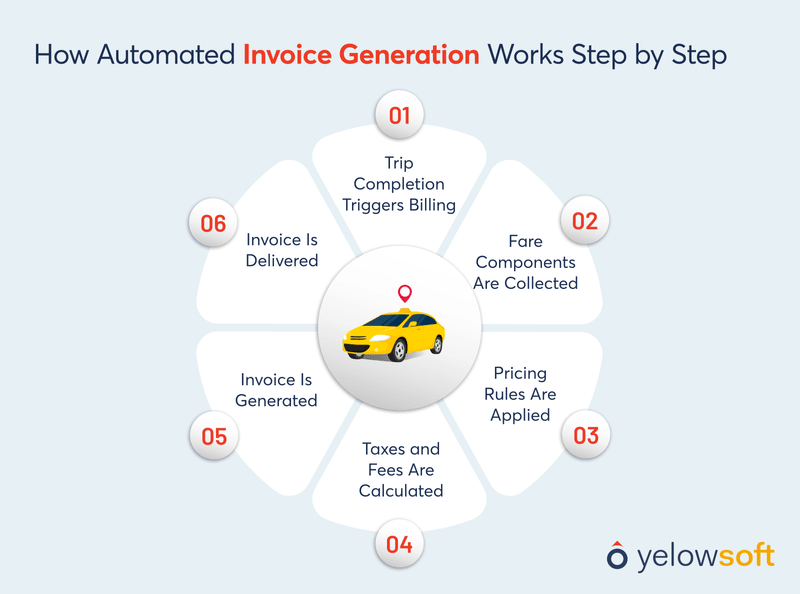
Although automated invoicing appears simple from the user's perspective, multiple systems work together behind the scenes.
Step 1: Trip Completion Triggers Billing
Once a driver marks a ride as completed, the billing workflow begins automatically.
The system identifies the completed trip and prepares the relevant financial data for processing.
Step 2: Fare Components Are Collected
The software gathers all billable elements associated with the ride, including:
-
Base fare
-
Distance charges
-
Time charges
-
Waiting fees
-
Tolls
-
Airport surcharges
-
Additional services
Every component is captured automatically from operational records.
Step 3: Pricing Rules Are Applied
Different customers may have different pricing agreements.
Corporate accounts may receive negotiated rates. Airport transportation may follow predefined pricing rules. Affiliate partners may have unique commission structures.
The system automatically applies the appropriate pricing model.
Step 4: Taxes and Fees Are Calculated
Local taxes, regulatory fees, service charges, and other applicable costs are calculated automatically.
This helps reduce compliance risks and improves billing consistency.
Step 5: Invoice Is Generated
Once all calculations are completed, the platform generates a professional invoice.
This often includes company branding, invoice numbers, customer details, trip summaries, tax information, payment instructions.
Step 6: Invoice Is Delivered
The completed invoice can then be delivered through email, customer portals, corporate dashboards, financial reporting systems.
The entire process often takes only a few seconds.
Expert Tip:
The most effective invoicing systems require virtually no manual intervention after trip completion. Every additional manual step increases the risk of delays and revenue leakage
The Technology Components Behind Automated Billing
Automated invoicing depends on several connected technologies.
Booking Management System
The booking platform stores essential ride information, including pickup details, drop off locations, customer records, trip duration, and service type.
This serves as the foundation for billing.
Pricing and Fare Engine
The fare engine determines how charges are calculated.
This may include:
-
Contract pricing
-
Hourly rates
-
Airport transfer pricing
Accurate fare calculations are essential for invoice accuracy.
Payment Processing Integration
Payment systems help manage:
-
Credit card transactions
-
Digital wallets
-
Corporate account payments
-
Online payment collection
These integrations streamline financial operations.
Reporting and Accounting Connections
Invoice data supports broader business processes such as:
-
Revenue reporting
-
Financial reconciliation
-
Tax reporting
-
Accounting workflows
This creates a more connected financial ecosystem.
Business Benefits of Automated Invoice Generation
The biggest advantage of automation is not simply speed. It improves financial performance across the entire operation.
Lower Processing Costs
Research shows substantial cost reductions through invoice automation.
| Metric | Manual | Automated |
|---|---|---|
| Cost per Invoice | $12.88 to $19.83 | $2.36 to $2.78 |
| Potential Reduction | — | Up to 80% |
Reducing invoice processing costs can significantly improve profitability over time.
Fewer Billing Errors
Automated calculations improve consistency.
This reduces:
-
Disputes
-
Incorrect charges
-
Revenue leakage
-
Administrative corrections
Faster Payments and Better Cash Flow
Invoices can be generated immediately after service completion.
This shortens payment cycles and improves cash flow visibility.
Improved Corporate Client Experience
Corporate customers value transparency and accuracy.
Automated invoicing provides:
-
Detailed billing records
-
Faster invoice delivery
-
Easier approvals
-
Better account management
Better Scalability
Operators can support higher booking volumes without proportionally increasing billing staff.
This creates a more scalable business model.
How Automated Invoicing Supports Corporate and Airport Transportation
Automation becomes even more valuable when managing complex transportation accounts.
Managing Corporate Accounts Efficiently
Corporate transportation often requires:
-
Department billing
-
Cost center allocation
-
Employee ride tracking
-
Monthly invoicing
Automation simplifies these processes while improving billing accuracy.
Handling Airport Transfer Billing
Airport transfers frequently include additional variables such as:
-
Waiting charges
-
Flight delays
-
Meet and greet services
-
Parking fees
Automated billing ensures these costs are captured consistently.
Simplifying Affiliate and Partner Payments
Affiliate bookings often require revenue sharing and commission calculations.
Automation reduces manual reconciliation while improving financial transparency.
What to Look for in a Limousine Dispatch Platform
Not all invoicing systems provide the same level of automation.
Essential Invoice Automation Features
When evaluating a platform, look for:
-
Automatic invoice generation
-
Corporate account billing
-
Recurring invoice support
-
Tax automation
-
Custom branding
-
Payment gateway integration
-
Financial reporting
Expert Tip:
When evaluating limousine dispatch software, focus on how much billing work remains after automation is activated. True automation should remove most manual tasks from the invoicing process.
The Future of Invoice Automation in Limousine Operations
Billing technology continues to evolve alongside transportation software.
AI Assisted Invoice Validation
Artificial intelligence is increasingly being used to identify:
-
Duplicate charges
-
Missing fees
-
Pricing anomalies
-
Billing inconsistencies
This helps improve invoice accuracy before delivery.
Predictive Revenue Tracking
Advanced platforms are beginning to forecast:
-
Cash flow
-
Expected payments
-
Revenue trends
-
Collection risks
This provides better financial visibility.
Fully Connected Financial Operations
Future platforms will continue integrating:
-
Accounting software
-
Financial dashboards
-
Payment systems
-
Reporting tools
The goal is complete end to end financial automation.
Conclusion
As limousine businesses grow, billing complexity grows alongside them. Corporate accounts, airport transfers, affiliate partnerships, and diverse pricing structures create challenges that manual invoicing struggles to manage efficiently.
Automated invoice generation helps eliminate repetitive administrative work while improving billing accuracy, reducing disputes, and accelerating payment collection. The result is stronger cash flow, lower operating costs, and a better customer experience.
The benefits extend beyond the finance department. Accurate invoicing improves client trust, supports scalability, and provides greater visibility into business performance. Operators can focus more on service delivery and growth instead of manual administrative tasks.
If your business manages increasing booking volumes, corporate transportation accounts, or airport transfer operations, modern limo booking software with advanced invoice automation can become a valuable competitive advantage. The right platform helps you streamline financial operations, improve revenue control, and build a stronger foundation for long term growth.
Stop Losing Time to Manual Billing and Start Collecting Revenue Faster
FAQs
Automated invoice generation creates invoices instantly after trip completion by collecting fare, taxes, surcharges, and customer details without manual data entry.
Automated invoicing uses predefined pricing rules and trip data to eliminate manual calculations, reducing fare discrepancies, tax mistakes, and invoice omissions.
Yes. Modern limousine software can automatically generate consolidated invoices for corporate accounts, including employee travel details, department billing, and cost allocation.
Yes. Automated billing can calculate airport surcharges, waiting time fees, meet and greet charges, tolls, and other airport-specific pricing components.
Transportation businesses can reduce invoice processing costs by up to 80%, minimize correction expenses, and save thousands annually through billing automation.
Yes. Most modern platforms allow operators to add company logos, contact details, payment terms, branding elements, and custom invoice templates.
Yes. Automated invoice generation speeds up billing cycles, enables faster payment collection, reduces delays, and improves overall cash flow visibility.
Look for automated invoicing, corporate billing management, tax calculations, payment gateway integration, recurring invoices, financial reporting, and customizable invoice templates.


