A customer opens your cab booking app, checks the fare and hesitates. The price feels too high for a short ride. They leave.
Now imagine another case. The same customer books during peak hours. Traffic is heavy. Drivers are scarce. Yet, the fare stays the same. You lose potential revenue.
This is the paradox. Fixed pricing was meant to simplify operations. Today, it quietly limits growth.
Taxi markets have changed. Customers compare prices in seconds. Demand fluctuates throughout the day. Competitors rely on dynamic taxi pricing and real-time adjustments.
If your pricing stays static, your business cannot respond to real conditions.
In this article, you will understand:
-
Why fixed pricing fails in modern taxi businesses
-
The hidden business impact behind static fares
-
How taxi zone price management and location based pricing models offer a better alternative
What Is Fixed Pricing in Taxi Businesses?
This section explains the foundation before we move into its limitations.
Definition and How It Works
Fixed pricing means a ride has a predefined fare. It does not change based on time, traffic, or demand.
The price remains constant regardless of:
-
Traffic conditions
-
Driver availability
-
Demand spikes
This model relies on simplicity rather than adaptability.
Where Fixed Pricing Is Commonly Used
You will often see fixed pricing in:
-
Airport transfers
-
Hotel pickup services
-
Corporate travel routes
These use cases depend on predictability. However, predictability alone is no longer enough.
Why Fixed Pricing Became Popular (And Why It Worked Before)
Before understanding failure, it helps to understand why it worked earlier.
Simplicity for Operators and Customers
Fixed pricing is easy to communicate. Customers know what they will pay. Operators do not need complex calculations.
This simplicity built trust in earlier markets.
Predictability in Low-Competition Markets
Before ride-hailing platforms, pricing competition was limited. Customers had fewer alternatives.
Operators could sustain fixed fares without losing demand.
Limited Technology Constraints
Earlier systems lacked real-time data. There was no real-time fare calculation or demand tracking.
Fixed pricing was not a strategy. It was a limitation.
Why Fixed Pricing Models Fail in Modern Taxi Businesses
This is where the real problem begins to show.
Ignores Real-Time Demand and Supply
Fixed pricing does not react to demand fluctuations.
During peak hours, you miss opportunities to increase fares. During low demand, prices remain high, reducing bookings.
You lose both revenue and volume.
Leads to Revenue Leakage on High-Demand Routes
Consider this data point. Missing just 15 bookings daily at an average fare of $25 results in $375 loss per day. That is over $11,000 monthly.
This happens because static pricing cannot capture peak demand value.
Modern systems using demand-based taxi pricing adjust fares instantly to maximize returns.
Creates Pricing Mismatch in Traffic Conditions
A ride stuck in traffic generates the same fare as a smooth ride.
Drivers feel underpaid. Operational efficiency drops.
This mismatch leads to dissatisfaction and poor service quality.
Reduces Competitiveness Against Ride-Hailing Apps
Customers compare prices instantly. Ride-hailing apps use AI-based taxi pricing and predictive systems.
These platforms adjust fares dynamically.
If your pricing remains static, customers will shift away.
Limits Scalability Across Cities and Zones
Every city behaves differently. Demand patterns vary.
Fixed pricing cannot adapt to:
-
Urban vs suburban demand
-
Peak hour variations
-
Special events
This limits expansion.
Increases Operational Friction and Manual Overrides
Dispatchers often need to adjust fares manually.
This leads to:
-
Delays
-
Human errors
-
Inconsistent pricing
Instead of automation, your team becomes reactive.
Expert Tip:
Use a pricing engine that combines real-time fare calculation with demand signals such as driver availability, trip density, and traffic API inputs. This ensures pricing adjusts without manual intervention.
Fixed Pricing vs Modern Pricing Models
| Factor | Fixed Pricing | Dynamic Pricing | Zone-Based Pricing |
|---|---|---|---|
| Flexibility | Low | High | Medium High |
| Revenue Optimization | Low | High | High |
| Customer Trust | Medium | Low | High |
| Scalability | Low | High | High |
| Ease of Implementation | High | Medium | Medium |
The most effective approach today is a hybrid model combining taxi zone price management with dynamic adjustments.
Hidden Business Impact of Fixed Pricing
Many operators underestimate the long-term impact.
Lost Booking Opportunities
If your fare feels high, customers leave.
This directly affects your taxi booking conversion rate.
Reduced Driver Retention
Drivers prefer profitable routes.
If earnings stay low due to static pricing, they shift platforms.
Lower Customer Lifetime Value
Inconsistent pricing experience leads to poor retention.
Customers expect fairness and transparency.
Poor Demand-Supply Balance
Without pricing incentives, drivers do not move to high-demand areas.
This results in longer wait times and lower efficiency.
What Modern Taxi Businesses Need Instead of Fixed Pricing
This section introduces better alternatives.
Adaptive Pricing Models (Dynamic Pricing)
This model adjusts fares based on:
-
Demand levels
-
Traffic conditions
-
Driver availability
It enables automated fare optimization and improves revenue.
Zone-Based Pricing for Predictability
Taxi zone price management divides areas into structured zones.
Each zone has predefined fare ranges.
This maintains predictability while allowing flexibility.
Hybrid Pricing Strategy (Best Practice)
This combines:
-
Zone-based base fares
-
Dynamic multipliers
Example:
Base fare for a zone + peak hour multiplier
This approach balances trust and profitability.
Expert Tip:
Define zones using historical trip density data rather than arbitrary geography. This improves multi-zone pricing configuration and ensures accurate fare distribution.
How Zone-Based Pricing Solves the Limitations of Fixed Pricing
Now let us look deeper at why this works.
Standardizes Pricing Without Losing Flexibility
Zones create structure.
Dynamic adjustments add flexibility.
This removes the rigidity of fixed pricing.
Improves Booking Conversion Rates
Customers prefer clear pricing.
Zone-based fares provide clarity while remaining competitive.
Enhances Operational Efficiency
With structured pricing rules, manual intervention reduces.
Dispatch becomes faster and more consistent.
Real-World Example
Airport Transfer Scenario
| Scenario | Fixed Pricing | Zone + Dynamic Pricing |
|---|---|---|
| Peak Hour | Same fare | Higher revenue |
| Off Peak | Same fare | Competitive pricing |
| Customer Trust | Medium | High |
This clearly shows how flexible pricing improves outcomes.
How to Transition from Fixed Pricing to Smarter Models
Switching requires a structured approach.
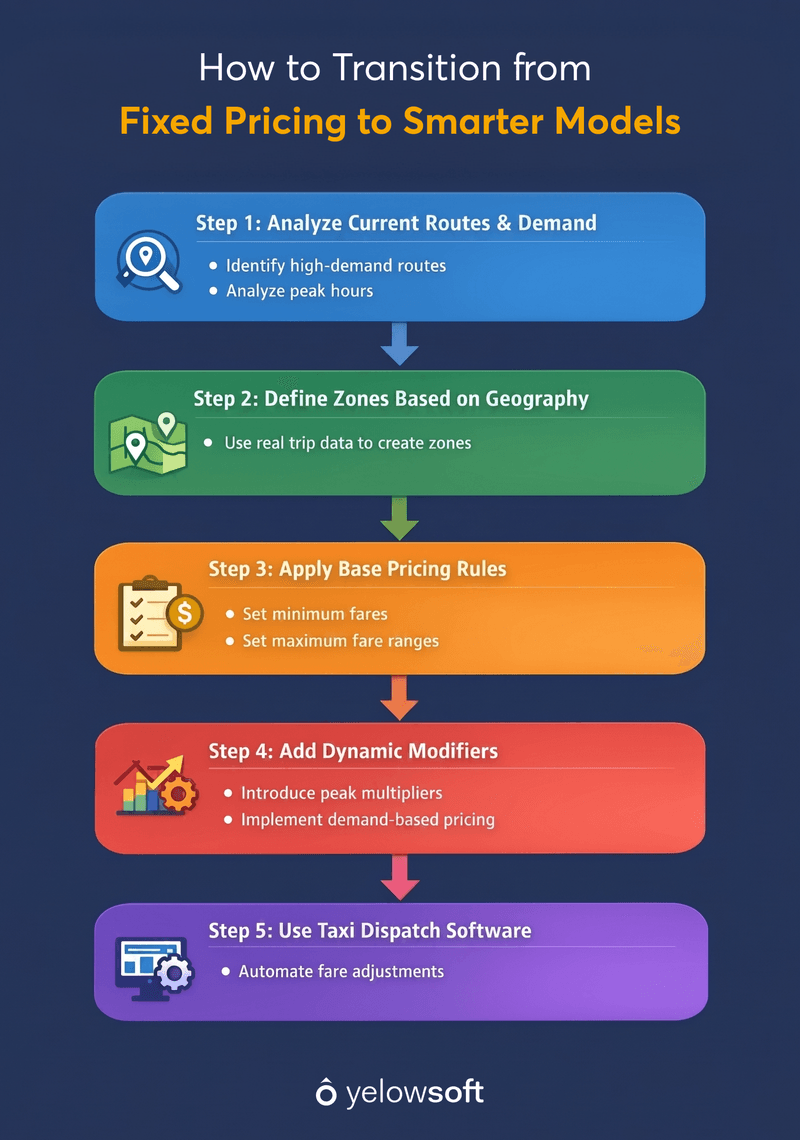
Step 1: Analyze Current Routes and Demand
Identify high-demand routes and peak hours.
Step 2: Define Zones Based on Geography
Use real trip data to create zones.
Step 3: Apply Base Pricing Rules
Set minimum and maximum fare ranges.
Step 4: Add Dynamic Modifiers
Introduce peak multipliers and demand-based pricing.
Step 5: Use Taxi Dispatch Software for Automation
Automation ensures accuracy and scalability.
Expert Tip:
Integrate traffic APIs and historical ride data into your pricing logic. This enables a smart fare prediction system that adjusts fares before demand spikes occur.
Choosing the Right Taxi Software for Advanced Pricing
Your technology determines your pricing success.
Key Features to Look For
-
Zone-wise fare management
-
Dynamic pricing engine
Why Automation Matters
Automation reduces dependency on manual processes.
It allows your business to scale without increasing operational complexity.
Fixed Pricing Is Simple But Simplicity Comes at a Cost
Fixed pricing fails because it ignores real-world variables.
Demand fluctuates. Traffic changes. Customer expectations evolve. Yet, static pricing remains unchanged.
This disconnect leads to revenue loss, poor driver satisfaction, and declining competitiveness.
Modern taxi businesses must shift from static models to adaptive systems.
By combining taxi zone price management with dynamic pricing strategies, you create a system that responds to real conditions while maintaining customer trust.
The future of taxi operations depends on treating pricing as a strategic lever rather than a fixed setting.
Explore smarter pricing strategies that adapt to your operations and improve revenue outcomes.
FAQs
Fixed pricing is not always bad, but it becomes inefficient in dynamic markets where demand and supply change frequently.
A hybrid approach combining location based pricing models with dynamic adjustments offers better flexibility and revenue optimization.
Yes, modern SaaS platforms allow even small operators to implement dynamic taxi pricing without technical complexity.
Not when implemented transparently. Clear pricing rules and visible fare logic improve trust rather than reduce it.


