Quick Summary
This blog explains how white-label taxi dispatch software helps transport businesses launch branded booking, dispatch, driver, fleet, payment, and administrative solutions without building a platform from scratch. It covers key benefits, customisation, integrations, pricing, data ownership, scalability, support, and vendor dependency to help operators choose a solution aligned with their business needs and growth plans.
Running a modern taxi or passenger transport business increasingly depends on more than vehicles and drivers. You need reliable booking channels, efficient dispatching, driver coordination, live trip visibility, pricing controls, payments, customer communication, and operational reporting working together.
Building all of this technology from scratch can require significant investment, development expertise, infrastructure, testing, maintenance, and ongoing product management. That is why many taxi, private hire, ride-hailing, airport transfer, corporate transport, and chauffeur businesses evaluate white-label taxi dispatch software as an alternative.
But a faster launch does not automatically make white-label software the right choice.
The real decision comes down to what you gain, what you give up, and how well the platform fits your operating model.
In this guide, you will learn how white-label taxi dispatch software works, what it normally includes, its key benefits, costs and limitations, how it compares with custom development, and what you should evaluate before choosing a provider.
What Is White Label Taxi Software?
White label taxi software is a prebuilt taxi booking, dispatch, driver and fleet management platform developed by a technology provider and licensed to a transport business under its own brand. The operator can typically apply its business name, logo, colours and app identity while the technology provider maintains the underlying software and infrastructure.
What Does White-Label Taxi Dispatch Software Include?
A complete white label taxi booking software solution normally combines customer booking channels, driver technology, dispatch operations, fleet controls, pricing, payments, tracking and reporting.
The exact modules vary between providers, so operators should evaluate the complete operating system rather than considering only the white label taxi app.
Passenger Booking Experience
This may include a branded passenger app, web booking interface, fare estimates, scheduled and immediate bookings, live driver tracking, payment options, trip history, saved locations, notifications, ratings, and promotional codes.
Driver Application
The driver app normally provides trip requests, acceptance or rejection controls, navigation, passenger communication, trip status updates, earnings information, availability controls, and document or profile management.
Admin and Dispatcher Tools
The operational platform may include manual and automated dispatching, driver and vehicle management, booking management, live trip monitoring, pricing configuration, service zones, customer records, corporate accounts, reporting, and user-role permissions.
Integrations
Depending on the provider, the platform may connect with payment gateways, mapping services, SMS and email tools, accounting systems, corporate platforms, airport or travel aggregators, telephony systems, and other third-party services.
Hosting, Maintenance, and Updates
In a SaaS white-label model, the vendor commonly manages hosting, system maintenance, product updates, security patches, monitoring, and technical infrastructure. You should confirm which services are included in the subscription and which require additional fees.
Many providers deliver the technology as cloud based taxi dispatch software, meaning hosting, monitoring, infrastructure maintenance, security patches and standard product updates are managed by the software provider rather than the taxi operator.
What Can Usually Be Customised?
Most white-label platforms allow customer-facing branding changes such as:
-
Business name and logo
-
Brand colours
-
App name and icons
-
Splash screens
-
Email and notification templates
-
Supported languages and currencies
-
Service types and vehicle categories
-
Fare and zone configurations
-
Selected booking and dispatch workflows
It is important to distinguish branding from product customisation. Changing a logo, colour scheme or app name is branding. Configuring fares, zones, service types or dispatch rules is operational configuration. Building a completely new module, workflow or technical capability is custom development. Providers may price and support these three levels differently.
More substantial changes, such as entirely new modules, unique user journeys, underlying architecture changes, or exclusive product functionality, may require paid custom development or may not be supported.
What Normally Remains Vendor-Controlled?
With most SaaS white-label platforms, the provider retains control over:
-
Core source code
-
Platform architecture
-
Hosting environment
-
Standard product updates
-
Security patches
-
Core release schedule
-
Supported technology framework
-
Decisions affecting the shared product roadmap
This is the central trade-off of white-label software. You gain faster deployment and lower development responsibility, but you do not receive the same technical independence as you would with a completely custom-built platform.
Yelowsoft aligns with these principles
Yelowsoft provides a configurable white-label taxi dispatch platform that can be branded for the operator’s business and configured around its booking, dispatch, pricing, driver, fleet, and customer-management requirements.
Yelowsoft maintains the underlying technology while the operator manages its branded service and operational data according to the applicable agreement.
And deliver exceptional passenger experiences—all while focusing resources on operations and growth.
Which Transport Businesses Can Use White Label Taxi Software?
White label taxi software is not limited to conventional street-hail taxi fleets. It can support several passenger transportation models when the platform's booking, pricing, dispatch, driver, fleet and integration capabilities match the operator's workflows.
Typical use cases include:
-
Taxi and private hire operators managing scheduled and on-demand bookings across multiple booking channels.
-
Ride-hailing businesses that need white label ride hailing software under their own passenger-facing brand.
-
Airport transfer providers managing scheduled trips, flight-related operations, meet-and-greet services and transfer pricing.
-
Corporate transportation businesses handling account bookings, passenger policies, invoicing and reporting.
-
Limo and chauffeur operators coordinating premium vehicles, scheduled journeys, corporate clients and driver assignments.
-
Multi-service transport businesses operating several vehicle categories, service zones or customer segments from the same taxi dispatch platform.
The deciding factor is therefore not the business label. It is whether the software can support the operator's actual booking, dispatch, pricing, fleet and customer-management model.
Key Benefits of White Label Taxi Software
White label taxi software can provide a practical middle ground between using generic third-party booking channels and funding a completely custom technology platform.
1. Launch Without Building the Core Platform From Scratch
A white-label platform already contains the main booking, dispatch, driver, customer and administrative infrastructure.
This can substantially reduce the amount of product design, engineering, testing, infrastructure and deployment work required before launch. A ready made taxi app should not mean that every implementation is identical; branding, configuration, integrations and operating rules still need to be set up around the business.
2. Operate Under Your Own Brand
Passenger apps, driver apps, web-booking interfaces and selected customer communications can normally carry the operator's business identity.
This allows customers to interact directly with the transport brand rather than experiencing every booking through an unrelated third-party marketplace.
3. Reduce Internal Technology Responsibility
With a SaaS model, the provider commonly manages hosting, core platform maintenance, monitoring, security patches and standard product releases.
The operator can therefore concentrate its internal resources on transportation operations rather than maintaining a complete software engineering and infrastructure function.
4. Connect Booking and Dispatch Workflows
A modern taxi booking and dispatch software platform can connect incoming bookings with driver availability, allocation rules, trip monitoring, pricing, passenger communication and operational reporting.
This reduces the fragmentation created when bookings, dispatch decisions and fleet information are handled through separate systems.
5. Support Fleet Growth Without Building New Infrastructure
A cloud platform can support expansion across more drivers, vehicles, service zones or booking channels without requiring the operator to build an equivalent software stack internally.
Actual scalability should still be evaluated against expected booking volume, fleet size, integrations, geographical coverage and the provider's infrastructure.
6. Improve Operational Visibility
Connected booking, driver and trip data can give dispatchers and managers a clearer view of active rides, driver status, cancellations, completed trips, pricing and operational performance.
Where fleet-management capabilities are included, the platform can also perform functions commonly associated with taxi fleet management software and taxi management software.
7. Shift Ongoing Product Maintenance to the Provider
One often overlooked benefit is ongoing maintenance.
Instead of separately funding every operating-system update, security patch, infrastructure change and standard platform enhancement, these responsibilities are typically managed by the SaaS provider according to the commercial agreement.
This benefit should be evaluated alongside the corresponding limitation: the provider also controls much of the underlying technology and release roadmap.
How Much Does White Label Taxi Software Cost?
There is no universal price for white label taxi software because the total cost depends on the platform, commercial model, fleet size, booking volume, required applications, integrations, customisation and third-party services.
A realistic cost assessment should therefore look beyond the initial setup fee.
Common Cost Components
| Cost area | What to check |
|---|---|
| Initial setup | Branding, platform configuration, onboarding and deployment |
| Subscription | Monthly or annual platform charges |
| Usage | Per-trip, per-driver, per-vehicle or transaction-based fees where applicable |
| Passenger and driver apps | Branding, publishing, app-store management and updates |
| Integrations | Existing connectors, new integration development and ongoing maintenance |
| Custom development | New workflows, features or modules outside standard configuration |
| Third-party services | Maps, SMS, email, payment processing, telephony or other APIs |
| Migration | Importing customers, drivers, vehicles, pricing or historical data |
| Support | Included support level, premium support or dedicated account services |
| Scaling | Changes in commercial terms as fleet size or booking volume increases |
The most useful comparison is therefore total cost of ownership, not simply the advertised monthly subscription.
Ask providers to separate mandatory platform charges from optional development and third-party costs. You should also understand how pricing changes as your operation grows.
Limitations of White Label Taxi Software
White-label platforms reduce development responsibility, but they also introduce dependencies that should be evaluated before signing a long-term agreement.
Limited Source-Code Control
In most SaaS arrangements, the provider retains ownership of the core code. You are licensing the platform rather than buying the underlying software product.
Customisation Has Boundaries
Branding and configuration may be flexible, but completely new workflows, modules or architecture changes may require custom development or may not be supported.
You Depend on the Vendor's Product Roadmap
Standard enhancements, technology upgrades and major architectural decisions are generally controlled by the provider. Your preferred feature may therefore compete with broader product priorities.
Integrations May Require Additional Work
A provider may support APIs or existing integrations without supporting every external system you want to connect. New integrations can introduce development costs, testing requirements and ongoing maintenance responsibility.
Migration Can Be Complex
Changing providers later can require exporting booking, customer, driver, vehicle, pricing and operational data. Data-export formats, migration assistance and termination procedures should therefore be agreed before launch, not when you decide to leave.
Third-Party Services Create Additional Dependencies
Maps, payment gateways, messaging services, app stores and other external services can have their own pricing, usage limits, policies and availability requirements.
Vendor Dependency Is Part of the Model
The same provider responsibility that reduces your engineering workload also creates operational dependency.
That does not automatically make white-label software a poor choice. It means vendor stability, support quality, service terms, data portability and technical governance should be evaluated alongside features.
How to Choose the Best White Label Taxi Dispatch Software
The best white label taxi dispatch software is not necessarily the platform with the longest feature list. It is the platform that can support your operating model without creating unacceptable technical, commercial or operational constraints.
Before selecting a provider, evaluate the following areas:
Booking Channels
Confirm whether the platform supports the channels your customers actually use, such as passenger apps, web booking, corporate booking, phone-assisted booking or supported automated channels.
Dispatch Model
Check how manual dispatch, automated assignment, scheduled bookings, driver availability, service zones and exceptions are managed.
Pricing Flexibility
Understand whether you can configure fixed fares, distance-based pricing, time-based charges, zones, vehicle categories, surcharges and other rules required by your business.
Driver and Fleet Operations
Review driver onboarding, availability, trip handling, vehicle management, tracking and operational controls.
Integrations
Identify existing integrations and determine what happens when you require something that is not already supported.
Branding and Customisation
Separate cosmetic branding, operational configuration and genuine custom development. Ask what is included in each category.
Data Ownership and Portability
Confirm who controls passenger, driver and trip data, where it is hosted, how it can be exported and what happens after termination.
Infrastructure and Scalability
Understand the provider's hosting model, monitoring, security processes, expected capacity and how commercial terms change as your operation grows.
Support and Service Management
Review support channels, support hours, response expectations, escalation processes, onboarding responsibilities and maintenance coverage.
Commercial Terms
Calculate the likely total cost over several years, including subscriptions, integrations, third-party services, additional environments, custom work and migration requirements.
White-Label Taxi Software vs Custom Development
The main difference is not simply price. It is the division of control, responsibility, risk, and ongoing technical work.
| Evaluation Area | White-Label Taxi Software | Custom-Built Taxi Software |
|---|---|---|
| Initial development | Core platform already exists | Platform must be designed and developed |
| Launch timeline | Usually faster, depending on configuration, branding, integrations, testing, and app-store approval | Usually longer because the product is built from the ground up |
| Upfront cost | Generally lower than full custom development | Generally higher because design, development, infrastructure, testing, and deployment are funded by the operator |
| Branding | Logo, colours, app identity, and selected customer-facing elements can normally be changed | Complete control over the visual and product experience |
| Features | Uses the vendor’s existing modules and supported configurations | Features can be developed around unique requirements |
| Source code | Usually retained by the platform provider | Usually controlled by the operator when contractually agreed |
| Hosting and maintenance | Commonly handled by the vendor | Must be handled internally or through a development partner |
| Updates | Delivered according to the vendor’s product and release process | Planned and funded by the operator |
| Integrations | Limited to supported APIs, available connectors, and approved custom work | Can be developed around almost any technically feasible requirement |
| Vendor dependency | Higher because the vendor controls the core platform | Lower when the operator owns the code and technical infrastructure |
| Internal technical team | Limited internal engineering resources may be required | Product, engineering, testing, DevOps, and security resources are normally required |
| Scalability | Depends on the vendor’s infrastructure, architecture, and commercial plan | Depends on the quality and capacity of the custom architecture |
When White-Label Software Is the Better Choice
A white-label platform may be suitable when you need to launch quickly, have a defined budget, do not want to maintain a development team, and can operate successfully within the vendor’s supported product framework.
When Custom Development May Be Better
Custom development may be more appropriate when your business requires proprietary workflows, exclusive functionality, complete source-code control, unusual infrastructure requirements, or a product roadmap that cannot depend on an external provider.
Before selecting either model, evaluate the total cost over several years rather than comparing only the initial launch price.
Features That Set Yelowsoft Apart
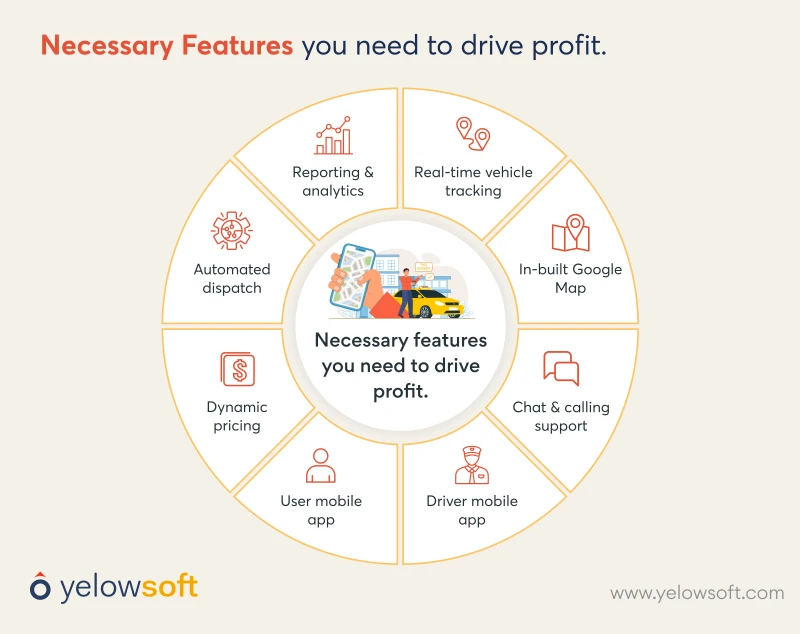
The value of a white-label platform depends on whether its features support your actual booking, dispatch, driver, fleet, pricing, payment, and reporting workflows. Below are the primary capabilities available within the Yelowsoft platform. Let’s have a look at each of them.
-
Real-time GPS vehicle tracking - Allows you to monitor all your vehicles in the fleet for efficient allocation and routing.
-
Map and navigation integrations: Connect booking, dispatch, location search, routing, ETA calculation, and live trip visibility through supported map services. Available providers, API charges, and usage limits should be confirmed during implementation.
-
Built-in chat and calling - Enables seamless communication between every character in the loop - you, your drivers and passengers.
-
Driver mobile app - You get a dedicated driver app that you can give to all your drivers. The app will provide access to ride requests, navigation, earnings and other features. You will be smart, advanced, and a market leader in the eyes of your drivers.
-
Passenger mobile app - And here comes where you get the bread and butter - customers. You get a customer app with an easy-to-use interface. Your customers can book, track, pay and do more on the go.
-
Dynamic pricing - A feature you get from us that helps you earn more. This feature helps you automatically adjust fares based on the supply/demand of the trips to maximize revenue.
-
Automated dispatch - This is what makes you smart. It helps you Intelligently assign bookings automatically to the nearest drivers for quick pickups.
-
Reporting and analytics - You can make wise decisions. With this feature, you can track key metrics of your business that includes a number of trips, customer feedback, driver behavior, canceled trips, rejected trips, completed trips, longest trip, shortest trips, and more.
You get detailed data to analyze. After evaluating, you can make a data-driven decision.
Customer Testimonials
Satisfied customers are hard to earn. But when you work with a pure heart and mindset of solving problems, you achieve what you want. And we did the same. Check out our couple of clients sharing their experiences.
Yelowsoft has a long list of satisfied clients. You can check who they are, what they are saying and what benefits they get using Yelowsoft that you can get too. You are just one step away from experiencing success.
Conclusion
White-label taxi dispatch software can give a transport operator a faster route to branded booking, driver, dispatch, fleet, pricing, payment, and reporting capabilities without funding an entire software product from scratch.
That convenience comes with trade-offs. Branding and operational configuration may be flexible, but the vendor will usually retain control over the source code, underlying architecture, hosting, maintenance, and core release roadmap. Costs may also include setup, subscriptions, usage charges, integrations, custom development, app-store accounts, and third-party services.
Before choosing a provider, confirm what is included, what can be customised, who owns the data, how integrations are handled, what support covers, how migration works, and what happens if you later decide to leave the platform.
The right white-label platform is not simply the one with the longest feature list. It is the one whose operating model, commercial terms, technical limitations, and support structure match your business.
Evaluate Whether Yelowsoft Fits Your Taxi Operations
Frequently Asked Questions
Usually, no. In a SaaS white-label arrangement, the technology provider normally retains ownership of the core source code and licenses the platform to the taxi operator. The operator typically controls its brand and business data according to the contract. Source-code ownership, escrow arrangements, export rights, and termination provisions should be confirmed before signing.
White-label branding commonly includes the business name, logo, colours, app name, icons, splash screens, and selected communication templates. Changes to layouts, workflows, platform architecture, or core modules may require custom development and may not always be available.
App-publishing responsibility varies by provider. Confirm whether the apps will be published through your Apple and Google developer accounts or the vendor’s accounts, who manages submissions and updates, and who retains access if the commercial relationship ends.
It can support custom integrations when APIs, technical documentation, security requirements, and commercial approval are available. Confirm whether the integration already exists, whether new development is required, who pays for it, who maintains it, and how failures will be supported.
Recurring charges may include monthly subscriptions, per-trip usage, hosting, support, maintenance, app services, third-party APIs, maps, messaging, payment processing, integrations, or additional environments. Request a complete cost breakdown rather than comparing only the initial setup fee.
In a SaaS white-label model, the vendor normally manages platform maintenance, security patches, and product updates. Ask whether updates are included, whether changes can affect existing workflows, how releases are communicated, and whether custom features are maintained separately.
It can. Dependence may arise because the provider controls the source code, hosting, infrastructure, updates, and technical roadmap. You can reduce this risk by defining data-export rights, migration assistance, service levels, notice periods, termination terms, and integration ownership in the agreement.
Implementation time depends on branding, configuration, integrations, data migration, testing, training, app-store approval, and custom requirements. A standard launch may be faster than custom development, but providers should give a scope-based timeline rather than an unsupported fixed promise.
Data ownership should be stated explicitly in the commercial agreement and privacy documentation. Confirm ownership, hosting location, access permissions, backups, retention, export formats, deletion procedures, subprocessors, and what happens to the data after contract termination.
Support scope can include onboarding, configuration, training, issue resolution, infrastructure monitoring, maintenance, and software updates. Confirm support hours, communication channels, response targets, escalation procedures, exclusions, and whether integrations or custom developments have separate support terms.