If most of your bookings come through WhatsApp, you are not alone. Many taxi operators rely on chat because it is simple, fast, and familiar for customers. A message comes in, you reply, confirm the trip, and move on.
But here is the real question you need to answer:
Are those messages turning into confirmed bookings consistently, or are you losing rides in the process?
When bookings are handled manually, even small gaps create problems. A missing pickup point, a delayed reply, or a misunderstood request can lead to lost revenue. As message volume increases, these issues become harder to control.
This is where whatsapp taxi booking software changes the outcome. It does not change how customers reach you. It changes how every message is captured, structured, and converted into a confirmed trip without delay.
In this blog, you will learn exactly how taxi operators move from handling chats manually to using taxi booking automation that turns every WhatsApp message into a reliable, trackable booking.
Why WhatsApp Has Become the Default Booking Channel for Taxi Businesses
To understand why automation is needed, you first need to see why WhatsApp became the primary way customers book rides today.
Reason 1: Customers Prefer Faster, Low-Effort Booking Methods
Customers no longer want to call and wait. They want a quick way to request a ride without friction.
-
Sending a message takes seconds
-
Location can be shared instantly
-
No need to repeat details
-
No dependency on call availability
This also protects your business from the revenue loss caused by missed taxi booking calls during peak hours and after-hours demand.
This shift is why taxi booking via WhatsApp has become common across markets.
Reason 2: WhatsApp is Already Widely Adopted by Both Customers and Operators
There is no learning curve.
-
Customers already use WhatsApp daily
-
Operators already have it installed
-
No training or onboarding required
-
Works across all devices
Because of this, businesses naturally start accepting bookings there without planning it as a system.
Reason 3: It Removes the Need For Initial Investment in Booking Infrastructure
For many operators, WhatsApp becomes the easiest starting point.
-
No software cost
-
No setup time
-
No technical dependency
-
Immediate booking acceptance
This makes it the default choice, especially for small and growing fleets.
Before automating the channel, review this complete WhatsApp taxi booking software guide to understand the features, workflows, and integration requirements that matter👇
The Problem: Why WhatsApp Messages Don’t Convert into Reliable Bookings
Now look at what actually happens when you depend on manual chat handling.
Messages Are Unstructured and Incomplete
Customers send messages like: “Need cab tomorrow morning”
This leaves gaps:
-
Pickup not clear
-
Drop missing
-
Time unclear
You spend time clarifying instead of confirming.
Manual Replies Create Delays and Confusion
Every message depends on a human response. This creates the same capacity problems seen in traditional taxi call-centre workflows, where each additional request increases waiting time and staff pressure.
-
Delays happen during peak hours
-
Replies vary between staff
-
Customers may move to another provider
This directly affects your ability to increase taxi bookings with WhatsApp.
Booking Details Get Lost Across Chats
There is no central system.
-
Conversations stay inside chat threads
-
No structured record
-
No easy way to track bookings
This creates confusion, especially when volume increases.
Dispatch Gets Delayed Due to Unclear Information
Dispatch depends on complete data. Without it:
-
Drivers are assigned late
-
Trips are mismanaged
-
Back and forth communication increases
What Actually Happens Behind the Scenes in Manual WhatsApp Booking
Let’s break down your current workflow clearly.
Step-By-Step Breakdown of Current Workflow
-
Customer sends message
-
Operator reads it
-
Operator asks for missing details
-
Customer replies
-
Booking is confirmed manually
-
Dispatcher receives details
Each step depends on human action.
Where Delays and Errors Occur
-
Missing information leads to repeated questions
-
Manual entry creates mistakes
-
Messages overlap during busy hours
Even small errors affect customer trust.
Why This Model Fails at Scale
As bookings increase:
-
More messages create more confusion
-
Staff becomes overloaded
-
Response time increases
This is where manual handling starts to break.
At this stage, dedicated taxi booking software becomes necessary to capture, validate, confirm, and organise ride requests without relying on individual chat threads.
Turn WhatsApp Chats Into Dispatch-Ready Bookings
See how Yelowsoft captures missing trip details, confirms requests, and sends structured bookings directly into your dispatch workflow.
What Does “Turning Messages into Bookings Automatically” Really Mean
Turning messages into bookings automatically means converting unstructured chat messages into complete, validated booking data that is instantly confirmed and sent to your dispatch system without manual involvement.
Let’s look what it actually is:
It is Not Just Replying Faster to Messages
Many operators assume automation means quick replies or predefined templates. That does not solve the core problem.
-
A fast reply is still a conversation
-
A conversation is not a confirmed booking
👉 Automation is not about speed alone. It is about completing the booking without manual effort.
It Means Converting Every Chat into Structured Booking Data
For a message to become a booking, certain details must be captured in a fixed format:
-
Customer name
-
Pickup location
-
Drop location
-
Date and time
-
Trip type or fare logic
In manual workflows, you collect this through back-and-forth messages.
With WhatsApp taxi booking software, the system ensures:
-
Every required field is captured
-
Data is consistent across bookings
-
No detail is missed
👉 This is the shift from conversation to structured input.
It Means Removing Manual Dependency From The Booking Process
In a manual setup, every step depends on a person:
-
Reading the message
-
Asking questions
-
Confirming details
-
Passing information to dispatch
Automation removes this dependency.
Using AI WhatsApp chatbot taxi booking, the system:
-
Understands the customer’s message
-
Asks for missing details automatically
-
Completes the booking flow without human intervention
👉 Your team no longer manages chats. The system manages bookings.
It Means Connecting Booking Directly to Your Dispatch System
A booking is only useful when it is ready for dispatch.
With proper WhatsApp ride booking integration:
-
Booking is created instantly in your system
-
Dispatcher receives complete trip details
-
Driver assignment can happen immediately
There is no manual transfer, no duplication of work.
How an Automated WhatsApp Booking System Works (Step-by-Step Flow)
Now let’s make the process easy to understand by looking at what actually happens from the moment a customer sends a message to the moment the trip is ready for dispatch.
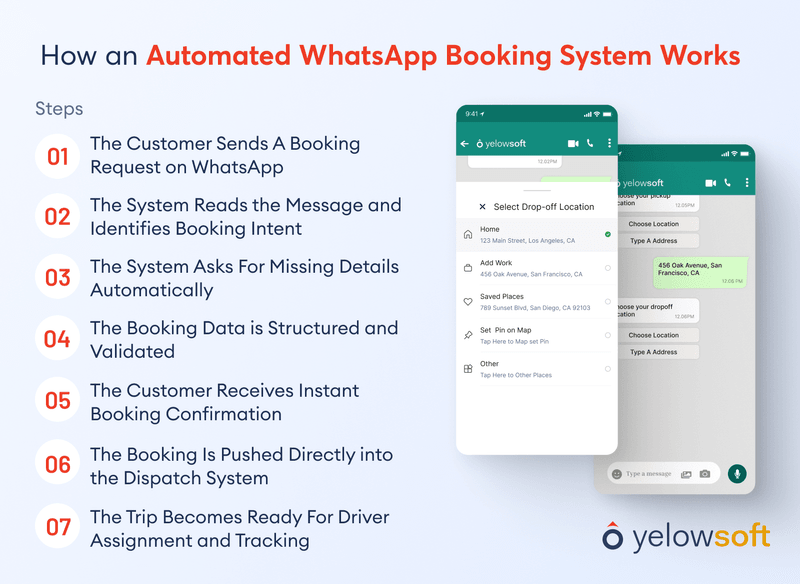
Step 1: The Customer Sends A Booking Request on WhatsApp
The process starts with a simple message. The customer may type something like:
-
I need a taxi from Airport Road to Downtown at 6 PM
-
Book a cab for tomorrow morning
-
Need pickup from hotel to office
At this stage, the message is only a request. It may contain full details, partial details, or unclear information.
Step 2: The System Reads the Message and Identifies Booking Intent
This is where AI WhatsApp chatbot taxi booking becomes important.
Instead of waiting for a staff member to read and interpret the message, the system detects that the customer wants to make a booking. It then identifies the key information already available in the chat, such as:
-
Pickup location
-
Drop location
-
Date
-
Time
-
Trip request intent
This step matters because it removes the first layer of manual effort.
Step 3: The System Asks For Missing Details Automatically
Most customer messages are incomplete. They may mention only the pickup point or only the time.
A proper WhatsApp chatbot for taxi booking does not stop there. It continues the conversation by asking only for the missing details needed to complete the trip request. For example:
-
What is your drop location?
-
What time do you need the ride?
-
Is this booking for now or later?
This creates a guided flow. The customer does not need to guess what information to send. The system collects it in the right order.
👉 This is the point where chat starts becoming a booking process instead of an open-ended conversation.
Step 4: The Booking Data is Structured and Validated
Once all required details are collected, the system organizes them into a clear booking format.
Instead of leaving information inside a chat thread, it converts it into structured trip data such as:
-
Customer name
-
Pickup point
-
Drop point
-
Scheduled date and time
-
Booking source
-
Fare logic or pricing conditions
Validation also happens here. That means the system checks whether the booking has the minimum required details to move forward.
This is one of the biggest differences between manual chat handling and taxi booking automation. In a manual flow, staff may confirm a ride even when details are unclear. In an automated flow, incomplete or invalid requests are identified before dispatch is affected.
Step 5: The Customer Receives Instant Booking Confirmation
After the trip details are captured and validated, the system sends a confirmation message on WhatsApp.
This confirmation can include:
-
Booking accepted
-
Pickup and drop details
-
Scheduled time
-
Next step or dispatch status
For the customer, this creates confidence. They know their request was not just seen, but actually recorded as a confirmed booking.
For your business, this improves conversion because the customer receives a response immediately instead of waiting for staff availability. This is one of the strongest ways to increase taxi bookings with WhatsApp.
Step 6: The Booking Is Pushed Directly into the Dispatch System
This is where the real operational value appears.
With proper WhatsApp ride booking integration, the confirmed booking does not stay inside WhatsApp. It moves directly into your central booking and dispatch system.
That means:
-
Dispatchers see a ready-to-assign trip
-
Trip details are already complete
-
No one needs to copy data manually from chat to software
-
Assignment can happen faster
This step removes the common gap between customer communication and backend operations.
Step 7: The Trip Becomes Ready For Driver Assignment and Tracking
Once the trip enters the dispatch system, it becomes part of your normal workflow. Depending on your setup, the trip can then:
-
Enter an automated dispatching workflow
-
Be assigned by a dispatcher
-
Reach the assigned driver through the driver app
-
Be tracked in real time
-
Trigger driver alerts and passenger notifications
At this point, WhatsApp has done its job as an input channel, and your taxi system takes over for execution.
👉 This is the real meaning of taxi booking via WhatsApp in a modern setup. The chat starts the process, but the system controls the outcome.
Key Benefits for Taxi Operators Using Automated WhatsApp Booking
Here’s how automated WhatsApp booking benefits taxi operators like you:
Faster booking confirmations: Customers receive instant responses instead of waiting for manual replies. This reduces drop-offs and improves trust in your service.
Reduced booking errors: Structured inputs ensure that pickup, drop, and timing details are captured correctly. This minimizes confusion and avoids costly mistakes.
Improved dispatcher efficiency: Dispatchers receive complete, ready-to-assign trips without follow-ups. This allows them to focus on allocation instead of clarification.
Higher booking conversion rates: Every message is guided toward completion, which reduces missed opportunities. This helps you consistently increase taxi bookings with WhatsApp.
Ability to handle higher booking volume: The system manages multiple requests at the same time without delays. This makes it easier to scale operations without adding more staff.
Final Thoughts
WhatsApp already brings you booking requests. The real challenge is turning those messages into confirmed trips without delay or confusion.
When handled manually, chats stay unstructured, details get missed, and dispatch depends on follow-ups. This limits your ability to scale and affects conversion.
With WhatsApp taxi booking software, every message is captured, structured, and converted into a ready-to-assign booking. You move from reacting to chats to controlling your booking flow.
Yelowsoft’s WhatsApp booking software connects this entire process end to end.
It captures booking details directly from chat, validates them, and pushes each trip into your dispatch system without manual effort.
And your team gets complete visibility, faster assignments, and consistent booking execution, so every WhatsApp message turns into a reliable business opportunity.
Turn every WhatsApp message into confirmed bookings with Yelowsoft and scale your taxi operations faster
FAQs
Yes. With WhatsApp taxi booking software, messages are captured, required details are collected, and bookings are created automatically. This removes manual steps and ensures every request becomes a structured, trackable trip.
No. Customers can book directly through WhatsApp without installing any app. The system handles the process in the background, making taxi booking via WhatsApp simple and accessible for all users.
An AI WhatsApp chatbot taxi booking system collects required trip details step by step. It ensures pickup, drop, and timing are captured correctly, reducing errors and improving overall booking accuracy.
Yes. With proper WhatsApp ride booking integration, bookings created from chat are sent directly to the dispatch system. This allows faster driver assignment without manual data entry or delays.
Automation handles message responses, data collection, and booking creation. This helps reduce call center load taxi business and allows your team to focus on dispatch and operations instead of managing chats.
Yes. When connected to configured fare rules, the system can calculate and share an estimated fare based on pickup, destination, distance, time, vehicle type, and applicable pricing conditions.
Yes. Customers can provide their preferred date and time through WhatsApp. The system validates the details and creates a scheduled booking in the central booking and dispatch platform.
Yes. After driver assignment, the system can send ride status updates, driver details, estimated arrival information, and a live tracking link through WhatsApp, depending on the configured workflow.
Yes. Multilingual booking flows can be configured around the languages your business supports. Operators should test local terminology, addresses, accents, and regional booking phrases before launch.
Yes. Human takeover can be enabled for complex requests, customer questions, booking exceptions, or conversations the automated system cannot complete confidently.
The system identifies missing details and asks follow-up questions for information such as pickup, destination, date, or time. The booking is created only after the required information is validated.


