Choosing taxi software is not only about features. You also need to decide how you want to acquire, host, maintain, and scale the technology behind your operation.
With a one-time purchase model, you typically pay a larger upfront amount to acquire the software or agreed licensing rights and take greater responsibility for hosting, infrastructure, maintenance, upgrades, and technical management. Depending on the agreement, source-code access may also be included.
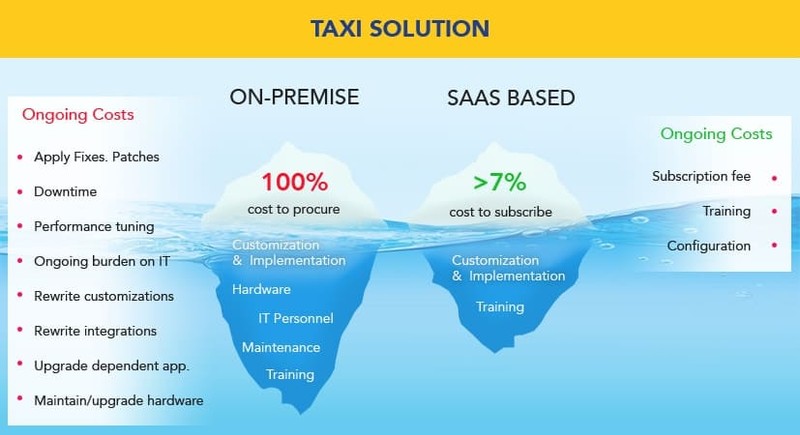
With SaaS taxi software, you subscribe to a cloud-hosted platform while the software provider manages much of the infrastructure, maintenance, security, and ongoing updates. Instead of maintaining the technology internally, your team can focus primarily on bookings, dispatch, drivers, vehicles, customers, and business operations.
Neither model is automatically right for every operator. Your best option depends on your fleet size, available technical resources, desired level of control, customization requirements, budget, integration needs, and growth plans. This comparison will help you understand the trade-offs before deciding.
One-Time Purchase vs SaaS Taxi Software at a Glance
| Feature | Third-Party Platform | YelowXpress White-Label Solution |
|---|---|---|
| Commission per order | 25%–35% | 0% |
| Customer data access | Not available | Full access to build loyalty |
| Branding | Aggregator’s brand | 100% yours |
| App Customization | Limited | Full control (multi-language, colors) |
| Integration with business tools | Paid feature or unavailable | Built-in + open API |
Upfront Cost vs Ongoing Cost

With SaaS taxi software, your technology cost is generally spread across setup and recurring subscription charges rather than concentrated into one large software-purchase payment.
This can make budgeting easier because you can evaluate your ongoing software expenditure against your operational volume and required capabilities. Infrastructure, maintenance, updates, and support may also be included within the SaaS relationship rather than managed separately by your internal team.
With a one-time purchase, the initial software investment is usually higher, but the more important calculation is the total cost of ownership.
If your business hosts the system itself, you may also need to budget for cloud or server infrastructure, backups, monitoring, technical staff, security, upgrades, and ongoing maintenance. For an organization with an established IT team, that additional responsibility may be acceptable in exchange for greater technical control.
Hosting, Deployment, and Time to Launch
SaaS platforms are usually already hosted and operational, so much of the core infrastructure does not need to be built or deployed by your internal team. Configuration, branding, integrations, data migration, testing, and app setup may still be required, but the underlying platform is already available.
A one-time or self-managed deployment can provide greater infrastructure control, but your organization may need to provision servers, configure environments, establish monitoring and backup processes, test deployment, and maintain the production system.
The right choice therefore depends partly on whether your business wants to operate the technology itself or concentrate its resources on transportation operations.

Recurring Costs and Long-Term Budgeting
A SaaS model gives you recurring software costs, which can make technology expenditure easier to forecast. However, you should evaluate the full subscription structure, including setup charges, usage limits, optional applications, integrations, additional services, and any costs that may change as your operation grows.
With a one-time purchase, recurring licence charges may be lower or absent depending on the agreement, but infrastructure and ownership costs do not disappear. Hosting, IT staffing, security, maintenance, third-party services, integrations, and future upgrades can become separate operating expenses.
Upgrades, Security, and Technical Responsibility
In a SaaS model, the vendor generally manages the application infrastructure, platform maintenance, software updates, backups, monitoring, and much of the security responsibility. Your business still needs appropriate account controls, operational policies, and user access management, but it does not have to maintain the complete technology stack internally.
With a self-hosted or one-time-purchase model, more of that responsibility can shift to your organization. Your technical team may need to manage infrastructure security, software deployment, backups, monitoring, vulnerability management, disaster recovery, and update testing.
Our cloud-based taxi software is securer than any enterprise--YelowSoft

Security should therefore be evaluated according to responsibility rather than assuming that either deployment model is automatically safer. Ask who controls access, where data is stored, how backups are handled, how incidents are managed, what security controls are provided, and how easily you can access or export your business data.

The practical question is whether maintaining transportation software infrastructure is a capability your organization wants to build internally or a responsibility you would rather assign to a specialist software provider.
Support should also be evaluated before choosing either model, including response channels, implementation assistance, troubleshooting, training, and ongoing product guidance.
Integrations and Scalability
Integrations matter because taxi businesses increasingly connect dispatch software with payment gateways, maps, communication providers, accounting systems, aggregators, corporate systems, and other operational tools.
With SaaS software, existing APIs and supported integrations can reduce the amount of custom development your technical team needs to maintain.
A source-code or self-managed solution may offer greater freedom to build highly specific integrations, but your organization also assumes responsibility for developing, testing, monitoring, and maintaining those connections as third-party systems change.
When you scale the taxi dispatch solution, you don’t have to buy new server capacity and software licenses. You just have to upgrade your subscription package.
Access and Operational Flexibility
Cloud-based software can give authorized teams access to transportation operations without requiring them to work from the same physical office or local server environment.
Dispatchers and administrators can manage bookings, monitor trips, and review operational information through connected interfaces, while drivers use their designated applications in the field.
Self-hosted systems can also provide remote access, but your organization may be responsible for configuring and maintaining the infrastructure, security, networking, availability, and remote-access controls required to support it.
Which Taxi Software Model Fits Your Business?
A one-time purchase can make sense when your organization has strong internal technical resources, wants greater infrastructure or source-code control, needs highly specialized development, and is prepared to manage hosting, security, maintenance, integrations, and future upgrades.
SaaS taxi software can be better suited to operators that want to reduce internal technical responsibility, spread software costs over time, receive ongoing platform updates, use vendor-managed infrastructure, and scale operations without maintaining the underlying software environment themselves.
Fleet size alone should not determine the decision. A technically mature 30-vehicle operator may value infrastructure control, while a 500-vehicle business may prefer vendor-managed SaaS because it does not want transportation software maintenance to become an internal IT function.
Before choosing either model, compare the total cost of ownership, control, technical responsibility, security, customization, integration requirements, scalability, support, and data ownership rather than simply comparing a one-time licence fee with a monthly subscription.
Conclusion
The difference between one-time purchase and SaaS taxi software goes far beyond when you pay for the system. You are deciding who will be responsible for hosting, infrastructure, security, updates, integrations, technical maintenance, scalability, and long-term platform development.
If your organization has the technical resources and strategic need to control more of the software environment, a one-time or self-managed model may be worth evaluating. If you would rather keep your team focused on transportation operations while the platform provider manages much of the underlying technology, SaaS can offer a more practical operating model.
Compare the complete operational responsibility and total cost of ownership before making the decision—not simply the upfront price.
Choose the Right Taxi Software Model With Yelowsoft
FAQ's
A one-time purchase usually requires higher upfront investment and more technical responsibility. SaaS taxi software uses recurring fees while the vendor typically manages hosting, updates, and maintenance.
Yes. Even without recurring licence fees, you may still pay for hosting, servers, backups, security, maintenance, technical staff, integrations, and future software upgrades.
Usually not. In most SaaS models, the vendor owns the source code and you pay to use the platform. Source-code access depends on the licensing agreement and should be confirmed before purchase.
The SaaS provider usually manages hosting, infrastructure, backups, and platform availability. With self-hosted software, your business or technical team normally manages these responsibilities.
Usually, yes. SaaS providers generally manage platform updates and maintenance as part of the service. With self-managed software, your team may need to test, deploy, and maintain upgrades.
One-time or source-code-based software can provide greater development control. SaaS platforms can still support branding, configurations, APIs, integrations, and custom features within the vendor’s architecture.
Not automatically. Security depends on infrastructure, access controls, monitoring, backups, patching, policies, and who manages them. Operators should evaluate each provider’s actual security practices.
Data ownership depends on the provider’s terms. Confirm who owns booking, customer, driver, and operational data, where it is stored, and whether you can export it if you change software providers.
Yes, if data export, integrations, contracts, or migration options are restrictive. Before choosing a provider, review data portability, APIs, contract terms, export options, and migration support.
Often, yes. SaaS can reduce the need for internal IT infrastructure and maintenance. However, the right model depends on your budget, technical resources, customization needs, and expected growth.
Either model can work. Enterprises should compare scalability, integrations, security, support, SLAs, customization, data control, internal IT resources, and total cost of ownership before deciding.
Compare upfront and recurring costs, hosting, source-code access, upgrades, security, support, customization, integrations, scalability, data ownership, and internal technical responsibility.


