Running a taxi business manually creates small operational gaps that quickly turn into lost revenue. Phone bookings may be entered late, drivers can remain idle while rides wait for assignment, passengers receive delayed updates, and payment or fare records may require repeated checking.
The problem becomes worse as booking volume grows. Your dispatchers must coordinate customers, drivers, scheduled rides, cancellations, pricing, payments, and service issues across different calls, messages, spreadsheets, and systems.
Taxi dispatch software connects these workflows and automates the repetitive decisions behind daily operations. It can capture bookings, assign suitable drivers, track live trips, apply fare rules, process payments, send passenger notifications, manage exceptions, and generate operational reports from one platform.
This guide explains how to automate your taxi business without removing the visibility and manual control your team still needs.
Where Manual Taxi Workflows Create Operational Gaps
A manual taxi workflow depends on people transferring information at every stage.
A customer calls or sends a message. A dispatcher records the booking, checks available drivers, contacts someone manually, confirms the assignment, updates the passenger, calculates the fare, and later verifies the payment and trip record.
That process may work when ride volume is low. It becomes unreliable when several bookings arrive together, drivers reject assignments, customers change pickup details, scheduled rides overlap, or a dispatcher needs to manage cancellations and delays.
The most common gaps include:
- Bookings being missed or entered incorrectly
- Slow driver assignment during busy periods
- Drivers remaining idle despite available demand
- Delayed passenger confirmations and trip updates
- Inconsistent fares, discounts, and waiting charges
- Payment records requiring manual reconciliation
- Limited visibility into active rides and fleet performance
- No structured fallback when a driver rejects or misses a ride
Automation connects these steps so your team can manage the complete trip lifecycle without rebuilding the workflow for every booking.
See What Taxi Automation Looks Like in Daily Operations
See how Yelowsoft automates booking intake, dispatch, driver coordination, passenger updates, and reporting while keeping your team in control.
Explore Taxi Automation
What Taxi Operations Can You Automate With Dispatch Software?
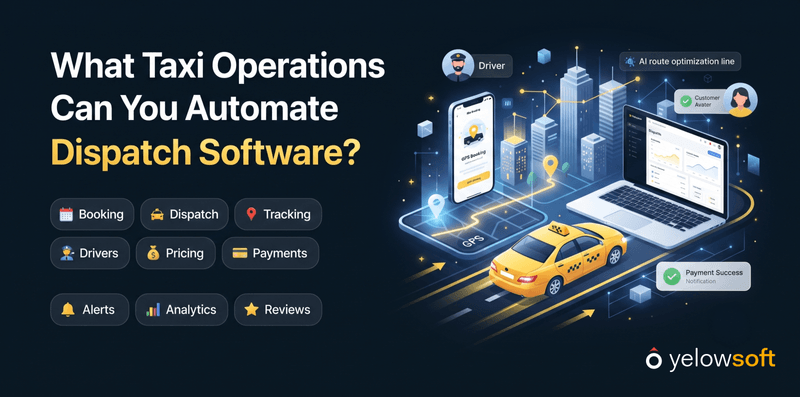
Taxi dispatch software can automate much more than ride assignment. It connects booking intake, dispatch, driver coordination, tracking, pricing, payments, notifications, reporting, and exception handling in one workflow.
Let’s look at them here:
1. Booking Intake and Ride Creation
Passengers may request rides through phone calls, websites, mobile apps, WhatsApp, email, kiosks, or corporate booking portals. Taxi booking software can bring these requests into one system, validate the trip details, and create structured bookings for dispatch.
2. Driver Assignment and Dispatch
Instead of checking drivers manually, the dispatch system can identify available drivers using location, vehicle type, service zone, schedule, and assignment rules. It can assign or broadcast the ride while allowing dispatchers to intervene when a priority trip or exception requires manual control.
3. Live Trip Tracking and Navigation
Live tracking allows dispatchers to see driver locations, accepted rides, arrival progress, pickups, active trips, and completed journeys. Drivers receive navigation support, while passengers can follow the approaching vehicle and receive clearer arrival information.
4. Driver Management and Coordination
Driver management tools provide visibility into availability, assignment history, acceptance, trip completion, earnings, and performance. This helps operators coordinate drivers more consistently, reduce idle time, investigate service problems, and make better fleet decisions.
5. Fare and Pricing Management
Taxi operators can configure base fares, distance and time charges, service zones, vehicle categories, waiting fees, discounts, and other pricing rules. The fare management system applies the relevant fare logic consistently, reducing manual calculations and pricing disputes.
6. Payments and Transaction Records
Payment integrations allow passengers or account customers to pay through supported digital methods while keeping the transaction connected to the booking. This reduces separate payment follow-ups and gives operators clearer trip-level payment records.
7. Passenger and Driver Notifications
Automated notifications can keep passengers and drivers informed when a booking is confirmed, a ride is assigned, the driver is approaching, trip details change, or the journey is completed. Timely communication reduces unnecessary calls to the dispatch team.
8. Reporting and Operational Analytics
Instead of manually combining booking, driver, fare, and payment records, operators can review ride volume, cancellations, revenue, driver activity, booking sources, and fleet performance through structured reports and dashboards.
9. Customer Feedback and Service Quality
No one can tell you how good your services are other than your customers and it is, in fact, the Digital ratings and feedback help operators identify pickup issues, driver behaviour problems, fare disputes, and service inconsistencies.
Instead of relying only on repeat customers or individual complaints, your team gains structured feedback connected to completed trips.
What Happens When Taxi Operations Stay Manual?
Well, when it comes to not having a taxi dispatch solution then you are losing so much. Let’s see what those are:
1. Limited Operational Visibility
How do you think your customers will find you or even book a taxi if they don’t even know that you exist? More visibility comes when your customers leave a feedback about your business.
2. Disconnected Booking and Dispatch Workflows
It ain’t an easy task to run business operations, especially for a taxi company. Functions like which driver picks which customer, maintaining a complete record of how many taxis and which ones are available, etc. need to be done manually in a traditional software.
3. Slower Booking Confirmation and Driver Assignment
Let’s imagine, a customer has to go to the airport and calls you for the same. You check which taxis are available at the customers’ pickup location.
Once you confirm to the customer that the nearest driver and taxi are available, then you get in touch with your driver via radio and let him know the customer details and then he/she goes to pick the passenger. Now, this whole process at least takes a good 20 minutes.
4. Revenue Leakage and Payment Delays
Manual fares, waiting charges, discounts, commissions and payment records create more opportunities for errors and delayed reconciliation.
5. Weak Exception Management
When a driver rejects a booking, arrives late, or becomes unavailable, the team must notice and solve the problem manually. Without defined alerts and fallback rules, rides can remain unresolved.
Automate the Work That Slows Your Taxi Business Down
Bring booking intake, dispatch, driver coordination, live tracking, fare management, payments, notifications, and reporting into one connected operating workflow.
Book a Tailored Demo
FAQs
Taxi business automation uses connected software to manage repetitive workflows such as booking intake, driver assignment, trip tracking, fare calculation, notifications, payments, and reporting.
Operators can automate booking creation, dispatch, driver matching, passenger updates, fare rules, payment records, reporting, and fallback actions when trips are rejected or delayed.
Small fleets can benefit when manual bookings, driver coordination, missed calls, or reporting consume too much time. The decision should depend on ride volume and workflow complexity, not fleet size alone.
Manual dispatch requires a person to review and assign each ride. Automated dispatch uses configured rules and live driver data to recommend, assign, or broadcast rides more quickly.
No. It reduces repetitive allocation work while allowing dispatchers to monitor rides, override assignments, manage priority bookings, and intervene when exceptions require human judgement.
Implementation depends on fleet size, required applications, booking channels, integrations, data migration, configuration, and training. The provider should confirm the rollout plan after reviewing the operational scope.
Drivers normally need onboarding for accepting rides, updating trip statuses, using navigation, communicating with dispatch, and reviewing earnings. Clear workflows and practical training improve adoption.
Yes. A well-configured system allows dispatchers to manually assign, reassign, cancel, prioritise, or manage rides while automation handles routine workflows and alerts.


