A passenger books a ride expecting a quick pickup. Instead, they spend the next ten minutes checking their phone, wondering where the driver is.
Five minutes later, they call your dispatch team for an update. Another few minutes pass before a driver is finally assigned.
By the time the vehicle arrives, the passenger is already frustrated.
Most taxi operators assume situations like this happen because of traffic, driver shortages, or peak demand. While those factors can contribute, they are often not the real problem. In many cases, longer passenger wait times begin with poor dispatching.
Every ride depends on how quickly your business can receive a booking, identify the right driver, assign the trip, and communicate effectively. When any part of that process slows down, your passengers wait longer.
The consequences extend far beyond a delayed pickup. Longer wait times can increase cancellations, damage customer trust, reduce driver productivity, and limit business growth.
In this article, you'll learn how poor dispatching affects passenger wait times, why it creates hidden operational costs, and what successful taxi operators do to deliver faster, more reliable service.
What Does Dispatching Actually Mean in a Modern Taxi Business?
Dispatching in a modern taxi business is the process of receiving bookings, assigning the most suitable driver, monitoring ride progress, managing driver availability, and ensuring passengers are picked up efficiently and on time.
It acts as the operational bridge between booking creation and trip completion. Let's explore what else dispatching in the modern taxi business implies:
Dispatching Is More Than Assigning Rides
Many operators think dispatching starts and ends with assigning a booking to a driver. In reality, dispatching controls nearly every stage between booking creation and passenger pickup.
A dispatch process typically includes:
-
Receiving bookings
-
Verifying ride details
-
Monitoring driver availability
-
Allocating rides
-
Managing schedules
-
Handling cancellations
-
Communicating with drivers
Every one of these activities directly affects how quickly a passenger gets picked up.
Why Dispatching Has Become More Complex
Years ago, most bookings arrived through phone calls.
Today, bookings may come from:
-
Websites
-
Airport partners
At the same time, operators are handling scheduled bookings, airport transfers, corporate rides, and on demand requests.
As booking volumes and ride types increase, dispatching becomes significantly more complex. And that complexity often exposes weaknesses in manual processes.
Why Passenger Wait Times Matter More Than You Think
Many operators view wait times as a customer service issue. The reality is far bigger than that. Let's explore here:
Passengers Judge Your Entire Service by Pickup Speed
Most passengers do not understand how dispatching works. They do not know whether a dispatcher is overloaded or whether a driver missed a notification.
They only know one thing:
"How long did I wait?"
A delayed pickup often creates the impression that the entire service is unreliable.
Longer Wait Times Reduce Repeat Bookings
Customer loyalty is difficult to earn and easy to lose. When passengers experience repeated delays, they start exploring alternatives.
Even if your pricing is competitive, customers often prioritize reliability over cost.
This is especially true for:
-
Airport travelers
-
Corporate passengers
-
Daily commuters
Delays Affect Online Reputation
Online reviews frequently mention:
-
Pickup speed
-
Arrival accuracy
-
Reliability
A passenger who waits too long may leave a negative review even if the actual journey goes smoothly.
Expert Tip:
Most passengers do not remember the dispatch process. They remember how quickly a vehicle arrived.
5 Ways Poor Dispatching Creates Longer Passenger Wait Times
If passengers consistently wait longer than expected, the cause often lies somewhere within the dispatch process. Let's explore the five ways poor dispatching leads to longer wait times for passengers:
Slow Driver Assignment
Every minute between booking creation and driver assignment increases passenger wait time. In many businesses, dispatchers manually review available drivers before allocating rides.
This process may work when demand is low. However, during busy periods, manual allocation creates bottlenecks that automated dispatching can help eliminate by matching bookings with suitable available drivers faster.
-
Bookings remain in queues.
-
Drivers remain idle.
-
Passengers continue waiting.
What appears to be a driver shortage is often an assignment delay.
Limited Visibility Into Driver Availability
Imagine a driver is only two minutes away from the passenger.
If your dispatcher cannot see that information in real time, the booking may be assigned to someone much farther away.
The result is simple:
-
Longer pickup times
-
Poor driver utilization
-
Lower customer satisfaction
Real time visibility, supported by effective driver management, is one of the most important elements of efficient dispatching because it helps operators understand driver location, availability, and current workload.
Incorrect Ride Allocation
Not every available driver is the best driver for a booking.
Poor allocation decisions can occur when dispatchers lack information about:
-
Driver location
-
Current route
-
Traffic conditions
-
Vehicle suitability
Assigning the wrong driver increases travel time before pickup and creates unnecessary delays.
Communication Delays
Communication breakdowns can quickly disrupt operations.
Common examples include:
-
Drivers missing notifications
-
Delayed ride acceptance
-
Unclear booking details
-
Missed status updates
Every communication gap creates friction.
And every delay adds additional waiting time for passengers.
Inability to Handle Demand Surges
Demand does not remain constant throughout the day.
Most operators experience spikes during:
-
Morning rush hours
-
Evening commutes
-
Airport arrivals
-
Concerts
-
Sporting events
Without efficient dispatch processes, booking requests accumulate faster than rides can be assigned. Heat maps help operators identify high-demand areas and position available drivers closer to where bookings are likely to increase.
Passengers experience longer waits precisely when service reliability matters most.
Reduce the Assignment Delays Behind Longer Passenger Wait Times
See how Yelowsoft helps you automate ride allocation, improve driver visibility, and respond faster when booking demand increases.
See How Smarter Dispatching Improves Pickups
Where Dispatch Delays Create the Biggest Problems
Not all bookings carry the same level of urgency. Certain ride categories are especially vulnerable to dispatch inefficiencies. Let's understand that in this section:
Airport Transfers
Airport passengers often operate on strict schedules. And a delayed pickup can lead to missed flights, passenger complaints, and refund requests.
Hence, airport transfers leave very little room for operational mistakes.
Corporate Transportation
Business travellers value punctuality. A late pickup may cause missed meetings, delayed events, and reduced confidence in the service provider.
Corporate accounts often judge providers based on reliability rather than price alone.
Peak Demand Periods
High demand exposes dispatch weaknesses faster than any other situation. And during busy periods, assignment times increase, dispatch workloads rise, and passenger expectations remain unchanged.
Without efficient processes, delays become unavoidable.
Multi-Zone Operations
Operators serving multiple areas face additional challenges because drivers may be unevenly distributed across service zones. A structured zone management system helps operators define service areas, apply location-based rules, and coordinate driver coverage more effectively.
Poor visibility can result in:
-
Overserved areas
-
Underserved areas
-
Longer pickup routes
Scheduled Bookings
Scheduled rides require planning. When driver allocation occurs too late, passengers may experience delays despite booking in advance. That often leads to frustration because expectations are higher for pre-booked rides.
The Hidden Cost of Longer Passenger Wait Times
Passenger delays create operational consequences that many operators underestimate. They are:
More Ride Cancellations
Passengers have options. If estimated arrival times continue increasing, many choose to cancel and book elsewhere. And each cancellation represents lost revenue.
Lower Customer Retention
Acquiring new customers is expensive. But losing existing customers because of poor service is even more costly.
Long wait times often reduce customer lifetime value by discouraging repeat bookings.
Reduced Driver Productivity
Poor dispatching does not only affect passengers. Drivers also suffer.
Common issues include:
-
Idle time
-
Empty mileage
-
Inefficient routes
This results in lower earning potential and reduced productivity.
Lower Fleet Utilization
A fleet generates revenue only when vehicles are completing rides. Long assignment delays reduce overall utilisation, leaving vehicles idle instead of generating income. Improving dispatch decisions is therefore central to achieving better fleet efficiency with AI-powered taxi dispatch.
Revenue Loss
The financial impact becomes significant over time.
Dispatch Issue Passenger Impact Business Impact Slow assignment Longer wait times More cancellations Poor visibility Delayed pickups Lower productivity Communication gaps Missed updates Customer dissatisfaction Demand surges Extended ETAs Lost bookings Wrong allocation Longer routes Reduced utilization.
When Manual Dispatching Starts Limiting Growth
Many operators do not notice dispatch problems until growth begins exposing them. Here are the clear signs of that:
Signs Your Dispatch Process Needs Improvement
You may be experiencing dispatch bottlenecks if you notice:
-
Rising customer complaints
-
Increasing cancellations
-
Longer pickup times
-
Dispatcher overload
-
Driver dissatisfaction
These indicators often appear long before revenue declines become visible.
Growth Makes Existing Problems More Visible
A process that works for ten drivers may fail completely at fifty.
As your fleet grows:
-
More bookings arrive
-
More drivers require coordination
-
More decisions must be made quickly
And manual systems struggle to scale under these conditions.
Expert Tip:
Growth rarely creates operational problems. Growth exposes the problems that already exist.
How Modern Taxi Operators Reduce Passenger Wait Times
The good news is that most wait time problems can be improved. Leading operators focus on dispatch efficiency before they focus on increasing booking volume. Here's how:
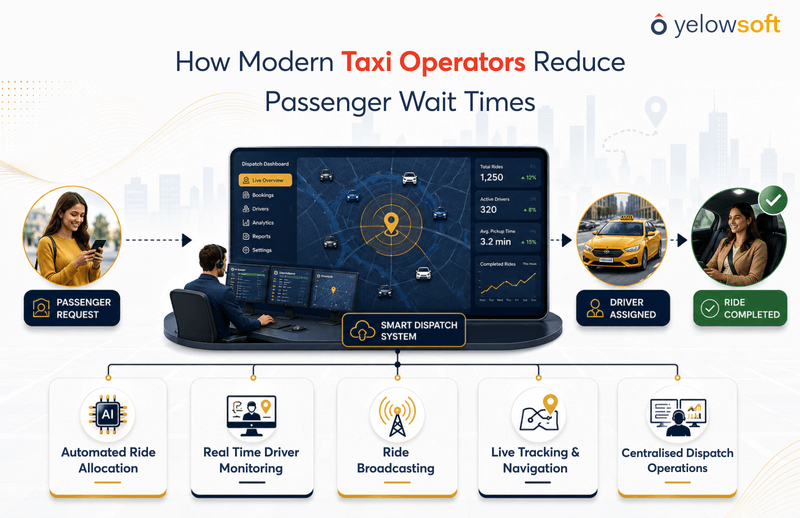
Automated Ride Allocation
Automated allocation reduces the time between booking creation and driver assignment.
Instead of relying entirely on manual decisions, bookings can be matched based on predefined criteria. This helps reduce delays and improve consistency.
Real Time Driver Monitoring
Knowing exactly where drivers are located improves decision making. Live tracking and navigation give operators real time visibility into driver movement, helping them assign rides more accurately and respond faster when traffic or route issues arise.
Ride Broadcasting
Ride broadcasting allows multiple eligible drivers to receive booking requests simultaneously. This often reduces assignment delays and speeds up driver acceptance.
Live Tracking and Navigation
Live visibility helps operators identify:
-
Traffic issues
-
Route inefficiencies
-
Driver delays
Faster adjustments lead to better pickup performance.
Centralised Dispatch Operations
Managing bookings, drivers, and vehicles through a single platform reduces operational complexity and improves coordination.
Expert Tip:
Faster pickups are rarely achieved by adding more drivers. They are usually achieved by improving how rides are assigned and managed.
Key Metrics You Should Track
Improvement starts with measurement. Track these metrics consistently:
Average Driver Assignment Time: How quickly rides are allocated.
Average Passenger Wait Time: How long passengers wait after booking.
Ride Acceptance Rate: How quickly drivers accept bookings.
Cancellation Rate: How often rides are cancelled before pickup.
Driver Utilization Rate: How effectively drivers spend time on revenue-generating activities.
Pickup Accuracy: How often vehicles arrive within expected timeframes.
Monitoring these metrics helps you identify inefficiencies before they affect customers.
Conclusion
Passenger wait times are far more than a customer service metric. They are often a direct reflection of how efficiently your dispatch operation functions. When rides are assigned slowly, drivers are allocated inefficiently, or communication breaks down, passengers feel the impact immediately.
Over time, these delays can lead to cancellations, negative reviews, lower customer retention, reduced driver productivity, and missed revenue opportunities.
The good news is that most wait-time challenges are preventable. By improving driver visibility, streamlining ride allocation, monitoring key performance metrics, and reducing manual bottlenecks, you can create a faster and more reliable pickup experience.
As customer expectations continue to rise, efficient dispatching is no longer optional. It has become a critical part of delivering consistent service and supporting long term business growth.
If your operation is struggling with delayed pickups or growing dispatch complexity, Yelowsoft's taxi dispatch software can help.
With automated dispatching, ride broadcasting, real-time driver tracking, multi-channel booking management, and intelligent ride allocation, Yelowsoft enables you to reduce passenger wait times, improve operational efficiency, and deliver a better experience for both passengers and drivers.
Passenger Wait Times Rising? Fix the Dispatching Problem Behind Them
Reduce delayed pickups, prevent cancellations, and improve customer satisfaction with Yelowsoft's intelligent taxi dispatch platform.
Reduce Passenger Wait Times Now
Frequently Asked Questions
Long wait times are commonly caused by slow ride allocation, poor driver visibility, communication delays, and inefficient dispatch processes.
Dispatching influences pickup speed, reliability, and overall passenger experience, making it one of the most important operational functions.
Manual systems require human intervention for every assignment, which becomes increasingly difficult as booking volumes grow.
Yes. Faster ride assignment and more accurate pickups often reduce customer frustration and cancellation rates.
Absolutely. Accurate visibility into driver availability helps operators allocate rides more efficiently.
Ride broadcasting speeds up driver acceptance by notifying multiple eligible drivers simultaneously.


