If your taxi business is growing but profits are not increasing at the same pace, the problem may not be your fleet size. It may be how efficiently your fleet operates.
Many taxi operators assume that adding more vehicles or drivers will automatically increase revenue. In reality, growth comes from maximizing the performance of the resources you already have.
When drivers spend too much time waiting for rides, vehicles remain underutilized, and dispatchers struggle to assign bookings quickly, efficiency drops and profitability suffers.
This is where an AI powered taxi dispatch system becomes valuable. It analyzes booking demand, driver availability, traffic conditions, and vehicle locations to support faster, more efficient ride allocation.
In this guide, you will learn how AI driven dispatching reduces idle time, improves vehicle utilization, supports driver productivity, and helps taxi operators complete more trips with their existing fleet.
What Does Fleet Efficiency Mean in a Modern Taxi Business?
Before exploring AI powered dispatching, it is important to understand what fleet efficiency actually means and why it directly affects your bottom line.
Fleet Efficiency Is About Getting More From What You Already Have
Many operators measure success by the number of vehicles they own. However, owning more vehicles does not automatically make your business more efficient.
Fleet efficiency means maximizing the value generated by every vehicle and driver in your operation.
A highly efficient fleet helps you:
-
Complete more trips per day
-
Reduce vehicle downtime
-
Improve driver productivity
-
Deliver faster service to customers
The goal is not simply to increase fleet size. The goal is to make every vehicle work harder and smarter.
Key Metrics That Measure Fleet Efficiency
Several performance indicators help determine how efficiently your fleet operates.
| Metric | Why It Matters |
|---|---|
| Vehicle Utilization | Shows how often vehicles generate revenue |
| Driver Utilization | Measures driver productivity |
| Idle Time | Reveals wasted earning opportunities |
| Pickup Time | Impacts customer satisfaction |
| Trips Per Vehicle | Indicates operational efficiency |
| Fuel Consumption | Affects profitability |
Monitoring these metrics regularly helps identify areas where improvements can be made.
Why Fleet Efficiency Directly Impacts Revenue
Every minute a vehicle sits idle represents lost revenue potential.
When your fleet operates efficiently:
-
Drivers spend more time completing trips
-
Customers wait less time for pickups
-
More bookings are completed successfully
-
Fuel costs are optimized
-
Revenue per vehicle increases
This is why successful taxi operators focus on efficiency before expanding their fleets.
Expert Tip:
Before investing in additional vehicles, evaluate your current fleet utilization rate. Many operators discover hidden capacity within their existing fleet.
Why Many Taxi Fleets Struggle With Efficiency
Now that you understand the importance of fleet efficiency, let's examine why so many taxi businesses struggle to achieve it.
Manual Dispatching Creates Operational Bottlenecks
Manual dispatching often works when booking volumes are low. As demand grows, however, dispatchers face increasing pressure.
Common challenges include:
-
Delayed ride assignments
-
Human error
-
Inconsistent decision making
-
Difficulty handling peak demand
The result is slower operations, missed opportunities, and longer passenger wait times caused by poor dispatching.
Drivers Often Spend Too Much Time Waiting
Idle drivers reduce productivity and profitability.
This happens when:
-
Ride assignments are delayed
-
Drivers gather in low demand areas
-
Dispatchers cannot balance demand effectively
Even a small increase in idle time can significantly impact revenue over time.
Poor Driver Distribution Reduces Coverage
Many fleets experience driver clustering. You may have too many drivers waiting in one area while another area experiences high demand.
This imbalance leads to:
-
Longer customer wait times
-
Lower trip completion rates
-
Missed booking opportunities
Zone management can further improve coverage by allowing operators to define service areas, configure location-specific operating rules, and control how rides are assigned across different demand zones.
Limited Real Time Visibility Hurts Decision Making
Without accurate visibility into vehicle locations and availability, dispatchers are forced to make decisions based on incomplete information.
This often leads to:
-
Inefficient assignments
-
Longer pickup times
-
Reduced operational control
What Is an AI Powered Taxi Dispatch System?
Understanding the limitations of traditional dispatching makes it easier to see why AI powered systems have become increasingly important.
How AI Dispatching Works
Modern taxi dispatch software uses real time operational data and intelligent allocation rules to automate ride assignment and coordinate drivers, vehicles, bookings, and dispatchers from one platform.
Instead of relying entirely on human judgment, the system evaluates multiple factors instantly, including:
-
Driver location
-
Vehicle availability
-
Traffic conditions
-
Estimated arrival times
-
Service requirements
The system then assigns the ride to the most suitable driver.
Traditional Dispatch vs AI Dispatch
Traditional DispatchAI Powered DispatchManual decision makingAutomated allocationSlower assignment speedReal time assignmentReactive approachPredictive approachHuman dependentData drivenLimited scalabilityHighly scalable
This shift allows operators to manage larger fleets more efficiently.
Why AI Is Different
AI does not simply automate dispatching.
It continuously learns from operational patterns and helps optimize fleet performance over time.
This creates a smarter and more adaptive operation.
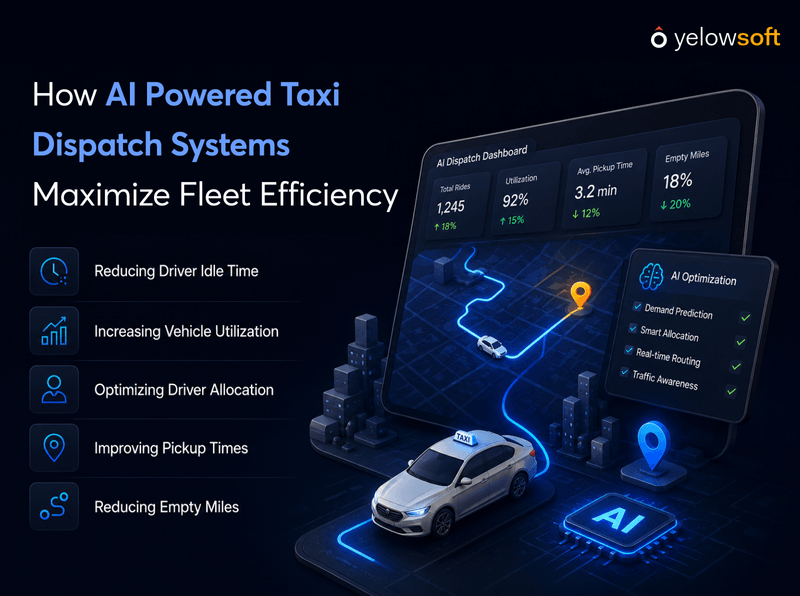
How AI Powered Taxi Dispatch Systems Maximize Fleet Efficiency
This is where AI begins delivering measurable business results. Here’s how AI powered taxi dispatch systems maximize fleet efficiency:
Reducing Driver Idle Time
One of the biggest benefits of AI dispatching is minimizing driver downtime.
The system continuously evaluates available bookings and drivers, helping assign rides faster.
Benefits include:
-
More active drivers
-
Higher productivity
-
Increased trip completion rates
When drivers spend less time waiting, they spend more time generating revenue.
Increasing Vehicle Utilization
Every vehicle represents an investment.
AI helps maximize that investment by keeping vehicles actively engaged in revenue generating activities.
Higher utilization means:
-
More trips per vehicle
-
Better return on assets
-
Improved profitability
Optimizing Driver Allocation
Assigning the closest available driver is only part of the equation.
AI also considers:
-
Driver availability
-
Current demand patterns
-
Future demand forecasts
-
Traffic conditions
This creates more balanced and efficient fleet coverage.
Improving Pickup Times
Customers expect fast service.
Long wait times often lead to dissatisfaction and lost business.
AI helps reduce pickup times by identifying the most suitable driver immediately.
Faster pickups improve:
-
Customer experience
-
Retention rates
-
Online reviews
Reducing Empty Miles
Empty miles occur when vehicles travel without passengers.
These journeys increase fuel costs without generating revenue.
AI minimizes empty miles by:
-
Optimizing assignments
-
Improving driver positioning
-
Predicting demand hotspots
This helps improve both efficiency and profitability.
Reduce Idle Time Without Expanding Your Fleet
See how Yelowsoft helps taxi operators assign rides faster, balance driver availability, reduce empty miles, and improve fleet utilization using real time dispatch automation.
See How Yelowsoft Improves Fleet Utilization
The Role of Predictive Demand Forecasting
The most advanced dispatch systems do not simply respond to bookings. They anticipate them.
How Demand Forecasting Works
AI analyzes historical operational data to identify booking patterns.
This includes:
-
Time of day
-
Day of week
-
Seasonal trends
-
Popular pickup locations
The system then predicts future demand.
Positioning Drivers Before Demand Increases
Imagine knowing where demand is likely to increase before bookings arrive. AI helps position drivers proactively.
Examples include:
-
Airport arrival periods and flight-related pickup demand
-
Morning commute hours
-
Weekend nightlife zones
-
Recurring employee travel and corporate booking peaks
This reduces response times and increases booking success rates.
Heat Maps Improve Fleet Coverage
Heat Maps visually display areas where demand is highest.
By using demand intelligence, you can:
-
Improve driver distribution
-
Reduce idle time
-
Increase completed trips
This creates a more efficient operation overall.
How AI Improves Driver Productivity
Fleet efficiency is impossible without productive drivers. Here's how AI improves driver productivity:
Fair Ride Distribution
Drivers want equal access to earning opportunities. AI helps distribute rides using objective criteria rather than manual preference.
This improves driver satisfaction, transparency, and retention.
More Earning Opportunities
Faster ride allocation and reduced downtime help drivers complete more trips. Higher productivity often translates into better earning potential.
Better Communication
Through a connected driver app, drivers receive real time ride assignments, route details, passenger information, booking updates, and trip status instructions without relying on repeated dispatcher calls.
Expert Tip:
Review driver utilization rates regularly. High performing fleets often focus on improving driver productivity before increasing fleet size.
Features to Look For in an AI Powered Taxi Dispatch System
Not all platforms offer the same capabilities. When evaluating solutions, focus on features that directly impact efficiency.
Essential features include:
Together, these capabilities help create a more intelligent and scalable operation.
When Should You Invest in AI Powered Dispatch Software?
Many operators wait until operational challenges become severe. The better approach is to recognize the warning signs early.
You should consider AI powered dispatching if you experience:
-
Frequent missed bookings
-
Long pickup times
-
Dispatcher overload
-
Increasing fleet size
-
Rising driver idle time
-
Poor fleet visibility
-
Difficulty scaling operations
The earlier you address these issues, the easier it becomes to maintain efficiency as your business grows.
Conclusion
Fleet efficiency has become one of the most important factors influencing profitability in the transportation industry.
The most successful taxi businesses are not always the ones with the largest fleets. They are the ones that maximize the performance of every vehicle and driver they already have.
An AI Powered Taxi Dispatch System helps you achieve that goal by reducing idle time, improving driver allocation, optimizing routes, forecasting demand, and increasing overall fleet utilization.
These improvements lead to faster service, better customer experiences, stronger driver productivity, and higher revenue potential.
As customer expectations continue to rise and competition becomes more intense, manual dispatching alone is often no longer enough. Modern operators need real time intelligence and automation to remain efficient and scalable.
If your goal is to complete more trips, reduce operational waste, improve driver productivity, and build a more profitable transportation business, Yelowsoft's taxi dispatch software is the solution.
It provides powerful capabilities such as automated dispatching, ride broadcasting, heat maps, fleet management, driver management, and reporting & analytics to help you maximize fleet efficiency and support long term growth.
Want to complete more trips without adding more vehicles?
See how Yelowsoft's AI Powered Taxi Dispatch Software helps you reduce driver idle time, improve fleet utilization, automate dispatching, and maximize revenue from your existing fleet.
Book Your Fleet Efficiency Demo
FAQs
Fleet efficiency in taxi operations refers to how effectively you use your vehicles and drivers to complete trips, reduce idle time, lower operating costs, and maximize revenue. Higher fleet efficiency means more trips completed with the same resources.
An AI powered taxi dispatch system improves fleet efficiency by automatically assigning the best available driver, reducing idle time, optimizing routes, balancing demand and supply, and increasing vehicle utilization to complete more trips efficiently.
Yes. AI dispatch software continuously analyzes driver availability and booking demand to assign rides faster. This reduces waiting time between trips, improves driver productivity, and helps increase revenue generated per driver.
An AI powered taxi dispatch system should include automated dispatching, ride broadcasting, real time tracking, heat maps, fleet management, driver management, demand forecasting, reporting, and analytics to maximize operational efficiency.
A taxi business should invest in AI dispatch software when it experiences frequent missed bookings, long pickup times, dispatcher overload, rising driver idle time, or challenges managing a growing fleet and increasing booking volume.
Fleet efficiency is measured using vehicle utilization, driver utilization, idle time, pickup time, trips per vehicle, empty miles, fuel consumption, booking acceptance, and revenue generated per vehicle.
No. AI handles routine ride allocation and analyzes real time data, while dispatchers manage exceptions, customer issues, special bookings, driver coordination, and operational decisions requiring human judgment.
AI taxi dispatch software may use driver location, vehicle availability, booking history, traffic conditions, estimated arrival times, service zones, ride requirements, demand patterns, and current trip status.
AI demand forecasting analyzes historical bookings, locations, time patterns, seasonal activity, events, and current operational data to predict where and when ride demand may increase.
Yes. Small fleets can use AI dispatch to reduce manual work, assign rides faster, lower driver idle time, improve coverage, and complete more bookings without immediately adding vehicles or dispatch staff.


