The transportation industry has changed significantly over the last decade. Customers no longer want to call a dispatcher, wait for confirmation, or wonder when their ride will arrive.
They expect instant booking, real time tracking, digital payments, and a seamless experience directly from their smartphones.
This shift has created a major opportunity for transportation businesses. According to Grand View Research, the global ride hailing market is projected to exceed $330 billion by 2030, driven by increasing smartphone adoption and growing demand for on demand transportation services.
If you are planning to launch a ride hailing startup, modernize an existing taxi business, or create your own branded transportation platform, building an e hailing app can help you compete more effectively in today's digital market.
In this guide, you will learn how an e hailing app works, the steps required to build one, the essential features every platform needs, common mistakes to avoid, and whether custom development or a ready made solution is the smarter path for your business.
Let’s get into it!
What Is an E-Hailing App?
Before discussing development, it is important to understand what an e hailing app actually does.
An e hailing app is a digital platform that connects passengers and drivers through mobile applications and a centralized management system. It allows customers to request rides, drivers to accept trips, and operators to manage the entire transportation process from one platform.
Unlike traditional taxi booking methods, e hailing platforms automate booking, dispatching, tracking, communication, and payments.
How Does an E-Hailing App Work?
A typical booking journey follows these steps:
-
Passenger requests a ride.
-
The system identifies nearby available drivers.
-
A driver accepts the booking.
-
Navigation and route guidance begin.
-
The trip is completed.
-
Payment is processed.
-
Ratings and feedback are collected.
This process happens within seconds, creating a faster and more reliable customer experience.
Who Should Build an E-Hailing App?
Not every transportation business has identical requirements. The right solution depends on your business model and growth goals.
Ride Hailing Startups
Entrepreneurs launching a new transportation brand often need a complete ecosystem including passenger apps, driver apps, dispatch management, and payment processing.
Taxi Companies Going Digital
Traditional taxi operators can use e hailing apps to replace manual bookings, dispatcher dependency, and outdated call center workflows.
Fleet Operators Building Their Own Brand
Businesses managing multiple vehicles may want a branded platform that gives them direct control over bookings, drivers, pricing, and customer relationships.
Regional Transportation Businesses
Local transport providers often use e hailing platforms to compete with larger mobility brands while maintaining control over their market and operations.
Expert Tip:
Many transportation businesses choose technology before defining how they plan to generate revenue. Decide whether your model relies on commissions, fixed fares, subscriptions, airport transfers, corporate accounts, or a combination of these before designing the platform.
Step-by-Step Process to Build an E-Hailing App
Building a successful e hailing platform involves much more than creating mobile screens. The foundation must support both operational efficiency and future growth.
Here’s the step by step process:
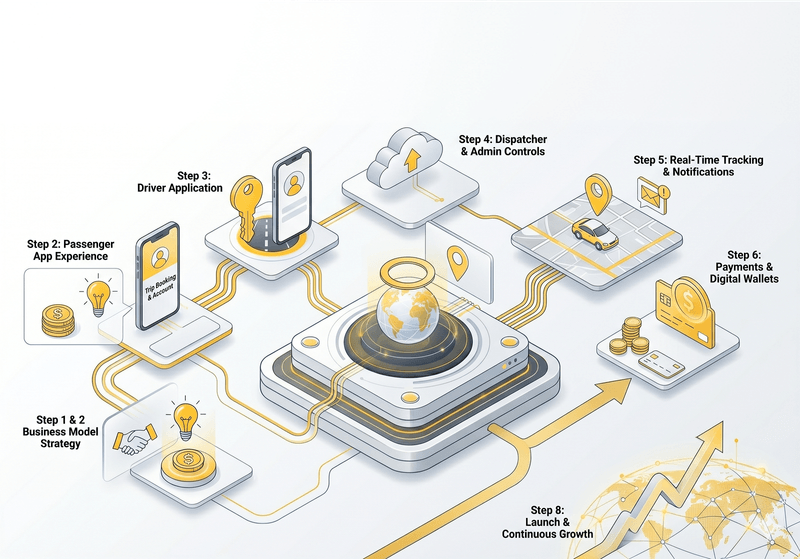
Step 1: Define Your Business Model
Start by identifying the services you plan to offer.
Common models include:
-
City taxi services
-
Ride hailing operations
-
Chauffeur services
-
Multi service transportation platforms
Your pricing strategy, dispatch workflows, driver management process, and reporting requirements will depend heavily on this decision.
Step 2: Design the Passenger Experience
The passenger application is often the first interaction customers have with your business.
The app should allow users to:
-
Create accounts
-
Book rides instantly
-
Schedule future rides
-
Track drivers live
-
Pay digitally
-
View trip history
-
Rate completed rides
The simpler the booking experience, the higher your conversion rates will be.
Step 3: Build the Driver Application
Drivers are the operational backbone of any e hailing business.
Your driver application should support:
-
Ride requests
-
Acceptance and rejection controls
-
Live navigation
-
Earnings visibility
-
Availability management
-
Trip history
-
Performance tracking
A poor driver experience often leads to lower ride acceptance rates and longer customer wait times.
Step 4: Create Dispatcher and Admin Controls
The administrative layer provides visibility across the entire operation.
Operators should be able to:
-
Monitor active trips
-
Manage drivers
-
Configure fares
-
Handle disputes
-
View reports
-
Manage customers
-
Track revenue
Without proper operational controls, scaling becomes extremely difficult.
Step 5: Integrate Real Time Tracking and Notifications
Modern transportation businesses depend heavily on location intelligence.
Passengers expect:
-
Estimated arrival times
-
Booking confirmations
-
Driver arrival alerts
-
Trip completion notifications
According to Statcounter, mobile devices generate most global web traffic today, making mobile first communication essential for customer satisfaction.
Step 6: Configure Payments and Wallets
Payment flexibility directly impacts booking completion rates.
Most successful platforms support:
-
Credit cards
-
Debit cards
-
Digital wallets
-
Cash payments
-
Corporate billing
Providing multiple payment options reduces booking friction and improves customer convenience.
Step 7: Test Before Launch
Before going live, test every critical workflow.
This includes:
-
Booking creation
-
Ride assignment
-
Payment processing
-
Driver navigation
-
Customer notifications
-
Cancellation handling
Small operational issues become major customer experience problems when ignored during testing.
Step 8: Launch and Continuously Improve
Launching the app is only the beginning.
Monitor:
-
Driver acceptance rates
-
Booking completion rates
-
Customer retention
-
Revenue performance
-
Average response times
Continuous optimization helps improve operational efficiency and customer satisfaction over time.
Must Have Features Every E-Hailing App Needs
The right feature set directly impacts user experience and business performance.
Essential Components of an E-Hailing Platform
| Component | Purpose |
|---|---|
| Passenger App | Ride booking and tracking |
| Driver App | Trip management and earnings |
| Dispatcher Panel | Ride assignment and monitoring |
| Admin Dashboard | Business control and reporting |
| Payment System | Transaction processing |
| Notification System | Customer and driver communication |
| GPS Integration | Navigation and ETA calculation |
Passenger App Features
-
Instant booking
-
Scheduled rides
-
Live tracking
-
Fare estimates
-
Digital payments
-
Ratings and reviews
-
Ride history
Driver App Features
-
Ride request management
-
Navigation assistance
-
Earnings dashboard
-
Availability controls
-
Trip history
-
Performance metrics
Dispatcher Features
-
Automated dispatching
-
Manual ride assignment
-
Ride monitoring
-
Driver visibility
-
Booking management
Admin Features
-
Driver management
-
Customer management
-
Pricing controls
-
Revenue reporting
-
Fleet monitoring
-
Business analytics
Expert Tip:
Do not treat the driver application as a secondary product. Drivers interact with your platform daily. A smooth driver experience often improves service quality, trip completion rates, and overall customer satisfaction.
How Much Does It Cost to Build an E-Hailing App?
One of the most common questions business owners ask is about development cost. The answer depends on several factors.
Factors That Influence Cost
-
Number of features
-
Mobile platforms supported
-
Third party integrations
-
Dispatch complexity
-
Payment systems
-
Custom branding requirements
-
Scalability expectations
Hidden Costs Many Businesses Overlook
Development is only part of the investment.
Additional expenses may include:
-
Cloud hosting
-
Mapping services
-
SMS notifications
-
Maintenance
-
Security updates
-
Technical support
-
Performance optimization
Industry benchmarks indicate that software maintenance and updates can consume between 15% and 25% of total development investment annually, making long term planning essential.
Custom Development vs White Label E-Hailing Software
At this stage, businesses typically face an important decision.
Should they build from scratch or launch using a ready made platform?
| Factor | Custom Development | White Label Solution |
|---|---|---|
| Initial Cost | High | Lower |
| Launch Time | Several Months | Weeks |
| Testing Requirements | Extensive | Mostly Completed |
| Maintenance Responsibility | Internal Team | Provider |
| Technical Expertise | High | Low |
| Time to Revenue | Longer | Faster |
| Operational Risk | Higher | Lower |
Custom development offers maximum flexibility but requires significant investment, technical resources, and ongoing maintenance.
White label solutions provide a faster path to market by delivering proven passenger apps, driver apps, dispatch systems, and management tools that can be branded for your business.
Expert Tip:
For most startups, speed to market creates more value than feature perfection. Launching early allows you to validate demand, pricing models, operational workflows, and customer acquisition strategies before investing heavily in custom development.
Common Mistakes Businesses Make When Building an E-Hailing App
Many projects struggle because they focus on technology instead of operations.
Ignoring Dispatch Operations: A visually appealing application cannot compensate for inefficient ride allocation.
Underestimating Driver Management: Driver retention, performance tracking, and earnings transparency are essential for sustainable growth.
Poor Pricing Configuration: Pricing models should support profitability while remaining competitive within local markets.
Launching Without Analytics: Without reporting and analytics, identifying operational problems becomes difficult.
Building Features Customers Do Not Need: Start with essential functionality and expand based on real usage data rather than assumptions.
Why Many Businesses Choose Ready Made Ride Hailing Software
Building every component from scratch can be time consuming, expensive, and operationally risky.
Many transportation businesses prefer ready made ride hailing software because it already includes:
-
Passenger applications
-
Driver applications
-
Dispatcher controls
-
Automated dispatching
-
Payment integrations
-
Live tracking
-
Reporting tools
-
Customer management
-
Scalability infrastructure
Instead of spending months developing core functionality, businesses can focus on customer acquisition, driver onboarding, and operational growth.
Solutions like Yelowsoft provide the operational foundation needed to launch and scale an e hailing business while reducing development complexity and time to market.
Conclusion
Building an e hailing app involves much more than developing a passenger facing mobile application. A successful platform requires driver management, dispatch operations, payment processing, real time tracking, customer communication, analytics, and scalable business controls working together in one ecosystem.
Whether you are launching a new ride hailing startup, modernizing a taxi operation, or creating a branded transportation platform, the decisions you make during planning will directly affect launch speed, operational efficiency, and long term profitability.
For many businesses, using a proven ride hailing software platform provides a faster and lower risk path to market than building everything from scratch. With ready-made passenger apps, driver apps, automated dispatching, payment integrations, and business management tools, solutions like Yelowsoft help transportation companies focus on growth rather than development challenges.
Ready to launch your own ride hailing platform faster and with less risk? Explore how Yelowsoft can help you go live and scale with confidence.
Launch your branded e-hailing platform faster and start accepting bookings without development delays.
An e hailing app is a digital transportation platform that connects passengers and drivers through mobile applications and automated dispatch systems.
The timeline depends on complexity. Custom development can take several months, while white label platforms can often be launched much faster.
Core features include passenger booking, driver management, dispatching, live tracking, payments, notifications, and reporting.
Costs vary based on feature requirements, integrations, customization, maintenance, and scalability needs.
It depends on business goals. White label solutions typically reduce launch time, development cost, and operational risk.
Yes. Many taxi operators use modern ride hailing platforms to digitize bookings, automate dispatching, and improve customer experience.


