The taxi industry has changed faster in the last few years than many operators expected.
Customer behaviour shifted. Booking habits evolved. Operational pressure increased. And while passenger demand continued growing, expectations also became much higher.
Today’s passengers expect instant bookings, accurate ETAs, live ride tracking, digital payments, and faster pickups without operational delays.
For taxi companies still depending heavily on manual coordination, meeting those expectations consistently has become difficult.
At the same time, app-based transportation platforms like Uber and Lyft have pushed the industry toward faster and more technology-driven operations.
That is exactly why taxi business automation is becoming a major operational priority for modern fleets.
Operators are no longer adopting automation simply to “digitize” their business. They are doing it because manual workflows create bottlenecks that directly affect bookings, dispatch efficiency, driver productivity, and customer retention.
From automated taxi dispatch systems to centralized booking management and real-time tracking, automation helps taxi companies simplify operations while improving service quality across the entire business.
For growing fleets especially, the shift toward automation is no longer optional. It is becoming a necessary part of running efficient taxi operations at scale.
This blog explains how taxi business automation improves dispatch management, helps drivers perform better, reduces operational inefficiencies, and creates stronger customer experiences that support long-term business growth.
Automation in Dispatch: The Backbone of Efficient Taxi Services
Every taxi company depends on dispatch efficiency.
When dispatch operations become slow or unorganized, the entire business feels the impact almost immediately. Customers wait longer, drivers lose productive time, and operators struggle to manage ride demand efficiently.
Traditional dispatch systems usually rely on manual coordination through calls, radios, or operator-based ride assignment. That process may work for smaller fleets, but operational complexity increases quickly as bookings grow.
Missed rides, delayed assignments, and communication gaps become common.
Taxi business automation solves many of these operational challenges by introducing automated taxi dispatch systems that process bookings and allocate drivers in real time.
Instead of relying entirely on dispatcher intervention, the system automatically identifies the most suitable driver for each booking based on live operational conditions.
How automated dispatch improves ride allocation
Modern dispatch platforms evaluate several factors before assigning rides, including driver proximity, current traffic conditions, estimated pickup time, vehicle availability, ride demand in nearby zones.
This allows taxi operators to manage fleet movement more efficiently throughout the day.
Drivers spend less time idle between trips, and passengers receive quicker confirmations and shorter waiting times.
Operationally, this creates better fleet utilization without increasing dispatcher workload.
A properly configured automated taxi dispatch system also reduces human allocation errors that commonly happen during peak booking periods.
For busy fleets, that operational improvement can directly influence customer satisfaction and daily trip volume.
Expert Tip:
Many taxi companies automate dispatch but fail to configure demand heat mapping properly. Dynamic zone-based driver allocation can significantly reduce empty mileage during peak hours and improve driver utilization rates across high-demand areas.
Faster response times improve driver productivity
One of the biggest operational advantages of taxi business automation is response speed.
During high-demand periods, manual dispatch systems often slow down because operators must coordinate multiple ride requests simultaneously.
Automated customer communication for taxis improves this process by handling booking confirmations and ride assignments instantly.
That leads to quicker ride allocation, reduced dispatch delays, improved driver movement, faster customer pickups.
Drivers receive bookings more consistently throughout the day, helping them maximize active driving hours instead of waiting for assignments.
From an operational perspective, faster response time also improves booking conversion rates because passengers are less likely to abandon ride requests due to delays.
Why Automation Benefits Your Drivers
Drivers experience operational pressure every day.
Traffic congestion, inconsistent ride assignments, payment handling, and delayed communication all affect driver productivity over time.
When operational systems become disorganized, driver frustration increases — and eventually customer experience suffers too.
Taxi business automation helps simplify many of those daily operational challenges.
Instead of relying heavily on manual coordination, drivers work through more connected and predictable systems.
That creates smoother workflows while improving overall fleet performance.
Better trip scheduling reduces operational stress
One major benefit of automation is more balanced trip scheduling.
Traditional dispatch operations often create uneven ride distribution, where some drivers remain overloaded while others wait long periods between bookings.
Automated taxi dispatch systems help distribute rides more efficiently across the fleet.
Drivers receive assignments through centralized systems instead of depending completely on dispatcher calls.
This reduces idle time and creates a more predictable workflow throughout the day.
For drivers, fewer operational interruptions usually mean lower stress levels and better productivity during shifts.
For operators, balanced ride allocation improves fleet efficiency and overall service consistency.
Faster fare management improves operational flow
Fare collection can become surprisingly time-consuming in manual taxi operations.
Payment disputes, delayed invoicing, and administrative coordination often reduce productive driving time.
Taxi business automation simplifies this through automated fare management systems that support digital payments, automated invoicing, cashless transactions, instant payment processing
Drivers spend less time managing payments and more time completing rides.
Operationally, this also reduces billing errors and improves financial transparency across the business.
Expert Tip:
Taxi companies handling airport transfers or corporate rides should integrate automated invoicing APIs directly into dispatch workflows. This reduces reconciliation delays and improves B2B account management efficiency significantly.
Real-time tracking improves ride efficiency
Modern taxi operations depend heavily on real-time visibility.
Drivers need live navigation support, traffic visibility, and route optimization to maintain efficient trip movement throughout the day.
Taxi automation software helps through real-time taxi tracking, GPS navigation, live traffic monitoring, intelligent route optimization.
These systems help drivers avoid traffic-heavy routes, roadblocks, and unnecessary delays.
Passengers benefit from faster arrivals and smoother ride experiences, while operators gain better fleet visibility.
Improved route efficiency can also reduce fuel wastage across daily operations.
Improve Customer Experience Through Automation
Customer expectations in transportation services have changed dramatically.
Passengers now expect convenience at every stage of the booking journey — not only during the ride itself.
Long waiting times, unclear pricing, or delayed communication often push customers toward competing ride services.
Taxi business automation helps operators create faster, smoother, and more transparent customer experiences.
Quick and easy bookings reduce customer friction
Passengers prefer simple booking experiences.
Automated taxi booking systems allow customers to request rides through mobile applications, online booking portals, digital booking systems.
This removes the need for lengthy calls and manual ride confirmations.
Passengers can confirm bookings within seconds and receive immediate updates about their ride status.
Faster booking experiences improve convenience while helping taxi companies manage ride demand more efficiently.
For repeat customers especially, smooth booking workflows strongly influence retention rates.
Transparent pricing builds customer trust
Pricing disputes remain one of the biggest customer concerns in taxi services.
Passengers want pricing clarity before confirming bookings.
Automated fare calculation systems provide estimated ride pricing using factors like trip distance, estimated duration, traffic conditions, service zones, dynamic pricing logic.
This improves pricing transparency while reducing confusion during the booking process.
Customers generally feel more confident using taxi services when pricing expectations are clear from the beginning.
Trust becomes easier to build when there are fewer billing surprises.
Real-time notifications improve customer confidence
Passengers appreciate visibility throughout the ride journey.
Taxi automation software keeps customers informed through booking confirmations, pickup alerts, driver arrival notifications, live ride tracking updates.
These updates reduce uncertainty and improve customer confidence during travel.
Passengers can track ride progress in real time instead of contacting dispatch teams repeatedly for updates.
Operationally, this also reduces customer support workload because passengers already receive most ride information automatically.
Expert Tip:
Operators using live ride tracking should enable delayed-trip trigger notifications. Proactive ETA alerts reduce inbound customer support calls significantly during traffic-heavy operating hours.
The Advantage of Automation in Retaining Customers
Customer acquisition matters.
Customer retention matters even more.
Taxi companies that consistently deliver reliable experiences are far more likely to generate repeat bookings and long-term customer loyalty.
Taxi business automation helps operators create that consistency.
Reliable service improves repeat bookings
Passengers usually return when ride experiences feel predictable and convenient.
Faster dispatching, transparent pricing, live ride tracking, and automated communication all contribute to stronger customer satisfaction.
Automation also allows operators to understand customer behavior more effectively.
Taxi companies can use ride history and booking data to create loyalty programs, targeted discounts, personalized offers, customer engagement campaigns.
Consistent operational quality helps strengthen long-term customer relationships.
That becomes especially important in highly competitive transportation markets where passengers have multiple booking options available.
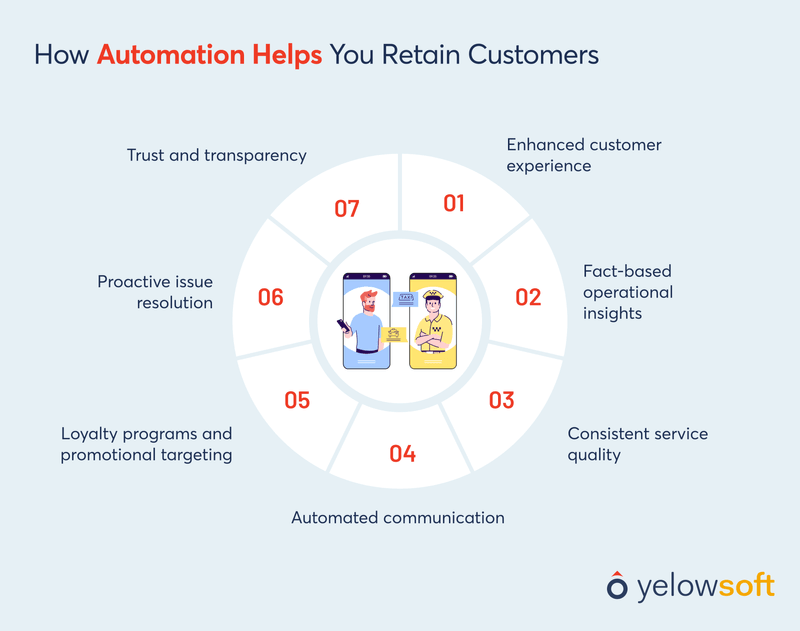
How Automation Helps You Retain Customers
Taxi business automation improves customer retention by creating more reliable and personalized service experiences.
Here’s how automation supports long-term customer relationships.
Enhanced customer experience
Automation simplifies the customer journey from booking confirmation to trip completion.
Passengers benefit from faster ride allocation, smoother communication, reduced waiting times, better ride visibility.
Convenient ride experiences encourage repeat usage.
Fact-based operational insights
Modern taxi management systems generate valuable business intelligence.
Operators can analyze booking patterns, customer preferences, demand fluctuations, ride frequency trends.
These insights help businesses improve service planning and customer engagement strategies.
Consistent service quality
Reducing delays and operational inconsistencies helps taxi companies maintain dependable service quality across the fleet.
Consistency builds trust over time.
Automated communication
Passengers receive ride updates automatically throughout the booking process.
This improves convenience while reducing uncertainty during travel.
Loyalty programs and promotional targeting
Taxi automation software allows businesses to create personalized reward programs and promotional campaigns based on booking behavior and ride activity.
This improves customer engagement and repeat booking opportunities.
Proactive issue resolution
Automated systems can identify operational problems early, including:
-
ride delays
-
driver inactivity
-
customer complaints
-
booking disruptions
Operators can respond faster before service issues escalate.
Trust and transparency
Features like automated fare estimates and real-time taxi tracking improve transparency between operators and passengers.
Transparent operations help strengthen long-term customer confidence.
How Taxi Automation Reduces Operational Costs
Reducing operational inefficiencies is one of the biggest reasons taxi companies invest in automation.
Manual workflows often increase administrative workload, booking mistakes, fuel wastage, dispatcher dependency, driver idle time
Taxi business automation helps companies organize operations more efficiently through automated dispatching, centralized booking management, route optimization, digital payment processing, operational reporting systems
Better coordination allows operators to scale operations without creating unnecessary operational pressure.
For growing fleets, automation often improves profitability simply by reducing avoidable inefficiencies across daily operations.
Modernize Your Taxi Operations Before Your Competition Does
modernize-your-taxi-operations-before-your-competition-does
Taxi companies that continue relying heavily on manual systems often struggle with operational delays, rising inefficiencies, and inconsistent customer experiences.
Modern taxi automation software helps simplify fleet management while improving operational control, customer satisfaction, and long-term scalability.
Ready to streamline your taxi operations with automation?
Conclusion
The transportation industry is becoming increasingly technology-driven.
Passengers expect faster bookings, smoother communication, transparent pricing, and reliable service experiences every time they request a ride.
Taxi companies that fail to modernize operations often struggle to maintain operational efficiency as demand grows.
Taxi business automation helps operators simplify dispatch management, improve driver productivity, reduce operational inefficiencies, and deliver stronger customer experiences across the entire ride journey.
From automated taxi dispatch systems and real-time taxi tracking to intelligent fare management and digital booking coordination, automation creates a more connected and scalable operating structure for modern fleets.
For taxi businesses planning long-term growth, adopting automation is no longer simply about improving convenience.
It is becoming an essential part of building a competitive, efficient, and sustainable taxi operation in today’s evolving transportation market.


