Choosing taxi booking software is not simply a matter of comparing feature lists. Private hire operators need to understand how each platform handles booking intake, driver assignment, scheduled journeys, corporate accounts, customer communication, reporting, system migration, support, data ownership, and long-term cost.
A platform may look affordable initially but become restrictive as booking volumes, drivers, account customers, or service areas increase. Another may offer advanced dispatching but require more implementation support than a smaller fleet needs.
This guide compares leading taxi booking software for private hire companies in 2026, explains where each platform is strongest, and outlines the operational questions you should ask before choosing or replacing your current system.
Why Private Hire Companies Need More Than Basic Dispatch Software
Before comparing platforms, it is important to understand why traditional dispatch systems often struggle to support modern private hire operations.
A purpose-built private hire dispatch system should connect bookings, dispatch, drivers, pricing, account work, and reporting instead of forcing operators to manage each workflow separately.
The Operational Challenges Private Hire Operators Face
Many private hire businesses still rely on a mix of phone bookings, spreadsheets, manual ride allocation, and disconnected tools.
As demand grows, these processes create operational bottlenecks.
Common challenges include:
-
Manual booking management
-
Driver allocation delays
-
Scheduled and recurring booking coordination
-
Corporate account handling
-
Pricing inconsistencies
-
Poor customer communication
For example, a dispatcher manually assigning rides during peak demand can easily create delays that affect both passengers and drivers. Scheduled and recurring bookings also become difficult to control when driver availability, timing changes, and customer instructions are managed separately.
How Technology Is Changing Private Hire Operations
Modern platforms are helping operators automate many of these challenges.
Automated dispatching reduces manual intervention. Cloud platforms provide visibility across the business. Mobile applications allow drivers to receive jobs instantly. Customers can book rides through websites, mobile apps, and self service portals.
A connected taxi dispatch software system can bring bookings, driver availability, assignments, live trips, and reporting into one operational workflow.
Cloud platforms provide visibility across the business. Mobile applications allow drivers to receive jobs instantly. Customers can book rides through websites, mobile apps, and self service portals.
This creates a more efficient operation where bookings, dispatching, communication, and reporting work together rather than separately.
Expert Tip:
Monitor driver utilization as a key performance metric. Many fleets operate at only 60 to 70 percent utilization. Improving utilization often generates greater profitability than adding more vehicles.
What Makes Great Taxi Booking and Dispatch Software in 2026?

Not every platform is built for the needs of a growing private hire business. What makes a taxi dispatch platform great, know below.
Intelligent Dispatching and Driver Allocation
Modern dispatch systems use automation to assign rides based on driver location, availability, vehicle type, and business rules.
This improves:
-
Response times
-
Fleet utilization
-
Driver productivity
-
Customer satisfaction
Automated ride assignment also reduces dispatcher workload, allowing teams to focus on exceptions rather than routine tasks.
Multi Channel Booking Capabilities
Customers increasingly expect flexibility.
A modern online taxi booking software platform should support:
-
Phone bookings
-
Mobile app bookings
-
Website bookings
-
Corporate bookings
All booking channels should feed into a centralized system that provides complete visibility.
Driver and Fleet Management Tools
A complete taxi management software solution should support:
-
Driver onboarding
-
Vehicle management
-
Compliance tracking
-
Performance monitoring
Operators need visibility into both driver activity and fleet performance to improve service quality and profitability.
Real Time Tracking and Customer Visibility
Passengers expect transparency.
GPS tracking, ETA updates, and live trip monitoring help reduce customer uncertainty while giving dispatch teams better operational control.
Corporate Account and Scheduled Booking Support
Private hire operators increasingly depend on corporate accounts, contract work, recurring journeys, and advance bookings.
Important capabilities include:
- Recurring journey management
- Account-specific pricing
- Approval workflows
- Department billing
- Monthly invoicing
These capabilities help operators manage valuable account work without relying on spreadsheets, emails, and repeated manual coordination.
Top Taxi Booking Software for Private Hire Companies in 2026
Several platforms serve the private hire market, each with different strengths.
1. Yelowsoft
Best For: Growing private hire operators, chauffeur businesses, corporate transport providers, and multi-channel booking operations.
| Feature | Availability |
|---|---|
| Automated Dispatching | ✓ |
| Voice AI Booking | ✓ |
| WhatsApp Booking | ✓ |
| Driver and Fleet Management | ✓ |
| Corporate Account Portal | ✓ |
| Bulk Booking Import | ✓ |
| Ride Broadcasting | ✓ |
Yelowsoft stands out because it goes beyond dispatching. It combines booking automation, fleet management, corporate account workflows, driver operations, reporting, and AI-powered booking channels within one ecosystem.
The platform is particularly strong for operators seeking scalability and operational automation rather than basic dispatch functionality alone.
2. iCabbi
iCabbi is widely used by larger operators. Its Google Fleet Engine integration and extensive configuration options make it suitable for complex operations.
However, smaller fleets may find implementation and configuration more demanding.
See the detailed Yelowsoft vs iCabbi comparison for a closer evaluation of features, operational control, and scalability.
3. Autocab
Autocab excels in network integration and booking distribution.
Its strength lies in helping operators connect with larger transportation ecosystems and partner networks.
Review the Yelowsoft vs Autocab comparison before assessing network connectivity against broader booking and dispatch requirements.
4. TaxiCaller
TaxiCaller offers affordability and simplicity through its pay per active vehicle pricing model.
It is often a good fit for smaller fleets, although growing businesses may eventually require more advanced automation.
Read the Yelowsoft vs TaxiCaller comparison to compare simplicity, customisation, integrations, and growth requirements.
5. Envoy
Envoy has built a strong reputation within the UK private hire sector.
Its unlimited fleet model and private hire focus make it attractive for UK operators.
Other Notable Platforms
Additional options include:
-
Jugnoo
-
Limo Anywhere
-
Cab Treasure
-
Chauffeur Drive Systems
-
Sherlock Taxi
Each serves specific market segments and operational requirements.
Feature Comparison of Leading Taxi Booking Software Solutions
A side by side comparison often makes software evaluation easier.
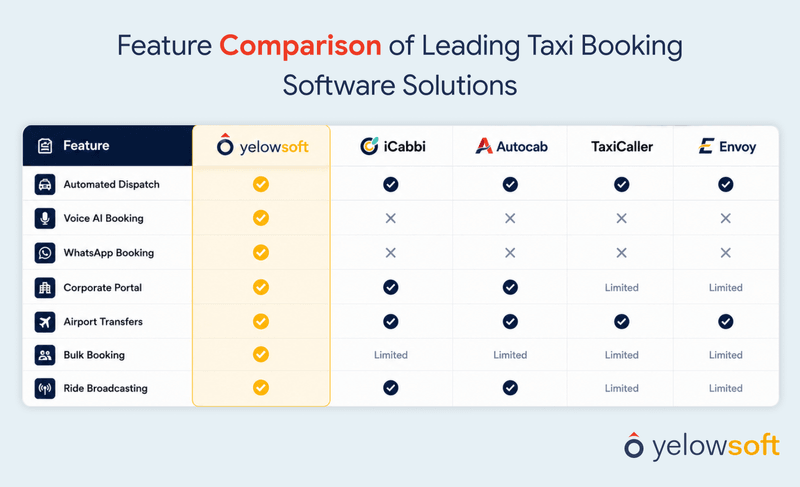
Operators replacing an existing platform should also review the vendor’s data migration, configuration, training, testing, and cutover process before signing.
How to Choose Taxi Booking Software for Your Private Hire Business
The best choice depends on your business goals. You should also confirm who owns your booking, customer, driver, and operational data and whether it can be exported if you change providers.
For Small Private Hire Fleets
Focus on:
- Availability of onboarding and customer support
- Ease of onboarding
- Transparent pricing, setup costs, and usage limits
- Simplicity
For Growing Regional Operators
Prioritize:
-
Scalability
-
Automation
-
Fleet visibility
For Scheduled and Account-Based Operations
Look for:
- Advance and recurring bookings
- Driver and vehicle availability
- Account-specific pricing
- Priority booking management
- Centralised customer instructions
For Corporate Transportation Providers
Choose platforms that support:
-
Approval workflows
-
Invoicing
-
Reporting
-
Account management
Expert Tip:
Ask vendors whether bookings, dispatch, corporate accounts, driver activity, and reporting share the same database. Connected records improve visibility and reduce duplicated work.
Emerging Trends Shaping Taxi Booking Management in 2026
The next generation of private hire operations will be driven by automation and customer convenience.
AI Powered Booking Channels
Voice AI, Email AI, and chat automation are helping operators capture bookings without increasing staffing requirements.
Predictive Dispatch and Demand Forecasting
Artificial intelligence is helping fleets predict demand, position vehicles proactively, and improve driver utilization.
Unified Mobility Operations Platforms
Operators increasingly prefer a single platform that manages bookings, dispatching, communication, billing, and reporting from one interface.
Why Many Private Hire Companies Are Moving to Yelowsoft?
Operators today need more than dispatching.
Yelowsoft provides a multi-channel booking ecosystem that includes Voice AI booking, WhatsApp booking, corporate account management, driver operations, reporting, analytics, and dispatch automation.
As a modern taxi dispatch platform, it helps businesses improve efficiency while maintaining visibility across their operations.
For operators seeking scalable cab booking software, Yelowsoft combines automation and operational control in a way that supports long term growth.
Its approach to taxi booking management focuses on simplifying complex workflows while improving customer experience.
Expert Tip:
Evaluate software based on the entire booking lifecycle, not just dispatching. The biggest operational savings often come from automating booking intake, invoicing, and customer communication.
Conclusion
Private hire transportation continues to evolve as customer expectations, competition, and operational complexity increase.
Modern operators need more than a dispatch tool. They need a platform that helps them manage bookings, drivers, vehicles, customers, reporting, and business growth from a single environment.
While several providers serve the market effectively, the right choice depends on your business model, growth plans, and operational priorities.
Yelowsoft has positioned itself as a comprehensive platform supporting booking management, dispatch automation, fleet visibility, corporate accounts, driver operations, and AI-powered booking channels. For private hire companies seeking efficiency, scalability, and operational control, it provides the capabilities needed to compete in a rapidly changing market.
Ready to Modernize Your Private Hire Operations?
See how Yelowsoft can connect booking intake, dispatch, driver operations, account work, and reporting around your existing workflow.
Book a Tailored Demo
FAQs
The best solution depends on your fleet size and operational requirements. Popular options include Yelowsoft, iCabbi, Autocab, TaxiCaller, and Envoy.
Operators should look for flight tracking, scheduled booking management, and passenger communication capabilities. Yelowsoft, iCabbi, and Envoy are strong options.
Pricing varies by provider and fleet size. Entry level solutions may start around €80 per month, while enterprise platforms often provide custom pricing.
Automated dispatching, real time tracking, fleet management, airport transfer support, corporate account management, and reporting are essential features.
Yes. Migration can include customer, driver, vehicle, pricing, account, and booking data. The exact scope depends on the old system, available export formats, integrations, and the vendor’s migration process.
Onboarding time varies by fleet size, required apps, data migration, integrations, configuration, testing, and staff training. Ask the provider for a documented implementation plan before signing.
Data ownership depends on the provider’s contract. Confirm who controls the data, how it is stored, whether it can be exported, and what happens to it when the agreement ends.
Many platforms offer a driver app for receiving jobs, navigation, status updates, communication, and trip completion. Confirm whether the app is included, branded, or charged separately.
Look for implementation assistance, training, documentation, technical support, escalation procedures, and defined response commitments. Exact support hours and SLAs should be written into the agreement.
Software can support booking records, driver and vehicle information, reporting, data controls, and operational workflows. However, operators remain responsible for meeting local licensing and regulatory requirements.
Relevant integrations may include maps, payment gateways, SMS, email, accounting systems, telephony, websites, corporate portals, and third-party booking APIs. Confirm compatibility with your existing providers.
Review setup fees, monthly charges, usage limits, add-ons, overage costs, support terms, data ownership, migration assistance, cancellation periods, renewal terms, and data-export conditions.


