Growing a taxi business beyond your local market is exciting, but it is also where many operators make costly mistakes. What works in one city often falls apart when you enter a new region or country.
Different regulations, driver management challenges, pricing structures, customer expectations, and operational complexities can quickly slow down growth if the right foundation is not in place.
A successful taxi business expansion strategy therefore needs to account for both local market requirements and the operational complexity created by managing multiple locations.
The market opportunity remains significant. According to Grand View Research, the global ride-hailing services market was valued at $47.6 billion in 2025 and is projected to reach approximately $181.5 billion by 2033, growing at a CAGR of 18.6% from 2026 to 2033.(source)
Increasing digital adoption, smartphone penetration, urban mobility demand, and the expansion of ride-hailing services into new geographies are contributing to continued market growth.
Whether you want to expand a ride hailing business, grow an airport transfer operation, or build an international taxi business across multiple cities, sustainable expansion depends on much more than adding vehicles.
In this guide, you will learn how to expand your taxi business by evaluating markets, through scalable operations, choosing the right technology, and preparing your business for long term global growth.
Let’s get into it now!
What Is a Global Taxi Business?
A global taxi business, or international taxi business, is a transportation company that operates across multiple cities, regions, or countries using standardized booking, dispatch, fleet management, pricing, and customer service processes while adapting to local market requirements.
Many operators assume that expanding into a new city simply means adding more vehicles. In reality, global expansion introduces entirely new operational challenges.
Here’s a quick difference between local and global taxi business models:
| Local Taxi Business | Global Taxi Business |
|---|---|
| Operates in one city | Operates across multiple markets |
| Single pricing model | Market specific pricing strategies |
| One regulatory framework | Multiple licensing requirements |
| Local driver network | Distributed driver operations |
| Limited reporting needs | Centralized business intelligence |
| Manual oversight possible | Automation becomes essential |
| Single currency/payment setup | Multiple currencies and local payment methods |
| One customer experience | Localized language, communication and booking experience |
For example, a company serving passengers in London, Dubai, and Barcelona must comply with different licensing laws, pricing structures, payment preferences, and customer expectations in each market.
Without scalable systems, operational complexity can quickly become unmanageable.
The challenge is not simply managing more rides. Operators need centralized control while still being able to configure pricing, payments, drivers, service zones, booking channels, and customer communication for individual markets.
Why Taxi Businesses Are Expanding Beyond Local Markets
Taxi business expansion is increasingly driven by operators looking beyond one local demand pool. Airport transportation, corporate mobility, tourism, commuter demand, and digitally booked rides can create opportunities to diversify revenue across multiple markets.
Here’s why taxi businesses are expanding beyond local markets:
Tourism Growth
International tourism continues to recover and expand across major destinations worldwide. Airports, hotels, resorts, and travel agencies generate consistent transportation demand throughout the year.
For airport transfer operators in particular, partnerships with hotels, travel agencies, OTAs, and other travel providers can create advance-booking demand rather than relying entirely on street or app-based bookings.
Urban Population Growth
Cities continue to attract larger populations, creating greater demand for daily transportation services. For operators evaluating new cities, population density alone is not enough; commuting patterns, transport gaps, peak demand zones, and local service availability provide a clearer picture of addressable ride demand.
Corporate Mobility Demand
Businesses increasingly rely on structured transportation solutions for employees, executives, airport transfers, and client travel. This creates recurring revenue opportunities through corporate contracts.
Unlike purely on-demand consumer rides, corporate transportation can also provide predictable recurring demand through contracted rates, account billing, scheduled rides, airport transfers, and employee transportation programs.
Digital Adoption
Digital adoption is also changing how operators enter new markets. Customers may prefer passenger apps in one market, web or WhatsApp booking in another, while corporate and airport clients may rely more heavily on portals, email, APIs, or advance booking channels.
Public Transportation Gaps
Many cities continue to experience transportation shortages, particularly during peak hours, late nights, and airport transfers. These gaps create opportunities for efficient taxi and ride hailing services.
How to Expand a Taxi Business Into New Markets?
Expanding successfully requires a sequence. Before adding drivers or launching marketing, you need to validate the market, choose the right operating model, establish scalable technology, and understand how local requirements affect your economics. Here are the six areas to address.
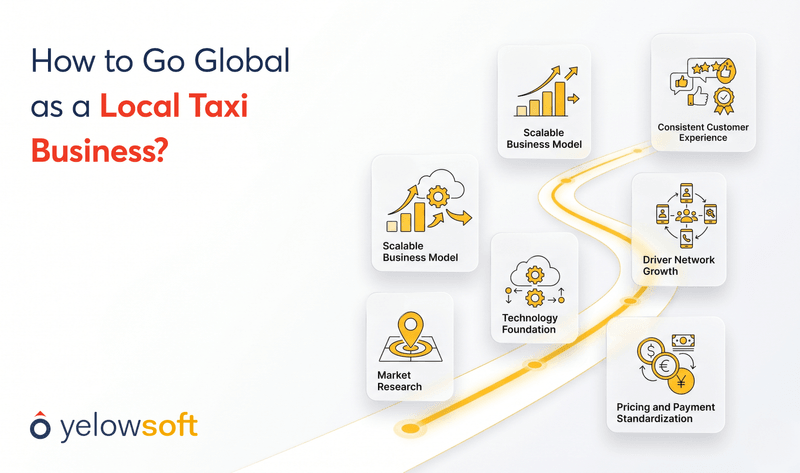
Step 1: Choose the Right Market Before You Launch
Not every market offers the same opportunity. A strong taxi business expansion strategy starts by evaluating demand, competition, regulation, driver availability, and unit economics before committing significant resources.
Assess Demand
Start by evaluating factors like:
-
Population density
-
Tourism activity
-
Airport traffic
-
Business districts
-
Public transportation limitations
-
Daily commuting patterns
Look for demand that exists across different dayparts and customer types rather than relying on a single seasonal or commuter segment.
High demand markets typically show consistent transportation needs across multiple customer segments.
Analyze Existing Competition
Study both traditional taxi operators and ride hailing platforms.
Evaluate:
-
service quality
-
pricing strategies
-
fleet size
-
customer reviews
-
market gaps
More importantly, identify where existing providers are weak. Slow pickup times, poor booking experiences, limited payment options, inconsistent airport service, or weak corporate support can reveal a more meaningful market gap than competitor count alone.
Understanding competitors helps identify opportunities to differentiate your service.
Understand Regulatory Requirements
Licensing rules vary significantly between countries and cities.
So you must research about:
-
commercial transportation permits
-
vehicle requirements
-
driver certifications
-
insurance obligations
-
tax regulations
-
data privacy requirements
Regulations should be validated at the city or jurisdiction level rather than assumed from national requirements, particularly for licensing, fare controls, driver eligibility, insurance, and data protection.
Ignoring compliance can delay launches and increase operational risk.
Evaluate Revenue Potential
Strong demand does not automatically mean a profitable market. Model the unit economics before committing to expansion.
Estimate:
-
Average fare values
-
Ride frequency
-
Customer acquisition costs
-
Driver supply availability
-
Operating expenses
Compare these numbers market by market. A city with higher average fares may still produce weaker margins if driver acquisition, insurance, payment processing, or customer acquisition costs are significantly higher.
A market with strong demand but unsustainable economics may not support long term growth.
Step 2: Build a Scalable Business Model
Choosing the right operating model determines how quickly you can scale, how much capital expansion requires, how much operational control you retain, and how predictable revenue becomes.
Here’s how to look at it:
| Business Model | Best For | Scalability |
|---|---|---|
| Traditional Taxi Fleet | Local transportation | Moderate |
| Ride Hailing Platform | Multi city growth | High |
| Airport Transfer Service | Tourism markets | High |
| Corporate Transportation | B2B contracts | High |
| Traditional fleet | Local/regional operations | Moderate |
| Ride hailing | Multi-city growth | High |
| Airport transfer | Tourism/travel | High |
| Corporate transport | B2B accounts | High |
Traditional Taxi Operations
Ideal for serving local transportation needs with owned vehicles and employed drivers.
Technology-driven models can support faster multi-city growth through distributed driver networks and digital booking infrastructure. Operators building this model should evaluate whether their ride-hailing startup software can support new markets without requiring separate operating systems for every city.
Focused airport operations often generate predictable bookings, premium fares, and recurring partnerships with travel providers.
Corporate contracts provide recurring revenue, predictable demand, and long term customer relationships.
Step 3: Build Scalable Technology Before Expanding Operations
Many transportation businesses struggle during expansion because operational processes fail to scale.
The technology requirement also changes as you move from one market to several. You may need market-level pricing, separate driver pools, multiple currencies and languages, local payment methods, different booking channels, and centralized reporting without operating completely separate systems.
Taxi Dispatch Software
A centralized cloud-based taxi dispatch software platform can become the operational foundation of a global taxi business by allowing multiple locations to operate through shared infrastructure while retaining market-level configuration.
Key capabilities include:
-
Driver allocation
-
Booking management
-
Fleet visibility
-
Route optimization
-
Operational monitoring
For larger operators, this can evolve into a multi-country taxi platform where management gets centralized visibility while individual markets retain control over drivers, fares, zones, services, and booking rules.
Multi Channel Booking Infrastructure
Passengers prefer different booking methods depending on region and demographics.
Support multiple channels:
Do not assume every channel will perform equally in every market. Consumer-heavy markets may favor mobile and messaging bookings, while corporate, hotel, travel, and airport customers may rely more heavily on web bookings, email, portals, APIs, or advance reservations.
Driver Management
Managing hundreds of drivers across multiple cities requires structured onboarding, verification, scheduling, performance monitoring, and communication systems.
Driver structures can also differ between markets, with operations relying on employed drivers, independent drivers, owner-drivers, affiliates, or partner fleets. Your system therefore needs enough flexibility to manage market-specific onboarding and operating rules.
Dynamic Pricing and Zone Management
Different markets require different fare structures.
Advanced dynamic pricing and zone management allow operators to manage:
-
Airport pricing
-
Zone pricing
-
Peak hour pricing
-
Corporate rates
-
Market specific fare models
This prevents the business from forcing one fare model onto markets with completely different commercial or regulatory requirements.
Expansion may also require local payment gateways, communication providers, mapping services, travel aggregators, or other third-party systems. Reviewing available taxi software integrations before launch can prevent costly technology gaps later.
Reporting and Analytics
Growth without visibility creates operational risk.
Centralized reporting and analytics helps operators monitor:
-
Booking trends
-
Revenue performance
-
Driver productivity
-
Fleet utilization
-
Customer satisfaction
Global reporting should make markets comparable. Management should be able to see which city is growing, which one is losing margin, and where operational intervention is required.
Planning Multi-City Taxi Operations?
See how one platform can help centralize bookings, dispatch, drivers, pricing, payments, and reporting while supporting market-level configurations.
Explore Taxi Dispatch Software
Step 4: Create a Driver Acquisition and Retention Strategy
Drivers directly influence customer experience, operational efficiency, and brand reputation.
When you scale a taxi business across several markets, driver acquisition cannot follow one universal model. Licensing requirements, employment structures, vehicle ownership, compensation expectations, and onboarding documentation may differ significantly by location.
Recruitment
Develop clear hiring standards and verify:
-
driving licenses
-
background checks
-
regulatory compliance
-
vehicle documentation
Training
Provide structured onboarding covering: customer service, safety procedures, local regulations, platform usage, route knowledge
Performance Monitoring
Track:
-
Acceptance rates
-
Completion rates
-
Customer ratings
-
Response times
-
Compliance records
Driver Retention
Competitive compensation, transparent earnings, flexible schedules, and effective communication improve long term retention.
Step 5: Standardize Pricing, Payments, and Financial Operations
An international taxi business may need to manage different currencies, payment gateways, tax treatments, driver settlement structures, refunds, and corporate billing requirements across markets.
Pricing Strategy
Each market may require different fare structures based on local competition, fuel costs, customer expectations, and regulatory limitations.
Payment Infrastructure
Support local payment preferences including: cash, credit cards, digital wallets, corporate invoicing, and online payments.
Before launching, verify that your existing payment provider supports the target country, currency, settlement model, and required payment methods. A payment stack that works in your home market may not be commercially or technically suitable elsewhere.
Corporate Billing
Corporate clients often require monthly invoicing, department level billing, approval workflows, and usage reporting
Revenue Visibility
Implement centralized financial reporting to monitor profitability across every market and business unit.
Do not evaluate expansion only on total bookings. Compare gross booking value, driver payouts, discounts, payment costs, customer acquisition costs, refunds, and contribution margin by market.
Step 6: Deliver a Consistent Customer Experience Across Markets
Customers expect reliability regardless of location.
The strongest global operators standardize the operational processes that protect service quality while localizing the customer-facing elements that differ by market.
Focus on:
| Standardize Across Operations | Localize by Market |
|---|---|
| Dispatch workflows | Language |
| Safety standards | Currency |
| Driver KPIs | Payment methods |
| Reporting structure | Pricing |
| Service quality | Booking channels |
| Trip visibility | Customer communication |
Common Challenges in Global Taxi Business Expansion
Operators frequently encounter common challenges like:
| Challenge | Potential Business Impact |
|---|---|
| Regulatory complexity | Launch delays or compliance risk |
| Driver shortages | Longer ETAs and rejected rides |
| Operational fragmentation | Poor visibility and duplicated work |
| Pricing inconsistencies | Margin leakage |
| Payment differences | Booking or settlement friction |
| High acquisition costs | Slower path to profitability |
| Poor fleet utilization | Higher operating costs |
Identifying these risks early allows businesses to build proactive solutions before expansion accelerates.
Global Taxi Business Launch Checklist
Before entering a new market, ensure the following are completed as a taxi business:
✓ Demand validation completed
✓ Regulatory requirements reviewed
✓ Business model selected
✓ Taxi dispatch platform implemented
✓ Driver onboarding framework established
✓ Pricing strategy finalized
✓ Payment systems configured
✓ Customer support processes prepared
✓ Localization requirements addressed
✓ Reporting dashboards activated
Conclusion
Building a global taxi business requires much more than expanding a fleet.
Successful operators combine market research, regulatory compliance, scalable technology, driver management, financial discipline, and customer focused operations to create sustainable growth across multiple markets.
The operators that scale successfully usually standardize their core processes before expansion accelerates. Centralized visibility, market-level configuration, disciplined economics, and local customer adaptation make it easier to grow without multiplying operational complexity.
If you are deciding how to expand a taxi business into another city or country, treat the move as an operating-model decision rather than simply a fleet expansion. Validate the market first, understand the economics, and make sure your systems can support the additional complexity before launch.
The right technology should give you centralized control without forcing every market to operate identically. Yelowsoft helps transportation businesses manage bookings, dispatch, drivers, fares, payments, customer workflows, integrations, and reporting from one configurable mobility operations platform.
Planning Your Next Market Expansion?
See how Yelowsoft can support multi-city and international taxi operations without adding disconnected systems for every new market.
Book a Demo
FAQ's
You need market validation, legal compliance, scalable dispatch technology, driver management processes, payment infrastructure, and a clear expansion strategy.
Operators typically enter one market at a time, establish operational processes, comply with local regulations, and use centralized technology to manage expansion efficiently.
Most operators require taxi dispatch software, driver management tools, booking applications, payment integrations, analytics platforms, and customer communication systems.
Centralized driver management systems help monitor onboarding, documentation, performance, scheduling, communication, and compliance across regions.
The ideal model depends on market conditions, but ride hailing platforms, airport transfer services, and corporate transportation solutions often provide strong scalability and recurring revenue opportunities.


